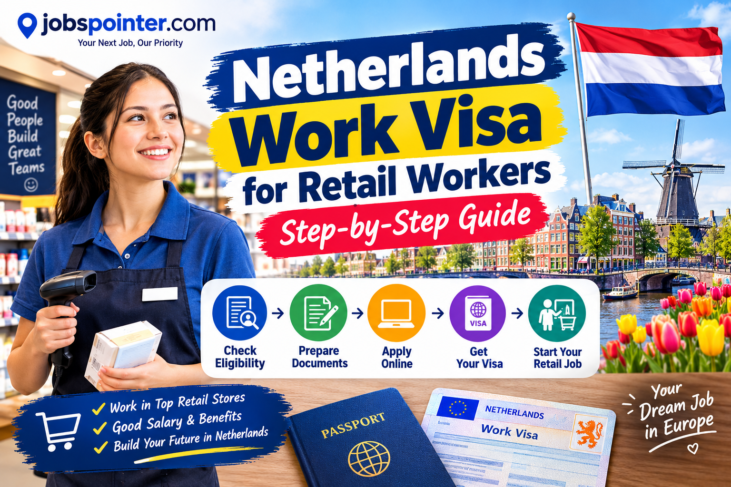
The Netherlands Work Visa for Retail Workers: Step-by-Step Process
Can Foreigners Get a Retail Work Visa for the Netherlands?
Sometimes, but it is harder than most job ads suggest. There is no single ‘Netherlands work visa’. If you come from outside the EU, EEA or Switzerland, you generally need a permit that lets you live and work in the country, and your employer usually has to arrange it. For ordinary retail jobs such as shop assistant or cashier, employers must first prove they could not find a suitable worker in the Netherlands or the wider EU. That test is why many retail vacancies do not offer sponsorship at all.
Your chances depend on your nationality, current residence status, the job duties and an employer willing to go through the process. This guide walks through the journey in order and is clear about where the real obstacles are.
Quick answer: check whether you already have the right to work, find an employer who can legally hire you, and let that employer apply for the correct permit. Do not start work or travel to work until authorisation is valid.
1. Understand the Dutch Work Permit Rules for Retail Workers
The Dutch government explains that foreign nationals who want to work in the country must meet certain requirements, and in many cases need a work permit (Government.nl). Key points:
- Who needs no separate permit: EU, EEA and Swiss nationals are free to work. So are people whose residence document states arbeid is vrij toegestaan (work freely allowed), such as some asylum permit holders.
- Who usually needs one: most other non-EU nationals, with the employer applying.
- Visitor visas: a short-stay visa or visa-free tourist stay does not normally authorise employment.
- Offer vs permission: a signed contract is not legal permission to work. Employers can be fined for letting someone work without the right permit, as reported by Dutch law firms.
Check your residence card or document first. If it already permits work, you may not need sponsorship at all.
2. Explore the Main Work Permit Options in the Netherlands
| Feature | TWV (employment permit) | GVVA (single permit) |
|---|---|---|
| What it is | Work permit only | Combined residence and work permit |
| Who applies | Employer, to UWV | Employer or worker, to IND (UWV advises on the labour market) |
| Typical use | Work of up to 90 days, or you already live in the Netherlands on a permit that does not allow work, or you work here for 90+ days without living here | Work of more than 90 days while living in the Netherlands |
| Labour-market test | Usually yes | Usually yes for regular employment |
| Retail relevance | Short or specific situations | The standard route for regular non-EU employees outside special schemes |
The TWV and GVVA descriptions follow Business.gov.nl. The GVVA is a residence permit with an additional document naming the employer and conditions, and is generally tied to that employer.
Other routes that may already give work rights: a permit with arbeid vrij toegestaan, a start-up or self-employment permit, family-based permits in some cases, and the orientation year for eligible graduates. Check the IND for your situation.
Highly skilled migrant route: this scheme depends on a recognised sponsor and a minimum gross monthly salary, and is generally not designed for ordinary retail assistant or cashier jobs. Do not apply under it unless the job and salary genuinely qualify.
3. Check Whether Your Retail Occupation Is Eligible
| Role | What to expect |
|---|---|
| Retail sales or shop assistant | Typically needs the labour-market test; sponsorship uncommon |
| Cashier, customer service assistant | Same as above |
| Stockroom or retail warehouse roles | Same, unless agency or seasonal rules apply |
| Retail supervisor, store manager | May still face the test; salary and duties matter |
The permit rules look at the actual duties, the offered salary and employment conditions, not the job title. A ‘store manager’ title on a contract does not by itself change the route.
4. Understand the Labour-Market Test for Non-EU Applicants
For most regular work permits, UWV checks that no suitable candidate is available in the Netherlands, the EU/EEA or Switzerland. Reported requirements include notifying UWV of the vacancy and recruiting for at least five weeks before the application, and documenting why each EU applicant was not suitable (verify the current period with UWV).
What this means for you:
- Employers cannot promise a permit. A contract does not guarantee approval.
- Retail is a hard category. Large pools of local and EU candidates make it difficult to show a vacancy cannot be filled.
- Language and rare skills help. Fluent Dutch plus another in-demand language, or specialist product knowledge, can make a stronger case.
5. Find Legitimate Retail Employers in the Netherlands
- Use official career pages of supermarkets, fashion chains, department stores and specialist retailers, and established recruitment platforms.
- Browse the Jobspointer job listings and filter by keyword.
- Ask early: ‘Can your company arrange work authorisation for non-EU applicants?’ Employers that have hired non-EU staff before understand the process.
- Check that the company is registered with the Dutch Chamber of Commerce (KvK) and that any agency is genuine.
Scam signs: you are asked to pay for a ‘guaranteed’ permit, the recruiter refuses a written contract, the salary looks unrealistic, or the employer will not name who applies for the permit. For general verification habits, read how to find verified jobs on Jobspointer. Official permit fees are paid to the government, not to an agent.
6. Prepare a Netherlands-Ready Retail CV and Application
- Lead with relevant experience: customer service, sales, cash handling, merchandising and stock control.
- Add numbers where honest: footfall handled, sales targets met, stock accuracy.
- State languages clearly: Dutch, English and others, with levels.
- Tailor each CV to the advertised vacancy.
- Be accurate about work authorisation. Say whether you need an employer to apply.
- Keep references and certificates ready.
Use the Jobspointer Resume Builder, or upload your resume so employers can find you. More CV advice is in the CV & Resume category.
7. Apply for Jobs and Complete the Employer Interview
- Apply through verified channels only.
- Prepare examples: handling a complaint, fixing a till error, dealing with a busy shift.
- Discuss availability for evenings, weekends and peak seasons.
- Ask about salary, hours, contract length and any accommodation.
- Ask the key question: which permit route does the employer plan to use, and who pays and applies?
8. Obtain a Job Offer and Arrange the Required Work Permit
- Review the contract for position, wage, hours and start date, and make sure it matches the permit application.
- Employer starts the process. For a TWV, the employer applies to UWV. For a GVVA, the employer (or sometimes the worker) applies to the IND, which asks UWV for labour-market advice.
- Entry visa (MVV). Depending on nationality, you may need a provisional residence permit, usually applied for together with the residence permit. Business.gov.nl notes it is not required if you already hold a Schengen residence permit and your employer is a recognised sponsor.
- Wait for approval and follow IND instructions on collecting your MVV and residence document.
- Do not start work early.
The correct process depends on your circumstances. When in doubt, the IND can confirm what applies to you.
9. Prepare the Documents Required for Your Application
The official checklist for your permit route always overrides a general list. Typically expect:
- Valid passport and identity documents
- Signed employment contract or job details
- Forms and evidence requested by the IND or UWV
- Supporting documents such as birth or marriage certificates where relevant, sometimes legalised or officially translated
- Documents for accompanying family members, if applicable
10. Understand Application Costs and Processing Times
| Item | What to know |
|---|---|
| IND fee for paid-employment permit | Reported as €423 for 2026 (check the IND fees page) |
| TWV from UWV | Reported as free of charge (verify) |
| Decision period | IND’s legal period for most first applications is about 90 days, and the IND says it can extend periods. Reported changes took effect on 22 May 2026, so see the IND decision periods page |
| Your own costs | Translations, legalisation, travel, medicals if requested |
| Employer costs | Recruitment effort and any agent fees on their side |
Treat any timeline as an estimate. Never plan around a promised date.
11. Prepare to Live and Work in the Netherlands
- Housing: the market is tight, so plan accommodation early and beware of rental scams.
- Registration: register with your municipality when required and obtain your citizen service number (BSN).
- Health insurance: Dutch basic health insurance is mandatory for most residents.
- Pay and rights: you must receive wages monthly into a bank account, with a payslip. Check minimum wage and working-time rules with the Dutch government and the Netherlands Labour Authority.
- Permit conditions: read what your document says about which employer and work you are allowed to do.
For a similar first-weeks checklist in another European country, see First 30 Days Working in Portugal. For budgeting ideas for shop workers, see the retail salary budget guide (UAE figures, so adapt it to Dutch costs).
12. Common Mistakes Retail Workers Should Avoid
| Mistake | Why it matters | Better approach |
|---|---|---|
| Assuming every retail job sponsors | Most cannot pass the labour-market test | Ask the employer directly |
| Applying under highly skilled migrant rules | Salary and sponsor rules rarely fit retail | Confirm with the IND |
| Paying an agent for a guaranteed permit | Fraud risk | Pay fees to the government only |
| Working on a tourist visa | Illegal work can lead to removal and bans | Wait for authorisation |
| Not checking the contract | Pay or hours may differ from the permit | Compare every detail |
| Starting before the permit is valid | Fines for employers, risk for you | Start only on the permitted date |
Netherlands Retail Work Visa Checklist
- Confirm whether your nationality and residence status permit employment.
- Identify the correct retail occupation and permit route.
- Find a legitimate employer willing and able to hire you legally.
- Prepare your CV, passport and supporting documents.
- Confirm the contract and the employer’s permit responsibilities.
- Complete the required work and residence permit process.
- Arrange accommodation and registrations.
- Confirm authorisation before starting employment.
Frequently Asked Questions
Can foreigners get retail jobs in the Netherlands with visa sponsorship? Sometimes, but it is uncommon for entry-level roles because of the labour-market test. Always confirm in writing.
Do shop assistants need a work permit? If you are from outside the EU/EEA/Switzerland and have no residence document allowing free work, yes, your employer generally needs to arrange one.
What is the difference between a TWV and a GVVA? A TWV is a work permit from UWV. A GVVA is a combined residence and work permit from the IND for longer stays.
Can a non-EU applicant get a Dutch work visa without a job offer? For regular employment, no. The permit is linked to a specific employer. Other routes, such as the orientation year for eligible graduates, work differently.
Do Dutch supermarkets hire workers from outside the EU? Some employers may, but each case needs a legal route. Ask the employer.
Can retail workers apply for a highly skilled migrant visa? Only if the job and salary meet the scheme’s conditions and the employer is a recognised sponsor. This is rare for standard retail roles.
How long does a Dutch retail work permit take? The IND’s legal decision period is generally around 90 days for first applications and can be extended, and employer preparation comes first.
Can I work in the Netherlands on a tourist visa? No. Short-stay and tourist status do not normally authorise employment.
Conclusion: Plan Your Dutch Retail Career Realistically
The strongest approach is honest and methodical: check your existing right to work, target employers with real experience hiring non-EU staff, understand the TWV and GVVA, and never pay for a promised permit. Browse current vacancies on Jobspointer and verify sponsorship and work authorisation independently. Jobspointer does not guarantee jobs, sponsorship or permit approval; see our disclaimer.