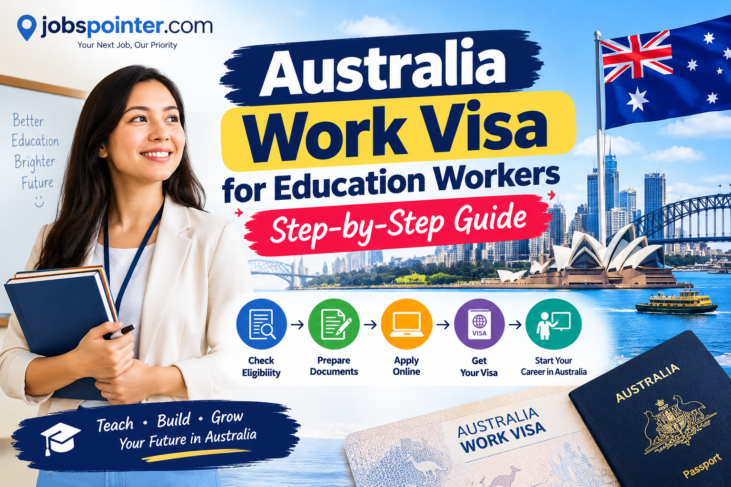
Australia Work Visa for Education Workers: Step-by-Step Process
Can Education Workers Get a Work Visa for Australia?
Yes, many can, but not automatically. Australia does not have one visa for all education workers. Your options depend on your exact occupation, qualifications, experience, English level and whether an employer or a state government will back you. A qualified secondary school teacher, an early childhood teacher and a childcare assistant can end up on very different paths.
The most common route for overseas teachers with a job offer is the Skills in Demand visa (subclass 482), where an approved employer sponsors you. Others apply independently through points-tested visas such as the Skilled Independent visa (subclass 189). This guide follows the real order of the journey so you know what to do first.
Quick answer: check your occupation on the official lists, get any required skills assessment, then either secure a sponsoring employer or lodge a points-tested expression of interest. Teacher registration is a separate step again.
1. Understand Australian Work Visa Options for Education Workers
Here is how the main pathways compare. Not every education occupation is eligible for every visa.
| Visa | Type | Who backs you | Best for |
|---|---|---|---|
| Skills in Demand (482), Core Skills stream | Temporary, up to 4 years | Approved employer | Teachers with a job offer in an occupation on the Core Skills Occupation List (CSOL) |
| Employer Nomination Scheme (186) | Permanent | Employer | Teachers moving to permanent residence through their employer |
| Skilled Independent (189) | Permanent | No sponsor; points-tested | Teachers with strong points and a positive assessment |
| Skilled Nominated (190) | Permanent | State or territory | Teachers whose occupation a state invites |
| Skilled Work Regional, provisional (491) | Provisional, regional | State, territory or eligible relative | Teachers willing to live and work in regional areas |
Employer-sponsored vs points-tested. With the 482 and 186, an employer nominates you for a specific position. With the 189, 190 and 491, you lodge an expression of interest in SkillSelect and wait for an invitation. Inclusion on a list does not guarantee an invitation.
2. Check Whether Your Education Occupation Is Eligible
Start with your ANZSCO occupation code, not your job title. Check it against the Department of Home Affairs skilled occupation list. The Core Skills Occupation List used for the 482 contains 456 occupations, according to the legislation that created it (LIN 24/089 explanatory statement).
Typical education occupations include:
- School teachers: primary, secondary and special education teachers
- Early childhood (pre-primary) teachers
- Childcare occupations: child care centre manager, child care worker, out of school hours care worker
- Vocational education teachers and university lecturers
- Education managers and other specialist roles
For example, Secondary School Teacher (ANZSCO 241411) is reported to sit on the CSOL and be assessed by AITSL. Do not assume the same for every role. A job title like ‘learning coach’ or ‘teaching assistant’ may not map to a listed occupation at all. The tasks you perform decide the code, not the title on your contract.
3. Review Your Qualifications, Experience and English Proficiency
Before spending money, check four things:
- Qualifications. Teaching roles generally need a bachelor-level degree with initial teacher education. Childcare roles follow different qualification standards from school teaching.
- Experience. For the 482 Core Skills stream, Home Affairs states you need at least one year of relevant work experience in the nominated occupation or a related field.
- Evidence of duties. Collect employer reference letters that describe your hours, subjects, year levels and responsibilities.
- English. Requirements differ by visa. Home Affairs and assessing authorities each publish accepted tests and scores, so use their pages rather than a general rule of thumb.
Keep certified copies of all documents, and obtain certified translations for anything not in English.
4. Complete a Skills Assessment if Your Visa Pathway Requires It
A migration skills assessment tests whether your qualifications and experience match the Australian standard for your occupation. It is not the same as teacher registration.
| Occupation group | Assessing authority | Notes |
|---|---|---|
| Primary, secondary, middle and special education teachers | AITSL | AITSL states teachers migrating on a skilled visa must complete its skills assessment. Fees changed on 7 September 2026, so check its fees page |
| Early childhood (pre-primary) teacher | ACECQA | Moved from AITSL to ACECQA on 7 December 2024 |
| Child care centre manager, child care worker, out of school hours care worker | ACECQA | ACECQA lists child care worker and OSHC worker assessments as starting in August 2025 |
| Vocational teachers, university lecturers | Often VETASSESS or another body | Verify the assessing authority for your exact code |
How to prepare: gather transcripts, course outlines, proof of supervised teaching practice where required, identity documents and employment evidence. Submit through the authority’s online portal, then respond quickly if it requests more evidence. AITSL notes it does not answer phone queries or requests for status updates, so use the portal.
Employer-sponsored note: some sponsored pathways may not require a migration skills assessment for every occupation, but your employer or the Home Affairs page for your visa will say so. Never skip this check.
5. Find an Eligible Education Employer in Australia
School systems, independent schools, childcare providers, universities and recruitment agencies all hire overseas educators, often in regional and remote areas where shortages are greatest. To search:
- Browse vacancies on Jobspointer’s Australia job listings and on employer and state education department career pages.
- Look for wording such as ‘sponsorship available for eligible candidates’. That phrase is not a promise; it means the employer may consider it.
- Tailor your CV to Australian style: concise, achievement-focused, with referees. Build one with the Jobspointer Resume Builder or upload your resume so employers can find you.
- Prepare for interviews that cover classroom management, child safety and curriculum.
- Read the job description: salary, location, contract type and term dates.
Scam warning: never pay anyone for a ‘guaranteed’ visa or job. For general checks that apply to any country, read how to verify jobs on Jobspointer. Genuine sponsors pay their own sponsorship and nomination charges.
6. Obtain an Offer and Confirm Sponsorship Requirements
A job offer is not a visa. Before signing, confirm in writing:
- Position title, duties and ANZSCO occupation
- Salary and employment conditions
- Which visa the employer intends to use
- That the employer is, or will become, an approved sponsor
For the 482 Core Skills stream, the nominated salary must meet the Core Skills Income Threshold and the market rate for the role. One agent source reports the threshold as AUD 79,499 for nominations lodged from 1 July 2026 (verify on Home Affairs). The employer lodges the sponsorship and nomination, and you then lodge your visa application.
7. Prepare the Documents for Your Australian Work Visa
Your exact checklist depends on the visa, but most applicants need:
- Valid passport and identity documents
- Qualifications and academic transcripts
- Employment references and evidence of experience
- Skills assessment outcome and English test results, where required
- Employer nomination details, where applicable
- Health, character and family documents, if requested
- Certified translations of any document not in English
Use the document checklist generated inside your online application, since it is tailored to your case.
8. Submit Your Visa Application Step by Step
- Pick the right subclass using the official visa finder and confirm eligibility.
- Create an ImmiAccount and complete the online application.
- Upload supporting documents clearly and consistently.
- Pay the application charge to the government only.
- Complete health examinations and police checks when requested.
- Watch your email and answer requests within the stated deadline.
- Wait for the decision before booking non-refundable travel or resigning from your current job.
9. Apply for Teacher Registration and Required Clearances
A visa lets you live and work in Australia. It does not authorise you to teach. Each state and territory has a regulator that decides who may teach in its schools, and you must register before starting regulated teaching duties.
| State or territory | Regulator |
|---|---|
| New South Wales | NSW Education Standards Authority |
| Victoria | Victorian Institute of Teaching |
| Queensland | Queensland College of Teachers |
| Western Australia | Teacher Registration Board of WA |
| South Australia | Teachers Registration Board of SA |
| Tasmania | Teachers Registration Board of Tasmania |
| Northern Territory | Teacher Registration Board NT |
| ACT | ACT Teacher Quality Institute |
Registration usually involves identity checks, qualification assessment, English proficiency and a suitability check. You will also need a Working With Children check or equivalent for your state. Childcare and other education roles have their own separate screening and qualification rules.
10. Understand Visa Costs and Processing Times
| Cost item | What to know |
|---|---|
| 482 visa application charge | Reported as AUD 4,015 for the main applicant in 2026–27, with AUD 1,005 per child under 18 (check current Home Affairs pricing) |
| Skills assessment | Set by AITSL, ACECQA or another authority; AITSL fees changed on 7 September 2026 |
| English test, translations, medicals, police checks | Paid by you; amounts vary by country |
| Sponsorship, nomination and levy charges | Normally paid by the employer |
| Processing time | Reported 482 Core Skills figures from September 2026: 50% of applications in about 4 months, 90% in about 9 months (check the live Home Affairs page) |
Fees and times change without notice, so use the official current visa pricing and processing times pages. Treat any estimate as a planning figure, not a promise.
11. Prepare to Relocate and Start Working in Australia
- Read your visa conditions, including who you may work for
- Arrange accommodation, flights and a document folder you carry on arrival
- Learn your rights on pay and conditions at Fair Work Australia and how superannuation works at the ATO
- Open a bank account, get a local phone plan and register for a tax file number
- Confirm your teacher registration before you take a classroom
12. Common Australian Education Visa Mistakes to Avoid
| Mistake | Why it hurts | Fix |
|---|---|---|
| Applying before checking the occupation list | Wasted fees | Check ANZSCO code first |
| Treating all teaching and childcare roles alike | Different assessors and rules | Confirm the assessing body for your code |
| Confusing registration with a skills assessment | Delays start date | Plan both |
| Incomplete or inconsistent documents | Requests, delays or refusal | Match names, dates and duties everywhere |
| Trusting ‘guaranteed visa’ recruiters | Fraud risk | Pay fees only to government bodies |
| Treating a job offer as work rights | Working illegally | Wait for the visa grant |
Step-by-Step Australia Education Work Visa Checklist
- Identify your exact occupation and relevant visa pathways.
- Check current occupation lists and eligibility.
- Verify qualification and English requirements.
- Complete any required skills assessment.
- Apply for eligible education vacancies.
- Confirm the employer’s sponsorship arrangements.
- Gather documents and lodge the correct visa application.
- Complete professional registration and clearances.
- Confirm visa approval and work conditions before starting.
Frequently Asked Questions
Which Australian work visa is suitable for teachers?
It depends on your occupation and situation. The 482 suits teachers with an employer offer; the 189, 190 and 491 are points-tested; the 186 leads to permanent residence through an employer.
Can overseas teachers get employer sponsorship?
Yes, some employers sponsor eligible teachers, particularly in regional areas, but sponsorship is never guaranteed.
Can childcare workers apply for an Australian work visa?
Possibly. ACECQA assesses child care and out of school hours care occupations for skilled migration, but eligibility depends on the occupation list and visa chosen.
Is AITSL assessment mandatory for every education worker?
AITSL says teachers migrating on a skilled visa must complete its assessment, but other education occupations use different assessors, and some pathways differ. Confirm for your code.
Do foreign teachers need Australian teacher registration?
Yes, to teach in schools you generally need registration in the state or territory where you work.
How much does an Australian work visa cost?
The reported 482 main-applicant charge is AUD 4,015 for 2026–27, plus assessment, English, medical and other costs. Check Home Affairs for the current figure.
How long does the process take?
Visa processing alone was reported at about 4 to 9 months for most 482 Core Skills applications, before you add assessment and registration time.
Can eligible applicants bring family members?
Many visas allow family members to be included or to apply as dependants, with additional charges. Check your visa page.
Can I apply for teaching jobs before receiving a visa?
Yes. Many employers recruit offshore, though you cannot start work until the visa is granted.
Conclusion: Plan Your Australian Education Career Carefully
The smartest approach is to separate the three approvals: assessment, visa and registration. Verify your occupation, avoid anyone who promises guaranteed outcomes, and rely on official pages for rules that change. When you are ready, explore education and other vacancies on Jobspointer. Jobspointer does not guarantee sponsorship, employment or visa approval; see our disclaimer.