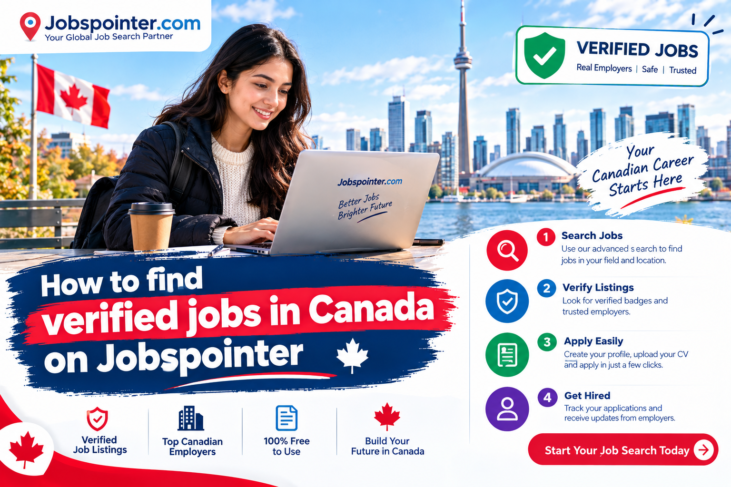
How to Use Jobspointer to Find Verified Jobs in Canada
Canada attracts job seekers from every region, and many of them start the same way: searching online for vacancies they can apply to from abroad. The harder part is knowing which listings are worth your time, which employers will consider international applicants, and which “offers” are traps.
Quick answer
To find verified jobs in Canada on Jobspointer, search by job title, industry and location, open each listing and read the employer details, requirements and application instructions, then check the vacancy against the employer’s own careers page before you apply. Finally, confirm your right to work through the official IRCC website. Jobspointer lists vacancies as verified, but a listing is a starting point, not a job offer, a sponsorship promise or a work permit.
What is Jobspointer and how does it work?
Jobspointer.com is a job listings website where you can search vacancies by country, industry and job title. Each listing shows employer details, requirements and application instructions, and the site describes its listings as verified.
Two practical points follow from that:
- Use the listing as a lead. Treat “verified” as a useful filter, not a guarantee. You should still confirm that the employer exists and that the vacancy is genuine, as the steps below show.
- Apply the way the listing tells you. Follow its instructions, and don’t send documents through channels the listing doesn’t mention.
[Jobspointer team: confirm the exact search fields, filters and application flow before publishing so this section matches the live site.]
How to search for Canada jobs on Jobspointer
Step 1: Visit Jobspointer and start with a clear target
Open Jobspointer.com and use the search fields to look for Canadian vacancies by keyword, job title or industry. Decide on one or two target roles first. Searching for everything produces long lists and weak applications.
Step 2: Search by job title
Use the title employers actually use. Examples of roles to try:
- Warehouse associate
- Sales assistant
- Care worker
- Software developer
- Agricultural worker
- Hospitality roles such as kitchen helper or housekeeping attendant
If you are early in your career, add “entry-level” or “no experience required” to see roles with lower barriers. Canada has many entry-level jobs in warehousing, hospitality and agriculture, but the listing’s own requirements decide whether you qualify.
Step 3: Narrow by industry and location
Then filter by industry (for example agriculture, construction, healthcare, IT, engineering) and by location. Location matters more than many applicants expect: regional rules, licensing and seasonal demand differ across provinces, so a listing in one province may not translate to another. [Internal link: Jobspointer Canada jobs by category page, if available.]
How to evaluate a Canadian job listing
Before you invest time in an application, screen the listing. A genuine, well-prepared vacancy usually makes most of these easy to find.
| Check | What to look for | Why it matters |
|---|---|---|
| Job title and duties | Specific tasks, not vague promises | Vague listings are common in scams and in poor-fit roles |
| Employer name | A real company you can find independently | Lets you verify the business |
| Work location | City and province | Needed for permits, licensing and relocation planning |
| Pay and terms | Pay rate or range, hours, contract type | Unrealistic pay is a warning sign |
| Requirements | Education, experience, language, licences | Tells you whether to apply |
| Eligibility | Whether international applicants are accepted | Saves time and avoids false hope |
| Application method | Clear instructions and a deadline | Legitimate employers have a defined process |
If a listing leaves out the employer’s name, the location, or how to apply, treat that as a reason to look more closely, not as a reason to hurry.
How to check employer details and verify a job offer
This is the step many applicants skip, and it is the most important one.
- Find the employer’s official website. Search for the company name yourself instead of following links sent by a recruiter or message.
- Look for the same job on its careers page. A matching vacancy is a strong positive sign. If it isn’t there, ask the employer directly using contact details you found yourself.
- Compare the details. Job title, location, salary, contract terms, contact details and deadline should be consistent between the listing and the employer’s own pages.
- Check the contact channel. Be cautious if hiring emails come from free personal email accounts or messaging apps only.
- Search for the company and the exact wording of the offer together with words like “scam” or “reviews.”
- Use official resources. The Government of Canada Job Bank and the Competition Bureau’s guidance on job scams explain how to check and report suspicious ads.
A useful rule: verify before you send anything personal, and verify again before you accept any offer.
How to apply for a job through Jobspointer
Step 4: Submit a tailored application
If you are applying for jobs in Canada online, quality beats quantity.
- Read the listing twice and note the keywords it uses.
- Update your CV so your most relevant experience appears first.
- Write a short cover letter that names the role and employer and links two or three of your skills to their stated needs.
- Follow the listing’s application instructions exactly.
- Keep a record of every application (see the tracker below).
Simple application tracker
| Date | Employer | Job title | Where found | Verified on employer site? | Applied via | Follow-up date | Status |
|---|---|---|---|---|---|---|---|
| Jobspointer | Yes / No |
How to prepare your CV and supporting documents
Canadian employers generally expect a concise, results-focused CV. Practical guidance:
- Keep it clear and easy to scan, usually one to two pages depending on experience.
- Lead with a short profile, then recent work history with achievements, then education and skills.
- Describe your experience in plain language, and explain foreign qualifications or job titles briefly so a Canadian reader understands them.
- Don’t include details such as age, marital status or a photo unless a listing specifically asks. Job Bank also advises against sharing personal details such as birth date or marital status on a CV.
- Have scans of your passport, references and certificates ready, but send them only once an employer has been verified and the hiring process is under way.
[Internal link: Jobspointer CV-writing guide; interview preparation article, if available.]
Finding jobs open to international applicants
Not every Canadian vacancy is open to people outside Canada. Job Bank advises candidates who don’t have a Canadian work permit to focus on employers that are open to international recruitment. When you review a listing:
- Look for wording such as “open to international applicants,” “temporary foreign workers,” or a mention of relocation support.
- Read the requirements for legal authorization to work in Canada. Many listings require existing work authorization.
- Check the Government of Canada’s Job Bank page for temporary foreign workers for vacancies from employers recruiting this way. [Confirm the exact page link before publishing.]
- If it is unclear, ask the employer one polite, specific question: “Do you consider applicants who do not currently hold a Canadian work permit?”
Understanding Canadian work permits and visa sponsorship
The short version: a job ad is not a sponsorship, and sponsorship is not a work permit.
Based on the IRCC guide for applying from outside Canada, the key points are:
- A work permit is usually valid only for a specific employer, job and length of time.
- It is based on either a positive Labour Market Impact Assessment (LMIA) from Employment and Social Development Canada, or an offer of employment from an LMIA-exempt employer.
- For LMIA-exempt, employer-specific permits, the employer must submit the offer of employment to IRCC through its Employer Portal before you apply. IRCC also says it does not vet that information before processing, and it assesses whether the offer is genuine when you apply.
- Some permits, such as open work permits, are not tied to one employer. Eligibility depends on your specific category.
What this means for you
- Do not assume every vacancy offers sponsorship.
- Ask any employer who says they will hire you whether they will obtain an LMIA or use an LMIA-exempt route, and verify their claims at IRCC.
- Check eligibility, forms, fees and processing times on the IRCC website and in Guide 5487: Applying for a work permit outside Canada, because rules change.
- Remember that nobody can guarantee a permit decision. IRCC makes it.
- You do not need to pay a recruiter to “secure” a job offer. See the scam section below.
Once you work in Canada, the Government of Canada’s pages on the rights of temporary foreign workers explain workplace protections and employer obligations. [Confirm the exact page link before publishing.]
How to recognize fake job offers and recruitment scams
Scammers target people who are eager to work abroad, and they often use convincing logos and professional language. Job Bank says legitimate Canadian job ads will not ask for banking or personal information, and it recommends not providing details such as your Social Insurance Number, birth date, driver’s licence number, health card number or financial information in a CV or an interview. These may be discussed only after the hiring process has begun.
Red flags
| Red flag | What to do |
|---|---|
| You are asked to pay for a job, visa, “processing” or “training” | Stop. Do not pay. Report it. |
| An offer arrives without you applying | Verify the company independently first |
| You are asked for bank details, SIN or ID scans early | Refuse until the employer is verified and hiring is under way |
| Pay is unusually high for the role | Compare with similar roles and be sceptical |
| Communication happens only through messaging apps or free email addresses | Ask for an official company contact |
| Pressure to decide immediately | Real employers allow time for checks |
| A cheque is sent and you are asked to send money back | A known scam type. Do not deposit or transfer. |
| Job details are short, vague or inconsistent | Compare against the employer’s official careers page |
If you think you were targeted
- Stop contact and don’t send further money or information.
- Report it to the Canadian Anti-Fraud Centre.
- Tell your bank if you shared financial details, and tell the platform where you found the ad. Jobspointer should offer a way to report suspicious listings. [Jobspointer team: add the reporting link or contact.]
- Keep screenshots and messages as evidence.
[Internal link: Jobspointer job scam prevention guide, if available.]
Using Canada’s official Job Bank alongside Jobspointer
Using more than one source gives you a way to cross-check. The Government of Canada’s Job Bank is the official job board, and it offers guidance for international candidates. A practical approach:
- Discover vacancies on Jobspointer.
- Search Job Bank and the employer’s careers page for the same role.
- Use IRCC for immigration and work permit questions. Job Bank itself says it does not handle immigration or admission.
Note that a job being posted on any site, official or not, does not prove it is open to overseas applicants. Always read the listing’s own eligibility requirements.
Common job search mistakes to avoid
- Assuming “verified” means you can skip your own checks.
- Applying to dozens of roles with the same CV.
- Sending passport scans or banking details too early.
- Paying anyone for an offer or a guaranteed visa.
- Ignoring eligibility wording about work authorization.
- Not keeping records, which makes follow-up and scam reporting harder.
- Relying on one website only.
Frequently asked questions
Does Jobspointer guarantee that every Canada job is genuine?
Jobspointer describes its listings as verified, but you should still confirm the employer and vacancy yourself, as described above. No job board can promise that an individual vacancy will lead to an offer.
Can foreigners find jobs in Canada through Jobspointer?
Yes, you can search and apply for vacancies. Whether you are eligible depends on each listing and on Canadian work authorization rules.
Can I find Canada job vacancies with visa sponsorship?
Some employers recruit internationally, but sponsorship is never automatic. Read the listing, ask the employer, and check the IRCC site for how permits work.
Do I need a work permit to work in Canada?
Most foreign nationals do. Check the IRCC website to see whether you need one and which type applies.
Are entry-level jobs in Canada open to international applicants?
Some are, particularly in sectors such as warehousing, hospitality and agriculture, but each employer sets its own rules.
How do I know whether a Canadian job offer is real?
Verify the company on its official website, confirm the job on its careers page, never pay for an offer, and be cautious about sharing personal or banking details. See the red-flag table above.
Should I pay a recruiter or agent for a Canadian job?
Be very cautious. Paying for a job offer is a common scam pattern. Use official sources to check any claim about hiring, LMIAs or work permits.