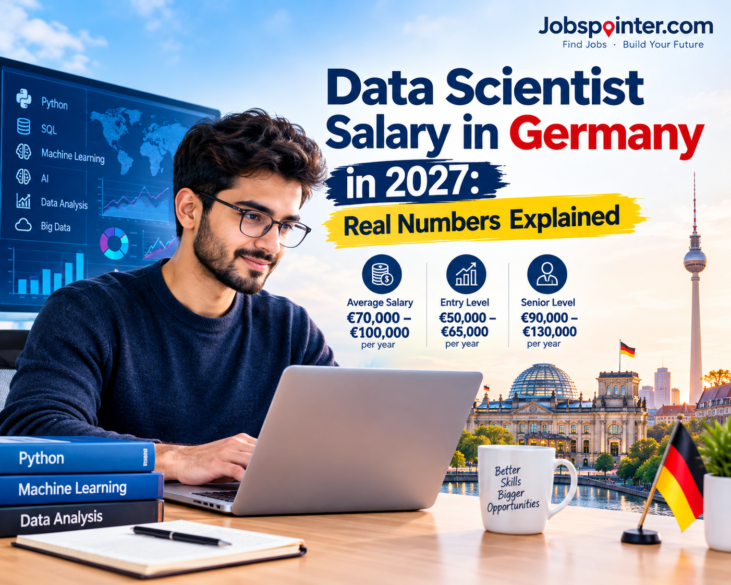
How Much Does a Data Scientist Earn in Germany in 2027?
There is no single “German data scientist salary,” because three popular sources measure different things. Here is how they compare:
| Source | Figure | What it measures |
|---|---|---|
| StepStone | €57,200 average; range €49,200 to €68,100 | Gross annual salary across the German market (about €4,766 per month) |
| Levels.fyi | €77,554 median; 25th to 75th percentile €63,200 to €101,000 | Total compensation reported mostly by tech-sector employees (205 reports) |
| JobMentis | €85,000 median; middle range €63,000 to €151,000 | Modelled regional estimate, last updated 1 August 2026 |
Why the numbers differ so much
- Base pay versus total pay. StepStone reflects typical salaries. Levels.fyi adds bonuses and stock, which are common at large tech firms but rare at small employers.
- Who reports. Self-reported platforms attract more people from well-paying tech companies, which lifts the median.
- Real data versus models. JobMentis says its seniority bands are estimates built from regional wage references, not official statistics. Treat them as a planning guide.
Our practical reading: for a typical data scientist at a mid-sized German employer, expect a gross salary in the high €50,000s to €70,000s. At large tech companies, scale-ups and in senior roles, packages above €90,000 are realistic. Advertised salary ranges and final offers can differ, so always ask what the figure includes (13th month, bonus, stock, pension contributions).
Monthly and annual salary at a glance
| Level | Annual gross | Monthly gross (approx.) | Basis |
|---|---|---|---|
| Entry-level | About €54,000 | €4,500 | StepStone entry-level figure |
| Junior | About €51,000 | €4,250 | JobMentis estimate |
| Mid-level | About €75,000 | €6,250 | JobMentis estimate |
| Senior | About €106,000 | €8,830 | JobMentis estimate |
| Lead / principal | About €149,000 | €12,400 | JobMentis estimate |
The entry-level number is a published market figure. The other rows are modelled estimates, not official statistics, and real offers will vary.
Data Scientist Salary in Germany by Experience Level
Experience is the biggest single driver of pay. Moving from entry-level to senior can roughly double your salary in a few years, but only if your responsibilities grow with it, not just your job title.
Entry-Level Data Scientist Salary in Germany
- Typical pay: around €54,000 gross per year, according to StepStone.
- Typical background: a bachelor’s or master’s degree in statistics, mathematics, computer science, physics or a related field.
- What helps: an internship, a working student (Werkstudent) position, a thesis built on real data, and two or three portfolio projects.
- Must-have tools: Python, SQL, basic statistics and a clear way of explaining results.
Junior Data Scientist Salary in Germany
- Experience: about one to two years.
- Reference estimate: around €51,000 (modelled; actual offers depend heavily on employer and city).
- Daily work: data cleaning, dashboards, simple predictive models and A/B test analysis under a senior’s guidance.
- Where to look: startups often move faster and give broader exposure. Established companies may offer structure, training and a better pension package.
Mid-Level Data Scientist Salary in Germany
- Experience: roughly three to five years.
- Reference estimate: around €75,000.
- What changes: you own projects end to end, build machine learning models and defend your results to business stakeholders.
- Negotiation tip: this is the stage where changing employers usually brings the largest jump. Bring evidence, such as a model that saved money or improved a metric.
Senior Data Scientist Salary in Germany
- Experience: about six to ten years or more.
- Reference estimate: around €106,000; the 75th percentile on Levels.fyi sits near €101,000 and the 90th percentile near €122,000.
- What employers pay for: judgment, mentoring and the ability to choose which problems are worth solving.
Lead and Principal Data Scientist Salary
- Reference estimate: around €149,000 at the very top of the modelled range, usually at large corporations, banks or well-funded tech companies.
- Responsibilities: team leadership, AI strategy, budgets and cross-department projects.
- Reality check: few roles reach this band. It is an upper marker, not an everyday expectation.
Data Scientist Salary by City in Germany
City matters, but less dramatically than in countries with one dominant capital. StepStone’s published city averages for data scientists are close to each other, and Stuttgart currently leads:
| City | Average annual gross (StepStone) | Range |
|---|---|---|
| Stuttgart | €64,300 | €54,400 to €74,400 |
| Hamburg | €60,400 | €49,900 to €69,400 |
| Berlin | €59,400 | €50,400 to €69,700 |
| Düsseldorf | €59,100 | €51,300 to €70,500 |
| Leipzig | €58,000 | €49,800 to €68,600 |
Source: StepStone data scientist salary pages, 2026. We did not find a verified StepStone figure for Munich, Frankfurt or Cologne at the time of writing, so we do not quote one.
Data Scientist Salary in Stuttgart
Home to Mercedes-Benz, Porsche and Bosch, Stuttgart has the highest StepStone average. Industrial and automotive companies hire data scientists for predictive maintenance, quality control and autonomous-driving projects.
Data Scientist Salary in Berlin
Berlin’s market is startup-heavy and international, and English is common at work. StepStone shows an average of €59,400, while Levels.fyi, which skews toward tech companies, lists a Berlin median of about €115,000. Both can be true: they describe different parts of the market.
Data Scientist Salary in Munich
Munich combines large corporations (such as Siemens and BMW) with a growing AI scene. Expect strong demand and high living costs. Check a current salary tool before negotiating, because we could not confirm a single reliable city average.
Data Scientist Salary in Frankfurt
Germany’s financial centre. Banks, insurers and consultancies hire data scientists for risk, fraud and analytics work. Pay is often competitive, but there is no verified city average in our sources.
Data Scientist Salary in Hamburg
Hamburg averages €60,400 on StepStone. Logistics, media, e-commerce and aviation are key employers.
Data Scientist Salary in Cologne
Cologne offers a mix of media, insurance and consulting employers, and living costs are generally a little lower than in Munich. As with Munich and Frankfurt, we recommend checking live listings.
Higher salary does not always mean more money in your pocket
A €65,000 offer in an expensive city can leave you with less spare cash than €58,000 in a cheaper one, because rent is usually the largest cost. Compare the monthly net salary against realistic rent in that city before you decide.
Which Employers and Industries Pay the Most?
We could not find reliable, publicly available salary statistics broken down by industry for data scientists in Germany, and we prefer to say that than to invent a table. What we can show is the pattern in the Levels.fyi data, where large tech and e-commerce companies pay the most:
| Employer (Levels.fyi) | Median total compensation, data scientist |
|---|---|
| Delivery Hero | €112,687 |
| Wolt | €106,765 |
| Zalando | €104,338 |
Self-reported figures with small sample sizes. Use them as a signal, not a promise.
Beyond tech, these sectors regularly hire data scientists:
- Software and IT services: product analytics, recommendation systems and AI features.
- Automotive and manufacturing: predictive maintenance, supply chain and quality analytics.
- Banking and financial services: credit risk, fraud detection and regulatory reporting.
- Healthcare and pharma: clinical data, imaging and research analytics.
- E-commerce and retail: pricing, demand forecasting and personalisation.
- Consulting: client-facing analytics projects, usually with demanding hours and strong pay progression.
- AI and machine learning companies: research-oriented and applied roles, often with a master’s or PhD expectation.
Skills That Can Raise Your Salary
German employers care about what you can actually do. Certificates help, but a GitHub project, a deployed model or a clear case study is more convincing in an interview. These skills tend to open doors to higher-paying roles:
- Python and R: Python is the default. R is still valued in research, pharma and statistics-heavy teams.
- SQL and databases: weak SQL is one of the most common reasons candidates fail technical screens.
- Machine learning and deep learning: scikit-learn, PyTorch or TensorFlow, plus the judgment to know when a simple model is enough.
- Generative AI and LLMs: demand is rising, particularly for people who can evaluate and deploy these systems safely.
- Cloud platforms: AWS, Azure or Google Cloud. Many German companies run on Azure or AWS.
- Big data tools: Spark and similar technologies for large-scale processing.
- MLOps: putting models into production, monitoring and retraining them. It separates good analysts from valuable data scientists.
- Visualisation and business intelligence: Power BI, Tableau or Python plotting libraries, along with the ability to explain results in plain language.
Data Scientist Salary After Tax in Germany
Gross salary is not what lands in your account. German employees pay income tax plus social contributions. The 2026 contribution rates are:
| Contribution | 2026 total rate | Notes |
|---|---|---|
| Pension insurance | 18.6% | Shared between employee and employer; applies up to €101,400 annual income |
| Unemployment insurance | 2.6% | Shared; same ceiling as pension |
| Health insurance | 14.6% plus an additional contribution (average 2.9%) | Shared; applies up to €69,750 annual income |
| Long-term care insurance | 3.6% | Shared, with an extra surcharge for people without children; same ceiling as health |
Source: krankenkassen.de, Rechengrößen 2026.
Illustrative take-home pay
The table below is our own approximation, not an official calculation. It assumes a single person in tax class 1, no children, no church tax, 2026 rates and the average health insurance surcharge. Treat it as a rough guide.
| Annual gross | Monthly gross | Approx. monthly net | Net as % of gross |
|---|---|---|---|
| €50,000 | €4,167 | about €2,700 | about 65% |
| €60,000 | €5,000 | about €3,150 | about 63% |
| €70,000 | €5,833 | about €3,550 | about 61% |
| €80,000 | €6,667 | about €4,000 | about 60% |
| €90,000 | €7,500 | about €4,450 | about 59% |
Your own figure will differ with your tax class (married couples often split classes 3 and 5), children, church tax, health insurer, private versus public insurance, and any benefits. At these income levels the solidarity surcharge generally does not apply, but check your payslip. Always confirm with an official or reputable salary calculator before you accept an offer.
Do You Need German to Work as a Data Scientist?
Not always, but it helps. In Berlin startups, international tech companies and research-driven teams, English is frequently the working language. In traditional industries, banks, public bodies and mid-sized companies, German is often expected, especially when you work with stakeholders or documents in German.
- English-only roles: available, but more competitive because every international candidate applies for them.
- Useful level: B1 to B2 opens many more doors. Even A2 shows effort and helps with daily life.
- Career effect: leadership and client-facing roles usually require good German.
- Settlement bonus: German language skills can also shorten the time to permanent residence for Blue Card holders (details below).
Requirements to Become a Data Scientist in Germany
Educational qualifications
- A bachelor’s degree is the minimum for most roles. A master’s degree is more common and strongly preferred for machine learning roles.
- Typical subjects: mathematics, statistics, computer science, physics, engineering or economics.
- Foreign degrees should be recognised or comparable to German ones, which matters especially for visas.
Technical skills and practical experience
- Programming (Python, SQL), statistics and machine learning fundamentals.
- Two or three portfolio projects that solve realistic problems, with clean code and short write-ups.
- Experience with version control, notebooks and basic deployment.
Professional certifications
Certifications are a bonus, not a substitute for experience. Cloud certificates (AWS, Azure, Google Cloud), machine learning specialisations and data engineering credentials can help you stand out, especially if you are changing careers.
CV, portfolio and interview preparation
- Prepare a clear, concise CV. German-style CVs are factual, usually two pages at most, and are reverse-chronological. Our free resume builder can help you structure one.
- Publish your work. Put your best projects on GitHub with readable README files.
- Expect a technical round. Typical tasks include SQL queries, a statistics question and a small case study or take-home assignment.
- Practise explaining. Interviewers want to hear how you think and how you communicate results to non-experts.
Visa Options for International Data Scientists
If you are searching for data scientist jobs in Germany as a foreigner, the main route for qualified graduates is the EU Blue Card. Immigration rules and thresholds change, so always confirm the current rules with official sources before you plan or apply.
EU Blue Card basics (2026 figures)
According to the official Make it in Germany portal, the main requirements are:
- A German or comparable foreign university degree (or an equivalent three-year tertiary qualification).
- A job offer in Germany lasting at least six months that matches your qualification.
- A minimum gross annual salary that depends on your situation.
| Category (2026) | Minimum gross annual salary |
|---|---|
| Standard Blue Card | €50,700 |
| Shortage occupations (subject to approval by the Federal Employment Agency) | €45,934.20 |
| Recent graduates (degree under three years old, with approval) | €45,934.20 |
| IT specialists without a degree (with at least three years of IT experience in the last seven) | €45,934.20 |
These thresholds are published each year by the Federal Ministry of the Interior. They apply for 2026, and the 2027 amounts had not been confirmed when this article was written. Do not treat one number as universal, and check the official page before you apply. You can read more about the IT specialist routes without a degree on the same portal.
Other options
- Opportunity Card (Chancenkarte): a points-based permit to look for work in Germany. Apply through the Federal Foreign Office online portal.
- Standard skilled worker visa: an alternative for qualified professionals whose job or salary does not meet Blue Card requirements.
Settlement and family
Blue Card holders may apply for a settlement permit after 27 months with basic German (A1), or after 21 months with B1 German. Family members can usually join you. Employer sponsorship is not a legal requirement, but a concrete job offer is, and many companies now have experience supporting relocation. Nothing here guarantees visa approval, since decisions rest with the authorities.
Looking for employers who recruit internationally? Browse our current job openings in Germany or the jobs by country page.
Companies Hiring Data Scientists in Germany
These well-known employers regularly advertise data, analytics and AI roles. Always check each company’s official careers page for current vacancies, because openings change constantly.
| Company | Typical data work | Environment |
|---|---|---|
| SAP | AI features in enterprise software, analytics products | Large software corporation, international teams |
| Siemens | Industrial AI, energy and infrastructure analytics | Large industrial group |
| BMW Group | Vehicle data, production and supply chain optimisation | Automotive, Munich area |
| Bosch | Sensor data, IoT, manufacturing analytics | Engineering-focused, many locations |
| Deutsche Telekom | Network analytics, customer data, AI services | Telecommunications |
| Zalando | Recommendations, pricing, demand forecasting | Fashion e-commerce, Berlin, tech-style culture |
Corporate or startup? Large companies offer structure, mentoring and often stronger benefits. Startups offer wider responsibility and faster learning, with more variation in pay and stability. Neither is automatically better; it depends on where you are in your career.
Where to Find Data Science Jobs in Germany
- StepStone: strong for German mid-sized and large employers.
- Indeed Germany: wide coverage and easy filters.
- LinkedIn Jobs: best for international and English-language roles, plus recruiter contact.
- XING: popular in German-speaking markets.
- Glassdoor: useful for salary and interview insights.
- Company career pages: often list roles before job boards do.
- Jobspointer job openings: browse listings and filter by country.
Practical tips for international applicants
- Tailor each application to the job description instead of mass-applying.
- Mention your work authorisation status honestly and early.
- Use a cover letter to explain relevant projects and why you want to work in Germany.
- Upload your CV to a professional profile and keep it updated. You can also upload your resume to Jobspointer.
- Read our FAQ page if you have questions about using the platform.
Is Germany a Good Country for Data Scientists in 2027?
| Advantages | Challenges |
|---|---|
| Solid salaries and a clear Blue Card route for qualified professionals | Net pay is reduced by taxes and social contributions |
| Strong demand across industry, not only tech | Entry-level competition can be intense |
| Good work-life balance and statutory paid leave | Bureaucracy can slow down relocation |
| Access to AI projects in automotive, finance and healthcare | Rent is high in major cities |
| Path to long-term residence | German skills are needed for many roles and daily life |
Our view: Germany rewards candidates who combine strong technical skills with patience and preparation. It is not the fastest way to earn the highest possible salary, but it offers stability and a good quality of life.
Frequently Asked Questions
1. What is the average salary of a data scientist in Germany in 2027?
No verified 2027 average exists yet. Using 2026 data, StepStone lists about €57,200 per year, while tech-focused sources report medians between roughly €77,000 and €85,000 because they include bonuses and cover higher-paying employers.
2. How much does an entry-level data scientist earn in Germany?
StepStone gives an entry-level figure of about €54,000 gross per year. Offers vary by city, employer and degree.
3. What is the salary of a senior data scientist in Germany?
A modelled estimate puts senior pay at about €106,000, and Levels.fyi shows a 90th percentile near €122,000 for all data scientists. Real senior salaries depend on company size and responsibility.
4. Which German city pays data scientists the most?
Among the cities published on StepStone, Stuttgart has the highest average at €64,300, followed by Hamburg (€60,400) and Berlin (€59,400). Tech-company samples in Berlin can be much higher.
5. Is data science a high-paying career in Germany?
Yes, it pays above the typical salary for many professions, especially at mid-level and above. It is not the highest-paying career in every industry, and net income is lower than gross.
6. How much does a data scientist earn per month in Germany?
StepStone lists an average of about €4,766 gross per month. After tax and contributions, a single person might take home roughly €3,000 to €3,400 at that level, though this is only an estimate.
7. What is the estimated take-home salary of a data scientist in Germany?
Typically 59% to 65% of gross for a single person without children in tax class 1, depending on income. See the take-home table above for estimates.
8. Can foreigners work as data scientists in Germany?
Yes. Qualified candidates can apply for an EU Blue Card or another work visa if they have a job offer that meets the requirements. Check the official Make it in Germany page for current rules.
9. Is German language proficiency necessary for data science jobs?
Not always. Many international and startup roles use English, but German improves your options, your negotiating position and your daily life.
10. Which skills are most valuable for data scientists in Germany in 2027?
Python, SQL, machine learning, cloud platforms, MLOps and generative AI are consistently in demand, along with the communication skills to explain findings to non-technical colleagues.
Final Thoughts
The data scientist salary in Germany depends less on one headline number and more on your experience, skills, city and employer. A realistic starting point is the mid-€50,000s, with strong growth into the €70,000s and beyond as you gain experience, and well above €100,000 at the senior end in well-paying companies. Always compare gross offers with take-home pay and local living costs, and check current visa rules on official government pages before you commit to a move.
If you are ready to start your search, explore the latest jobs in Germany on Jobspointer, prepare your CV with our resume builder, and keep an eye on our blog for more career guides.