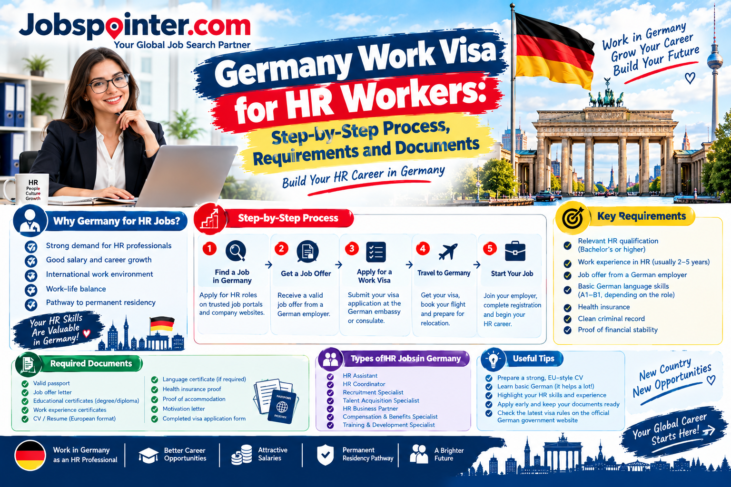
Germany Work Visa for HR Workers: Step-by-Step Process, Requirements and Documents
HR professionals from outside the EU can work in Germany, but there is no visa called an “HR visa”. You apply under a general skilled-worker route that matches your degree, experience and job offer. For most HR officers, recruiters, talent acquisition specialists, HR business partners and HR managers, the realistic options are the EU Blue Card, the work visa for qualified professionals, the visa for professionally experienced workers, or the Opportunity Card if you have no job offer yet.
One point first: finding an HR vacancy does not mean a visa will be granted. The authorities look at your qualification, your experience, the contract and the salary. Nobody can promise approval, and anyone who does should be treated with caution.
Quick answer: how to apply in 8 steps
- Check which visa route fits your degree, experience and nationality.
- Search for HR jobs on employer career pages and reputable job platforms.
- Check whether your degree is recognised or comparable in Germany.
- Secure a job offer and review the contract and salary.
- Prepare your documents, with translations where required.
- Apply through the German mission in your country or the Consular Services Portal.
- Attend your appointment, give biometrics and answer any requests for further evidence.
- Travel to Germany, register your address, arrange health insurance and obtain your residence permit.
The sequence follows the official guidance on Make it in Germany. Exact steps depend on your route and country of residence.
Which German work visa is suitable for HR professionals?
| Route | Best suited to | Main conditions (2026) | Watch out for |
|---|---|---|---|
| EU Blue Card | HR professionals with a university degree and a well-paid offer | Recognised or comparable degree, job that matches the degree, contract of at least six months, gross salary of at least €50,700 (standard) or €45,934.20 (reduced threshold) | HR is not usually listed as a shortage occupation, so the standard threshold most likely applies. Confirm on the official shortage list. |
| Work visa for qualified professionals | Degree or vocational holders who miss the Blue Card salary | Recognised or comparable qualification and a concrete job offer. The Federal Employment Agency may check pay and working conditions. | Recognition evidence is the usual slow step. |
| Visa for professionally experienced workers | Experienced staff in non-regulated occupations | State-recognised vocational or academic qualification, at least two years of related experience within the last five years, job offer with gross salary of at least €45,630 (2026) | Experience must qualify you for the specific job. Higher salary rules apply to some applicants aged 45 or over. |
| Opportunity Card | Eligible applicants with no job offer yet | Recognised skilled-worker status or at least 6 points (language, experience, age, ties to Germany), plus funds to support yourself | It is a job-search permit, not a guarantee of a job. Work is limited to 20 hours a week plus trial work. |
| Recognition partnership | Cases where formal recognition is still pending | Check the official page for conditions | Mainly relevant to professions needing formal recognition. HR is generally non-regulated, so it may not apply. |
The salary figures above come from the 2026 thresholds published for Germany. The Blue Card amounts are reported consistently by several sources that cite Make it in Germany, and the €45,630 figure appears in the official step-by-step graphic. Thresholds are adjusted every year, so verify them on the linked pages on the day you apply.
Work visa for qualified professionals
This is the broad route for people with a recognised degree or vocational qualification who have found a job. If you hold an academic qualification, check the Blue Card first, because it carries extra advantages. If your salary is below the Blue Card threshold, this visa may still work.
EU Blue Card for eligible HR professionals
The Blue Card suits HR graduates (business administration, HR management, psychology, law or a related field) whose job matches their degree. Make it in Germany notes easier family reunification and better settlement prospects as main benefits.
Visa for professionally experienced workers
This route can fit HR officers and coordinators whose strength is experience rather than a high salary. It applies to non-regulated occupations, which HR generally is. Treat that as a point to confirm for your exact job title.
Opportunity Card for HR job seekers without a job offer
The card allows up to 12 months in Germany to look for qualified work, and the Federal Foreign Office confirms part-time work of up to 20 hours a week and trial work are allowed. Under the points route you need at least 6 points. If you find a qualifying job, you may be able to move to a different residence title, and a follow-up card exists in some cases. Use the official self-check rather than an unofficial calculator, and apply via the Opportunity Card portal page.
Eligibility requirements for an HR work visa in Germany
Educational qualifications
For the Blue Card and the qualified-professionals visa, your degree must be recognised in Germany or comparable to a German degree. A degree in HR, business administration or a closely related field makes the job match easier to show. If your degree is in another subject, the job duties and the evidence you provide matter more.
Relevant HR work experience
The experienced-worker route requires at least two years of qualified experience in the last five years. Keep reference letters that describe your duties (recruitment, payroll, employee relations, HR administration), not only your job title.
Qualification comparability and recognition
HR is not a regulated profession in Germany, so you usually do not need a licence to practise. You still need proof of your qualification. Two common tools:
- anabin database: check whether your university and degree are rated as comparable. A printout can be enough where your degree is listed. See anabin (German-language site).
- ZAB Statement of Comparability: if your degree is not listed, apply to the Central Office for Foreign Education through ZAB.
Start early. Official guidance on recognition is on Make it in Germany.
Job offer, contract and salary
Expect to need a concrete job offer or signed contract that states your duties, working time and gross salary. The salary must meet the threshold of your route, and pay and conditions must be comparable to those of local employees.
Illustrative example (not a real case): an HR graduate with four years’ recruitment experience receives an offer as HR business partner at €52,000 gross. That is above the standard Blue Card threshold, so the Blue Card is worth checking. At €47,000 the Blue Card would not apply, but the qualified-professionals visa might, if the degree is recognised or comparable and the pay meets local standards.
Financial resources and other conditions
You must show you can support yourself, normally through the job. Opportunity Card applicants must prove funds for the job-search period, and the required amount should be checked on the official page. Health insurance is also required for the visa and after arrival.
Step-by-step process to apply for a German work visa
| Step | What to do | Practical tip |
|---|---|---|
| 1. Check eligibility | Compare your degree, experience and expected salary with each route above. | Use the Make it in Germany visa overview. Also check whether you need a visa at all using the “Do I need a visa?” page. |
| 2. Find HR jobs | Search employer career pages and trusted platforms. | Browse Germany listings on Jobspointer. |
| 3. Check qualifications | Use anabin or request a ZAB statement. | Recognition can take months, so begin before you accept an offer. |
| 4. Secure a job offer | Read the contract, duties, salary and employer details. | Ask the employer if they have hired from abroad before. |
| 5. Prepare documents | Collect originals, copies and translations. | Follow the checklist of your own German mission. |
| 6. Submit your application | Apply on the Consular Services Portal or as your mission instructs. | The visa fee is not refunded if you are refused. |
| 7. Complete formalities | Attend the appointment, give biometrics, supply extra evidence. | Reply to requests quickly and consistently. |
| 8. Move and register | Arrange housing and health insurance, register your address, then apply for your residence permit at the local immigration office. | Registration is usually due within days of arrival. Confirm the deadline locally. |
Documents required for a German HR work visa
The exact list depends on your route and mission. A typical set looks like this:
| Document | Notes |
|---|---|
| Valid passport and signed application | Some missions require validity beyond your planned stay, two blank pages and issue within the last 10 years. Check yours. |
| Biometric photo(s) | Follow the mission’s photo specification. |
| Degree certificates and transcripts | With anabin printout or ZAB statement where required. |
| CV and employment references | Show HR duties and dates clearly. |
| Job offer or signed contract | Salary, duties, hours and start date. |
| Employer’s declaration on the employment relationship | The Federal Employment Agency provides a form. Your employer usually completes it. |
| Federal Employment Agency pre-approval, if applicable | Your employer may be able to request it. |
| Health insurance proof | Often travel cover until your German insurance starts. |
| Financial evidence | Mainly for the Opportunity Card. |
| Certified translations | Needed where documents are not in German or English, as your mission specifies. |
Keep a consistent spelling of your name, dates and job titles across every document. Mismatches are an easy way to create delays.
How much does a German work visa cost?
Avoid budgeting from one fixed total, because costs vary by person and route.
| Cost | Amount | Notes |
|---|---|---|
| National visa application fee | €75 | Stated on German mission pages. Not refunded if the application is withdrawn or refused. |
| ZAB Statement of Comparability | About €208 | Per a Make it in Germany handout. Check the ZAB site for the current fee. Not needed if anabin is enough. |
| Translations and certifications | Varies | Depends on documents and language. |
| Residence permit in Germany | Varies | Issued by the local immigration office after arrival. Check the local fee. |
| Health insurance, travel, housing deposit | Personal costs | Plan these separately from official fees. |
Some employers cover recognition, translation or relocation costs. Ask before you assume.
German language requirements for HR jobs
Official visa pages for the Blue Card and similar routes do not set one German level for everyone, and employers decide what a role needs. For the Opportunity Card, language skills earn points. In practice, HR work is language-heavy:
| HR role type | German usually needed? (general guidance, not a legal rule) |
|---|---|
| Payroll, HR administration, employment-law or works-council contact | Yes, usually at a high level |
| Employee relations with local staff | Yes |
| Recruiter or talent acquisition for an international or English-speaking team | Sometimes English is enough, but German widens options |
| HR business partner, HR systems or global HR in a multinational | Often English with some German |
To prepare, take a recognised exam such as telc or ÖSD and put the certificate in your CV. Employers read a certificate as stronger proof than “fluent”.
How to find HR jobs in Germany with visa support
Germany does not work like the UK’s sponsor-licence system. In most cases you apply for the visa or residence permit yourself, and the employer supplies employment documents and support. So an “HR manager job with visa sponsorship” usually means an employer willing to hire from abroad and help with paperwork, not one who obtains the visa for you.
- Search by title: HR specialist, HR manager, recruiter, talent acquisition, payroll specialist. Also try German titles such as Personalreferent.
- Target international employers: multinationals and companies with English-speaking teams.
- Build a German-style CV: concise, dated, with a clear career line and certificates. The Jobspointer Resume Builder can help, and the CV and resume category has more guides.
- Ask employers: Have you hired from abroad? Will you issue the employment declaration? Who handles pre-approval?
- Spot scams: be wary of anyone who demands fees for a “guaranteed” job or visa, offers a contract without an interview, or asks you to pay via personal accounts.
Starting out in another field? Our guide to a first engineering job in Germany explains how the Blue Card, recognition and language fit together for graduates. Also compare HR routes in Oman and Poland.
Common mistakes to avoid
- Choosing a route without checking its conditions
- Assuming every HR job counts as qualified employment
- Leaving qualification checks until after the job offer
- Underestimating German in payroll and employment-law roles
- Submitting incomplete or inconsistent documents
- Trusting recruiters who promise guaranteed visas
- Entering on a tourist visa to start work, which is unauthorised employment
Frequently asked questions
Can foreign HR professionals work in Germany?
Yes, if they qualify under a work route and have the right to work for the specific job.
Is a job offer necessary?
For the Blue Card, qualified-professionals visa and experienced-worker visa, yes. The Opportunity Card is the route for people without one.
Do HR professionals qualify for the Blue Card?
They can, if they hold a recognised degree, the job matches it and the salary meets the threshold. HR is generally not a shortage occupation, so expect the standard threshold. Verify.
Is German mandatory?
Not as a single legal rule for these visas, but many HR roles require it. Check each job advert.
Are foreign HR qualifications recognised?
Degrees are assessed through anabin or a ZAB statement. HR itself is not a regulated profession.
Can I look for HR jobs without an offer?
Yes, with the Opportunity Card if you qualify.
How long does it take?
It varies by mission, route and recognition. Plan for weeks to months and check your mission’s current guidance.
Can I bring my family?
Family reunification rules depend on your title. The Blue Card is the most favourable route. See the official family reunification page.
Conclusion: start your HR career in Germany
The strongest applications choose the right route early, confirm qualification evidence, secure a suitable contract and submit a clean document set. Check the official pages once more before applying, then explore HR and other jobs in Germany on Jobspointer and more guidance in our Visa & Immigration category.
This guide is general information, not legal advice. It does not promise employment or visa approval.