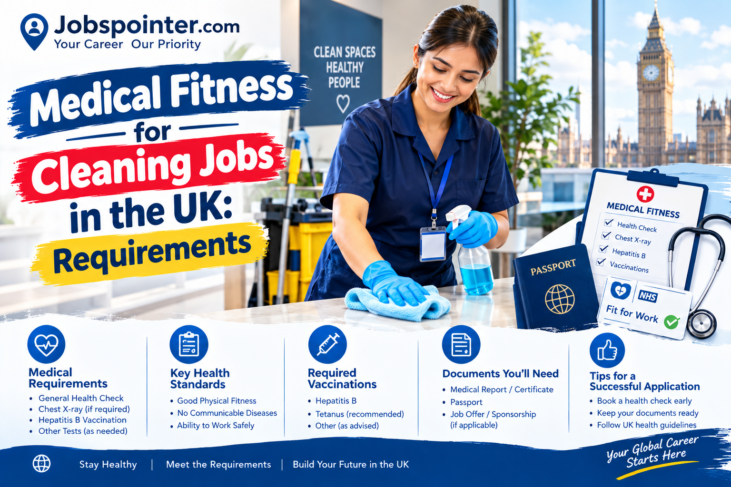
Medical Fitness Standards for Cleaning Jobs in the UK
If you are applying for a cleaning job in the United Kingdom, you may be wondering whether you must pass a medical examination before starting work. The answer depends on the job, the working environment and the health risks involved.
There is no single universal medical fitness test required for every cleaning job in the UK. Some employers may arrange an occupational health assessment, while other positions may require no separate medical examination. Health surveillance may also be necessary for certain workplace exposures under health and safety legislation.
For example, cleaning offices or hotel rooms generally involves different risks from cleaning hospital environments or industrial facilities. Employers should assess the actual demands and hazards of the role rather than assume that every applicant must meet the same medical standard.
This guide explains the medical fitness requirements for cleaning jobs in the UK, possible pre-employment checks, workplace safety expectations and the rights applicants should understand before accepting an offer.
Do Cleaning Jobs in the UK Require a Medical Test?
Not necessarily. A routine cleaning job does not automatically require a medical certificate, blood test, chest X-ray or full medical examination.
An employer may request an appropriate health assessment when it is relevant to the position, subject to applicable recruitment and equality rules. For example, an assessment may help establish whether a worker needs adjustments to perform the job safely or whether a specific workplace exposure requires health surveillance.
UK government guidance explains that health-related questions during recruitment are restricted under the Equality Act 2010, with exceptions for specified purposes. An employer can also consider relevant health requirements after making a conditional job offer.
Here is a practical overview:
| Cleaning job | What may apply |
|---|---|
| Office or domestic cleaner | Usually a focus on job duties, safe working practices and any relevant workplace assessment |
| Hotel or housekeeping cleaner | Assessment of physical duties, safe equipment use and workplace-specific procedures |
| Hospital cleaner | Infection-control training and potentially role-specific occupational health or screening procedures |
| Industrial cleaner | Additional controls or health surveillance where particular chemical, dust or other hazards require them |
| Specialist cleaner | Additional assessments or training depending on the substances, equipment and environment involved |
These are general examples, not a list of mandatory tests. The actual requirements must be confirmed with the employer and, where necessary, the relevant occupational health professional.
Understanding Medical Fitness Requirements for Cleaners
Medical fitness generally means being able to carry out the essential duties of a particular job safely, with appropriate workplace controls and reasonable adjustments where applicable.
It does not mean that an applicant must have perfect health or be free from every medical condition.
Routine office, hotel and domestic cleaning
Common tasks may include vacuuming, sweeping, mopping, cleaning washrooms, wiping surfaces, changing bed linen and disposing of waste.
Employers may consider whether applicants can perform the relevant tasks, follow instructions and use cleaning products safely. Depending on the work, prolonged standing, bending, reaching and repetitive movements may be important considerations.
A separate medical examination should not be assumed to be compulsory simply because the position involves physical work.
Hospital and healthcare cleaning
Hospital cleaning can involve additional risks because cleaners may work around patients, potentially infectious materials, clinical waste and disinfectants.
Depending on the specific duties and workplace policies, employers may require infection-prevention training, appropriate protective equipment, occupational health advice or particular screening procedures.
These requirements should be confirmed for the individual vacancy. There is no basis for assuming that every hospital cleaner must undergo the same medical tests.
Industrial and specialist cleaning
Industrial cleaning may involve more demanding physical tasks, confined spaces, machinery, hazardous substances or exposure to dust and fumes.
A job involving specific hazardous substances may require health surveillance when the legal conditions apply. Certain specialist activities may also require task-specific training, protective equipment or additional assessments.
Read the Health and Safety Executive’s guidance on controlling hazardous substances at work for more information.
Physical Requirements for Cleaning Workers
Cleaning jobs vary considerably, so applicants should read the job description carefully rather than assume that every position has identical physical requirements.
Depending on the role, duties may involve:
- Standing or walking for extended periods.
- Bending, stretching and reaching to clean surfaces.
- Pushing vacuum cleaners or cleaning trolleys.
- Repeating hand, wrist and arm movements.
- Moving cleaning supplies or waste containers.
- Using steps or access equipment where permitted and properly controlled.
Employers should consider the actual tasks, their frequency and the equipment available. For example, a position requiring the movement of heavy waste containers may have different requirements from one focused on light office cleaning.
If a task is difficult because of a disability or health condition, ask whether suitable equipment, modified duties or another reasonable adjustment could help. Do not assume that a diagnosis automatically makes you unsuitable for the role.
Occupational Health Assessments and Health Surveillance
An occupational health assessment and health surveillance serve related but different purposes.
An occupational health assessment may help an employer understand how a person’s health relates to the duties of a specific job and whether support or adjustments may be appropriate.
Health surveillance is specifically concerned with identifying early signs of work-related ill health and checking whether workplace risk controls are effective. Under the Control of Substances Hazardous to Health Regulations (COSHH), it may be necessary when the relevant exposure and risk conditions are met.
For cleaning workers, health surveillance might involve:
- Checking for signs of work-related dermatitis.
- Asking about breathing symptoms where there is a relevant exposure risk.
- Monitoring lung function when appropriate.
- Referring workers to a competent occupational health professional when necessary.
The exact approach depends on the hazard and the level of risk. A general health questionnaire is not automatically a substitute for the surveillance required by a proper risk assessment.
If an employer arranges an assessment, ask what it covers, why it is necessary and how the information will be handled. Health surveillance findings should be interpreted appropriately, and employers should act when the results indicate a workplace risk.
Cleaning Chemicals, Allergies and Skin Protection
Cleaning products can cause skin irritation, dermatitis, eye injuries or respiratory problems if they are not used safely. Frequent contact with water and cleaning solutions can also damage the skin.
The HSE specifically warns that some cleaning-product ingredients can cause skin allergies and asthma, while corrosive products can cause burns.
To reduce these risks:
- Follow product instructions. Use cleaning products according to their labels and workplace procedures.
- Wear suitable protective equipment. Use the gloves, aprons and eye protection specified for the task.
- Maintain ventilation. Follow instructions for safe use in enclosed or poorly ventilated areas.
- Never mix cleaning chemicals unless explicitly authorised by a safe, approved procedure. Some combinations can release dangerous gases.
- Practise good hand care. Remove contamination promptly, wash and dry hands properly, and use suitable skin-care products.
- Report symptoms early. Tell your supervisor if you develop a persistent rash, wheezing, coughing or breathing difficulties associated with work.
What is COSHH training?
COSHH stands for the Control of Substances Hazardous to Health. It is a UK workplace safety framework requiring employers to assess and control risks from hazardous substances.
Employers must provide relevant information, instruction and training, and ensure that suitable protective measures are in place. The precise training depends on the products and activities involved. A particular standalone COSHH certificate should not be assumed to be mandatory for every cleaner. Official guidance: COSHH and cleaners — key safety messages.
Manual Handling and Workplace Safety
Safe working practices are important even when a job does not require a medical examination.
Before starting work, understand how to use cleaning equipment, move supplies safely and report hazards. Do not attempt to lift a load that you cannot handle safely.
Employers should assess relevant risks and implement suitable control measures. Depending on the workplace, these may include equipment to reduce manual handling, safer storage arrangements, training, appropriate footwear and procedures for dealing with spills.
For example, if moving a heavy cleaning trolley causes pain or is beyond your safe capacity, report the problem rather than repeatedly attempting the task. The employer can consider whether the equipment, work method or task allocation needs to change.
These measures can help prevent injuries and support workers with different physical capabilities.
Disability, Reasonable Adjustments and Employment Rights
Having a disability or long-term health condition does not automatically prevent you from working as a cleaner.
Under the Equality Act 2010, applicable employers have duties concerning disability discrimination and reasonable adjustments. The specific legal position depends on the circumstances, and the legislation has separate provisions and scope rules for different parts of the UK.
Reasonable adjustments may include:
- Providing suitable equipment or an adapted trolley.
- Changing the way certain tasks are carried out.
- Adjusting working arrangements where reasonable.
- Making recruitment assessments accessible.
- Considering changes that reduce a substantial disadvantage for a disabled worker.
The employer should consider the individual situation rather than make assumptions based on a diagnosis. What is reasonable depends on factors such as practicality, effectiveness, cost and health and safety considerations. UK law also generally restricts questions about an applicant’s health or disability before an offer of work, subject to exceptions. These include certain questions about adjustments needed for the recruitment process and whether an applicant can carry out an intrinsic function of the job. Further questions may be permitted after a conditional offer. Applicants who are uncertain about their rights can consult the official government guidance on health and disability questions during recruitment.
Documents and Assessments Employers May Request
The documents and checks required for a cleaning job depend on the employer, the duties and any applicable legal requirements.
An employer may request some of the following:
| Document or assessment | Purpose |
|---|---|
| Application form and CV | To assess relevant experience, skills and suitability |
| Identity documents | To establish identity as part of the recruitment process |
| Right-to-work evidence | To verify permission to undertake the offered work in the UK |
| Occupational health questionnaire | To identify relevant workplace health risks or support needs, where appropriate |
| Health surveillance records or assessment | To monitor specific work-related health risks where required |
| Training records | To demonstrate relevant training where the position requires it |
| References | To support employment history checks where requested |
Important: This table describes possible requirements, not a universal checklist. A medical certificate, blood test, chest X-ray or drug test is not a standard requirement for every cleaning position simply because it involves cleaning.
For international applicants, medical fitness and immigration permission are separate matters. Employers must complete the applicable right-to-work checks before employment begins. Whether someone can take a particular job depends on their immigration status and the conditions attached to their permission.Check the official UK right-to-work guidance for details.
How to Prepare for a Cleaning Job Medical Assessment
If an employer tells you that an occupational health assessment is required, take these practical steps.
- Confirm the reason for the assessment. Ask whether it is a general occupational health assessment, a task-specific fitness assessment or health surveillance for a workplace hazard.
- Read the job description. Identify the physical tasks, working hours, cleaning products and environmental conditions involved.
- Provide accurate information when appropriate. Answer relevant questions honestly. Ask how your information will be used and who will receive the results.
- Discuss support needs. If you have a relevant health condition or disability, consider whether you need an adjustment, suitable equipment or another practical measure.
- Follow the assessment instructions. Bring any requested documents and follow the healthcare provider’s instructions. Do not arrange or pay for additional medical tests unless they have been appropriately requested and their purpose is clear.
- Ask about the outcome. Find out whether the assessment has identified any work-related precautions, adjustments or follow-up requirements.
An assessment does not necessarily result in an unconditional pass-or-fail decision. Depending on the circumstances, it may identify adjustments, protective measures or further assessment that could allow someone to perform the role safely.
Frequently Asked Questions
1. Is a medical fitness certificate compulsory for cleaning jobs in the UK?
No. There is no universal medical fitness certificate requirement for every cleaning job. Check the vacancy details and ask the employer whether a particular assessment is necessary for the position.
2. Do cleaners in the UK need a blood test or chest X-ray?
Not as a general requirement for all cleaning jobs. A particular test should only be expected when it is supported by the relevant job requirements, occupational health advice or applicable rules.
3. Can I work as a cleaner in the UK if I have asthma?
Possibly. Asthma does not automatically disqualify someone from cleaning work. However, certain cleaning products may trigger symptoms, so relevant risks, exposure controls and any necessary adjustments should be considered.
4. Can someone with a disability apply for cleaning jobs?
Yes. Applicants with disabilities can apply, and applicable equality law may require employers to make reasonable adjustments. The relevant question is how the essential duties can be performed safely and whether appropriate adjustments are possible.
5. Do hospital cleaners need additional medical checks?
Some healthcare cleaning roles may involve additional screening, occupational health procedures or infection-control requirements. The exact requirements depend on the duties, workplace risks and employer policy. There is no single additional test that applies to every hospital cleaner.
6. Is COSHH certification compulsory for all cleaning jobs?
No universal standalone COSHH certificate is required for every cleaning job. Employers must provide appropriate information, instruction and training for the hazardous substances and activities involved.
7. Can I get a cleaning job in the UK without experience?
Some employers recruit entry-level cleaners and provide training. Experience requirements vary by vacancy, and specialist positions may require previous experience or particular training. Applicants must also meet any applicable right-to-work requirements.
8. Can an overseas applicant work as a cleaner in the UK?
Only if they have legal permission to undertake the particular work. Being medically fit does not provide immigration permission or guarantee a visa. Applicants should check current immigration rules and the conditions attached to their permission before accepting an offer.
9. What should I do if I develop a skin rash or breathing problems after starting a cleaning job?
Stop or reduce exposure where necessary to protect yourself, follow the workplace’s reporting procedures and seek appropriate medical advice. Tell your employer about suspected work-related symptoms so that the relevant risks and protective measures can be reviewed.
10. Where can I verify the medical requirements for a particular cleaning job?
Start with the employer’s written job description and occupational health instructions. For chemical exposure and health surveillance, consult the Health and Safety Executive. For recruitment and disability rights, consult GOV.UK guidance.
Conclusion
The medical fitness requirements for cleaning jobs in the UK depend on the duties, workplace hazards and relevant legal requirements. Many routine cleaning positions do not require a separate medical examination, while certain healthcare, industrial and specialist roles may involve additional assessments or health surveillance.
Applicants should focus on understanding the job, preparing for relevant assessments, following workplace safety procedures and asking employers to clarify any medical requirements. A health condition or disability does not automatically make someone unsuitable for cleaning work, and international applicants should check their right to work separately.
For reliable information, use official government and Health and Safety Executive guidance rather than assuming that every vacancy requires the same tests.