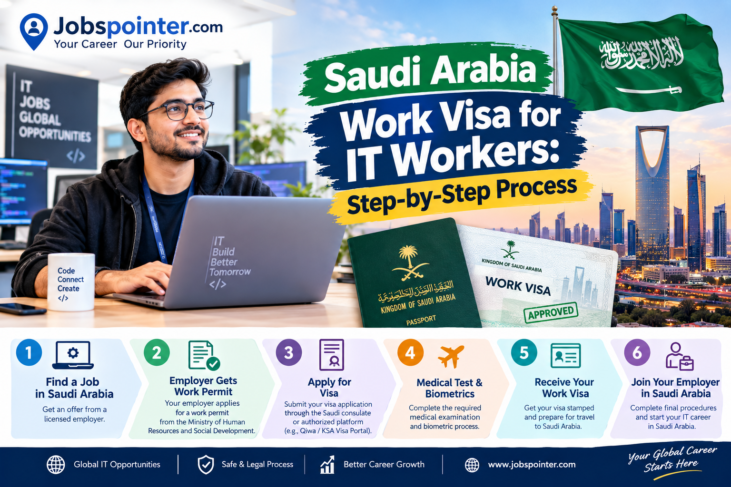
Saudi Arabia Work Visa for IT Workers: Step-by-Step Process
If you have a job offer in Saudi Arabia’s technology sector, the visa process can look like a maze of platforms and acronyms: Qiwa, Muqeem, Absher, MOFA, Iqama. In practice, your employer drives most of it, and you handle a smaller set of tasks.
This guide explains the process for software developers, engineers, data and cloud specialists, cybersecurity staff and IT support professionals. It covers who does what, which documents you need, what the fees look like and what to check before you sign.
The short answer
- You need a sponsor. Every foreign worker is sponsored by an employer. One 2026 guide states there is no job-seeker visa, so you cannot go and look for work on a visa. Confirm this with the Saudi Ministry of Foreign Affairs before you travel.
- The employer starts the process. It requests a visa quota and issues your visa authorisation on Qiwa, the Ministry of Human Resources and Social Development (HRSD) platform.
- You verify your qualifications. HRSD’s Professional Verification service checks degrees and experience for skilled roles. Engineers also deal with the Saudi Council of Engineers.
- You get a work visa, then an Iqama. The visa lets you enter. The Iqama is your residence card, issued after arrival.
- Timing varies. Published estimates range from a few weeks to about 14 weeks. No official timeline was found.
Nothing here promises a job or visa approval. Rules change, and the employer and government make the final decisions.
How Saudi work visa sponsorship works
Three documents get confused online. They are different, and they appear at different stages.
| Document | What it is | Who applies | When |
|---|---|---|---|
| Work visa | Entry visa stamped in your passport for the approved job | Employer authorises it on Qiwa; you apply at the Saudi embassy or visa centre | Before you travel |
| Work permit | HRSD authorisation for a non-Saudi to work for that employer; the employer pays the related fees | Employer, through Qiwa | Around arrival |
| Iqama | Residence permit and ID card | Employer, through the Muqeem portal | After arrival, within 90 days according to secondary guides |
Who does what
| Employer | You |
|---|---|
| Holds a valid commercial registration and Qiwa account | Hold a valid passport (many guides say at least 6 months) |
| Secures a visa quota and issues your visa authorisation | Gather and attest your documents |
| Documents your employment contract on Qiwa | Complete qualification verification when required |
| Pays the work permit levy and Iqama fee (see fees section) | Take the pre-departure medical and attend visa stamping |
| Processes your Iqama and renewals | Travel, give biometrics and complete the local medical |
Why your employer’s status matters
Saudi employers are rated under the Nitaqat Saudization programme. An employer’s band can affect whether it can bring in new foreign hires. A reputable employer will know its status, and it is a fair question to ask during interviews.
Step-by-step: from job offer to Iqama
This sequence combines official programme descriptions with several 2026 guides. The order is consistent across sources, but exact steps can vary by nationality and visa centre.
- Receive and review the offer. Get the offer in writing. Check the job title carefully, because the visa is issued for a specific title, and a mismatch between documents and the Qiwa job title is reported as a cause of rejection.
- Employer secures a visa quota. Through Qiwa, the employer requests visa allocation for new foreign hires. This is the employer’s task and depends on its Nitaqat status.
- Employment contract and visa authorisation. The contract is documented on Qiwa, and the employer issues a visa authorisation for you and your job.
- Qualification verification. For skilled roles, upload degrees, certifications and experience for HRSD’s Professional Verification. See the next section.
- Pre-departure medical. Take the required medical at an approved centre in your country. Guides name the Wafid platform, which is said to have replaced the older GAMCA system.
- Apply for the visa. Apply through the Saudi embassy or its authorised visa centre. An embassy page for one country lists a work visa permit authorised by the Ministry of Foreign Affairs and obtained by the employer, plus a medical report and attested certificates.
- Travel to Saudi Arabia. Enter on the work visa. Do not travel on any other visa to start work.
- Local medical and biometrics. After arrival you complete a local residency medical and give fingerprints.
- Iqama issued. The employer processes your Iqama through Muqeem. Secondary guides say it should be completed within 90 days of arrival.
- Work permit and renewals. The work permit is managed on Qiwa and the Iqama is renewed through Muqeem. Ask your employer to share the expiry dates so you can track them.
Quick timeline (indicative only)
| Stage | Reported range | Source quality |
|---|---|---|
| Visa quota and authorisation | About 1 to 4 weeks | Secondary guides, ranges differ |
| Embassy visa stamping | About 1 to 6 weeks | Secondary guides |
| Local medical, biometrics, Iqama | About 1 to 4 weeks | Secondary guides |
| Whole process | About 2 to 14 weeks | Secondary guides; no official figure found |
Documents and professional qualification verification
Documents checklist
Requirements differ by embassy and nationality, so use this as a preparation list and confirm with your employer and the Saudi embassy for your country.
| Document | Notes |
|---|---|
| Valid passport | Many guides ask for at least 6 months of validity |
| Passport photos | Follow the embassy or visa centre specification |
| Employment contract and visa authorisation number | Provided by the employer |
| Degree certificate and transcript | May need attestation; see below |
| Experience letters and professional certificates | Needed for qualification verification; keep originals |
| Medical report | From an approved centre; embassy pages say it must be signed and stamped |
| Police clearance certificate | Listed by some guides; confirm if required for your nationality |
| Updated CV | Keep job titles and dates consistent with the verification upload |
Professional qualification verification
HRSD’s Professional Accreditation programme includes a Professional Verification service. According to HRSD, it checks that expatriate workers in highly skilled jobs have reliable academic qualifications and the practical experience the Saudi labour market requires, before they enter the Kingdom. It was introduced under Cabinet Decision 195 and has reached 160 labour-exporting countries.
The service focuses on professions in groups 1 to 3 of the Saudi occupation classification. Reports name engineering and health roles. Whether your exact IT job title is covered was not confirmed, so ask your employer’s HR team which assessment applies to your title.
One 2026 guide says degrees, certifications and experience documents are uploaded on the qualification verification portal, and that it has replaced the old cultural-mission attestation for most degrees. Treat that as unconfirmed until you see it on an official HRSD or embassy page. Some embassy pages still describe attesting degrees in your home country and then at the Saudi embassy.
If your job title includes “engineer”
The Saudi Council of Engineers states that all engineers practising in the Kingdom must be registered with it. Its page lists a three-year professional registration for non-Saudi engineers at SAR 1,250, including engineers invited by a Saudi employer who are not yet resident. Software developers with a non-engineering title may not need it, but the rule depends on the title on your visa and Iqama.
A separate industry news report says foreign engineers now face stricter criteria, including minimum experience, an exam and an interview. Its date was not confirmed, so check the current Council requirements before assuming it applies.
Practical tip
Ask the employer to confirm in writing the exact occupation that will appear on your visa and Iqama, and whether verification or Council registration applies to it.
Saudi work visa fees and processing time
No official fee schedule was opened for this article. The figures below come from commercial expat sites that cite the Labor Law and Qiwa, so confirm them on the official platforms before relying on them.
| Cost | Reported amount (SAR) | Usually paid by | Notes |
|---|---|---|---|
| Iqama issuance or renewal | 650 per year | Employer | Reported under Article 40 of the Labor Law |
| Work permit levy | 700 or 800 per month per worker | Employer | Rate depends on the employer’s Saudization position |
| Work permit service fee | 100 per year | Employer | Reported separately from the levy |
| Dependent levy | 400 per month per dependent | Employee or sponsor | Applies if your family joins you |
| Absher service fee | 51.75 per transaction | Employee or employer | Varies by service |
| Saudi Council of Engineers registration | 1,250 for 3 years | Check with employer | Engineering titles; listed on the Council’s site |
| Pre-departure medical, visa centre fees | Not confirmed | Agree in writing | Ask the employer to confirm who pays |
The rule to remember
The employer is responsible for the Iqama fee and work permit levy under the Labor Law, according to the secondary sources reviewed. If a recruiter or employer asks you to pay these, ask for the legal basis in writing and speak to your embassy or the Ministry of Human Resources and Social Development before paying.
How long does it take?
Secondary guides report anything from about 2 to 14 weeks. The spread comes from different counting methods, nationalities and verification steps. One guide notes that the employer has 90 days from your entry to finish the Iqama. Plan for delays, and do not resign from your current job or sell assets until the visa is in your passport.
Your employment contract in Saudi Arabia
The Labor Law was amended in February 2025. Summaries by law and HR firms describe the following rules for contracts. Check the current text on the HRSD site or Qiwa.
| Topic | What sources describe | Confidence |
|---|---|---|
| Form | Written, in Arabic, documented on Qiwa | Medium |
| Duration for non-Saudis | Fixed term; one year if none is stated | Medium |
| Probation | Must be written in the contract. Up to 180 days after the 2025 amendments (90 days before). An older HRSD leaflet still says 90 days | Conflicting; verify |
| Annual leave | 21 days, rising to 30 days after five years of service | Medium |
| End-of-service award | Half a month’s wage per year for the first five years, a full month per year after | Medium |
| Notice | 60 days from the employer on an indefinite monthly-paid contract | Medium |
What to check before you sign
- Job title. It must match the title used for your visa and verification.
- Salary breakdown. Basic pay, housing, transport and any other allowances, in writing.
- Probation clause. Length and who can end it.
- Contract length and renewal. Fixed term and what happens at the end.
- Benefits. Health insurance, annual flight ticket, relocation help, leave days.
- Costs. Who pays for the medical, visa centre, flights and any registration fees.
- Where it is registered. Ask your employer to confirm the contract is documented on Qiwa. One guide says employees can view contracts in their individual Qiwa account.
Negotiating tip
Negotiate before you accept, not after. Once visa work starts, both sides have invested time, and a changed term is harder to win. Keep any agreed change in writing and make sure it appears in the Qiwa-documented contract.
IT jobs in Saudi Arabia, Saudization and finding a sponsor
Saudization and why it affects IT titles
Saudization requires private employers to meet quotas of Saudi staff under the Nitaqat system, and HRSD has been widening the list of professions with localisation targets. Reports describe these recent moves:
| Area | What was reported | Source quality |
|---|---|---|
| Communications and IT | More than 30 professions set for Saudization, with minimum monthly salaries of SAR 5,000 for technical and SAR 7,000 for specialised roles to count towards targets. Roles named include application development, programming, analysis and technical support. | Press report; date not confirmed |
| Engineering | 30% target for establishments with five or more workers in 46 engineering roles, with a SAR 8,000 minimum wage for those roles (January 2026 report) | News report |
| Procurement | 70% target for 12 purchasing professions (January 2026 report) | News report |
| Administrative support | 69 professions fully reserved for Saudis from 5 April 2026 | Arab News |
A quota is not the same as a ban. Many employers still hire foreign IT specialists, but your exact job title may fall under a localisation decision, and that can make approval harder. Ask your employer whether your title is covered, and check the current HRSD list.
How to get an IT job in Saudi Arabia
There is no shortcut, and no one can guarantee a job. This is a sensible order of work:
- Match your skills to a verifiable job title. Titles such as software engineer, data engineer or security analyst should reflect your degree and experience.
- Prepare proof. Keep degree, transcripts, certifications and experience letters ready in PDF. They are needed for verification.
- Apply through reliable channels. Use company career pages, professional networks and recruiters that you can verify. Search for roles located in Saudi cities where the technology sector is active.
- Interview remotely and ask the visa questions early. Ask who sponsors, which title will be filed, and who pays which costs.
- Get the offer in writing and review it with the checklist in the contract section.
- Start the visa steps only after the offer and Qiwa contract are in place.
Roles this guide covers
| Role group | Examples |
|---|---|
| Software | Software developers, web developers, mobile app developers |
| Infrastructure | Network engineers, cloud specialists, database administrators |
| Data and AI | Data analysts, data engineers, AI specialists |
| Security and support | Cybersecurity professionals, IT support specialists |
Process steps are the same across these groups. What differs is the job title used, and whether verification, Council registration or a Saudization rule applies to it.
Scam warning signs and a safe-application checklist
Fake visa offers target people who want to work abroad. The checklist below keeps you on the safe side, whatever country you are applying from.
Before you pay or travel
- Ask for the employer’s full legal name and commercial registration number, and check that the company exists.
- Get a written offer and a contract. Ask for confirmation that it is documented on Qiwa.
- Ask for your visa authorisation details and check them with the employer’s HR contact and the Saudi embassy for your country.
- Confirm in writing who pays the medical, visa centre fees and flight.
- Use your own country’s licensed recruitment channels where required, and check the recruiter’s licence with your labour authority.
- Keep copies of every document, receipt and message.
Red flags
| Warning sign | Why it matters |
|---|---|
| “Guaranteed visa” or “100% job” | Only the Saudi authorities and the employer decide approvals |
| Asked to pay for the Iqama, work permit levy or “quota” | These are reported employer costs under Article 40 of the Labor Law |
| Offer to arrive on a visit or tourist visa and “convert” | Entry should be on the approved work visa |
| Job title that does not match your skills | May signal a fake offer, or a visa that will be refused or cause trouble later |
| No contract, or contract only by messaging app | Legitimate employment is documented on Qiwa |
| Pressure to pay cash quickly to a personal account | Common in fraud |
| Employer asks you to hand over your passport permanently | Confirm the rule with your embassy before agreeing |
If you think you have been targeted, contact the Saudi embassy for your country and your own country’s labour or migrant-worker authority.
FAQ
Can I get a Saudi work visa without a job offer?
No. Work visas are tied to an employer sponsor, and one 2026 guide says there is no job-seeker visa. Confirm the current position with the Saudi embassy for your country.
Who applies for the work visa?
The employer starts the process on Qiwa. You then complete your part: documents, verification, medical and visa stamping.
What is the difference between a work visa and an Iqama?
The work visa lets you enter Saudi Arabia for the approved job. The Iqama is the residence permit issued after arrival.
How long does the Saudi work visa process take?
No official timeline was found. Secondary guides report roughly 2 to 14 weeks, and the employer has 90 days after your arrival to complete the Iqama.
Do software developers need qualification verification?
HRSD’s Professional Verification covers skilled professions in groups 1 to 3 of the occupation classification. Ask your employer whether your exact title is covered.
Do IT workers need Saudi Council of Engineers registration?
The Council says engineers practising in the Kingdom must register. If your title is not an engineering title, check with your employer.
Who pays the Iqama and work permit fees?
Secondary sources say the employer pays them under Article 40 of the Labor Law. Confirm in your contract.
Can my family join me?
In general, a dependent levy applies after you hold an Iqama, reported at SAR 400 per month per dependent. Check current family visa rules on official portals.
Can I work in Saudi Arabia on a visit visa?
No. Work needs a sponsored work visa and Iqama. Treat any “visit visa to work” offer as a red flag.