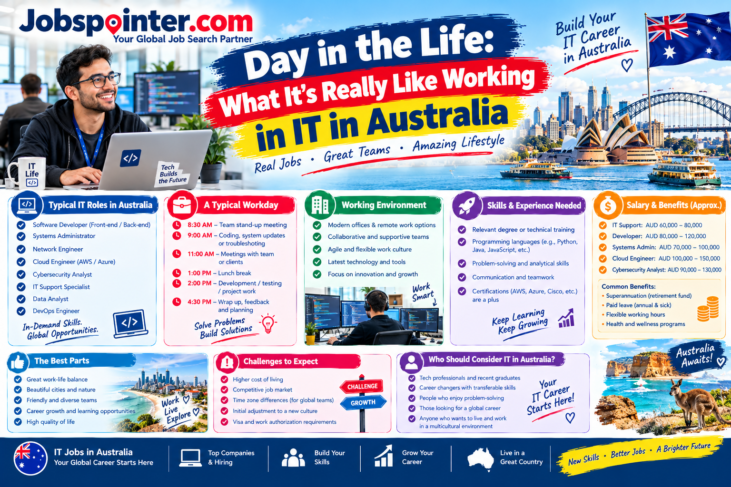
Day in the Life: What It’s Really Like Working in IT in Australia
Last reviewed: 28 October 2026. Salary, visa, and workplace rules change, so check the official links before you act.
Working in IT in Australia usually means a structured, collaborative job with decent pay and reasonable hours. The detail depends on your role, employer, city, and seniority. A developer at a Sydney fintech, a help-desk analyst at a Perth mining company, and a security engineer in Canberra all have very different days.
This guide covers what a normal workday looks like, how the culture feels, what people earn, and what international applicants should check first. It does not promise jobs or visa outcomes.
1. Starting the Day: Morning Routines in Australian IT
Most IT workers begin between 8:00 and 9:00 AM. The first 30 minutes are usually planning, not coding.
- Check email, Slack or Teams, and overnight alerts
- Review tickets, sprint boards, or incident queues
- Join a short stand-up, usually 10 to 15 minutes
- Decide the day’s top two or three priorities
Office, hybrid, or remote? Many employers use hybrid schedules, with a few set office days each week. Fully remote roles exist but are less common. Always confirm the arrangement in writing before you accept an offer.
2. What IT Professionals Actually Do All Day
| Role | Typical daily work |
|---|---|
| Software developer | Writing and testing code, fixing bugs, reviewing teammates’ code, joining planning sessions |
| IT support specialist | Working the ticket queue, resetting access, fixing devices, explaining fixes in plain language |
| Cybersecurity analyst | Monitoring alerts, investigating suspicious activity, patching, writing incident notes |
| Data analyst | Cleaning data, building dashboards, presenting findings to non-technical colleagues |
| Cloud or network engineer | Maintaining infrastructure, watching performance, automating repetitive tasks |
Across all of them, the day is a mix of focused technical work and communication. Writing clearly and explaining problems simply matters as much as technical skill.
3. Australian IT Workplace Culture
Australian workplaces tend to be informal and direct. Many teams use first names even for senior managers. Hierarchy exists, but staff are usually expected to ask questions, give opinions, and disagree politely.
- Communication: Be clear, honest, and respectful. Vague agreement, such as saying “yes” when you mean “maybe”, can cause problems.
- Feedback: Regular check-ins and code reviews are normal. Feedback is meant to improve the work, not to criticise you personally.
- Punctuality: Arriving on time and meeting deadlines is taken seriously.
- Diversity: Tech teams in major cities are often highly multicultural, so working across languages and backgrounds is routine.
These are general observations, not rules. Culture varies a lot between a bank, a startup, a university, and a government agency.
4. Working Hours, Breaks, and Work-Life Balance
Australian law sets a baseline. Under the National Employment Standards, a full-time employee works a maximum of 38 hours a week unless their award or agreement says otherwise. Employers can ask for extra hours only if they are reasonable. fairwork
For pay and hours, Jobs and Skills Australia data shows software and applications programmers average about 41 full-time hours a week, compared with 44 across all occupations. Full-time IT staff are not unusually overworked by that measure. jobsandskills
Other points that affect work-life balance:
- Right to disconnect: Employees can refuse contact outside working hours unless refusing would be unreasonable. fairwork
- On-call and release deadlines: Operations, support, and security teams often run on-call rosters. Product launches and incidents can cause busy periods.
- Annual leave: Full-time employees get four weeks a year under the National Employment Standards (check the Fair Work National Employment Standards page).
- Variation: Balance differs by company. Ask about on-call duties and overtime during interviews.
5. IT Salaries in Australia: What Can You Expect to Earn?
Salary depends on occupation, seniority, city, and employer. Treat any single “average” with caution.
Official benchmark. The Jobs and Skills Australia profile for software and applications programmers shows median full-time earnings of $2,537 per week (ABS data, May 2025), against $1,852 for all occupations. That works out to roughly A$131,900 a year before tax, based on weekly earnings multiplied by 52. It covers full-time employees only. jobsandskills
Indicative figures from private sources (not official):
| Role | Indicative figure | Source type |
|---|---|---|
| Cybersecurity analyst | About A$100,000 to A$120,000 average in 2026 | Training provider |
| Cybersecurity engineer (Sydney) | About A$170,000 estimated average | Recruiter calculator learningpeoplemorganmckinley |
How to read salary numbers:
- Base salary and superannuation: Super is paid on top of base pay. Always ask whether an advertised figure includes it.
- Contractors: Day rates look high but exclude leave, super, and sick pay.
- Location: Sydney and Melbourne often pay more but cost more to live in. Brisbane, Perth, Adelaide, and Canberra can offer a better balance.
- Seniority: Pay usually climbs from junior to mid-level to senior, with the largest jumps for specialist and architecture roles.
- Advertised ranges: These are not guaranteed earnings.
Editorial note: Before publishing, add junior, mid-level, and senior ranges from a named 2026 salary guide, such as Hays, Robert Half, or Michael Page. Include the date and state whether figures are base pay only.
6. Tools, Technology, and Skills Used Every Day
| Area | Common examples |
|---|---|
| Development | Python, Java, C#, JavaScript/TypeScript, Git |
| Cloud | AWS, Microsoft Azure, Google Cloud |
| Data | SQL, Power BI, Tableau |
| Support and ITSM | Jira Service Management, ServiceNow, Microsoft 365 admin tools |
| Security | SIEM tools, identity and access management |
| Collaboration | Teams, Slack, Confluence |
Soft skills count as much as tools: problem-solving, writing, and teamwork. Employers also expect continuous learning, because tools change fast.
Cloud, cybersecurity, and data skills are widely discussed as high-demand. For occupation-level evidence, check the Jobs and Skills Australia occupation profiles.
7. Lunch Breaks, Team Meetings, and Relationships
Teams often eat together or have coffee, and this is where useful conversations happen. A few habits help:
- Join social events when you can, even if you only stay briefly
- Ask colleagues about their projects
- When remote, schedule short video chats, not just messages
- Protect focus time by blocking calendar slots, so meetings don’t consume the day
8. Common Challenges
- Tight deadlines and changing requirements
- Incident pressure when systems fail
- Skill upkeep in a fast-moving field
- Competition for entry-level roles, since many graduates apply for the same positions
- Distributed-team communication, such as time zones and unclear messages
- Burnout risk: use your leave and set boundaries
9. Career Growth and Professional Development
- Learn through projects. Real work beats courses alone.
- Find a mentor or an experienced colleague who gives honest feedback.
- Earn certifications where employers value them, such as AWS, Azure, or security credentials.
- Choose a path: specialist (architect, security lead) or leadership (team lead, manager).
- Join the community. The Australian Computer Society (ACS) runs events and professional resources for ICT workers.
Set short-term goals, such as a certification this year, and long-term ones, such as a senior role in three to five years.
10. What International IT Professionals Should Know Before Moving
Checklist:
- Check whether your qualifications and experience match the role.
- Confirm your right to work before applying.
- Research employers that have sponsored workers before.
- Prepare an Australia-style CV, usually 2 to 3 pages, focused on achievements. Use the Jobspointer Resume Builder.
- Budget for relocation, rent, and a few months of living costs.
- Verify every job offer and recruiter. Our guide on spotting genuine job offers explains the checks, and the same principles apply to Australian offers.
Visa reality check
Not every IT job qualifies for sponsorship, and no employer is obliged to sponsor you.
- The Skills in Demand visa replaced the Temporary Skill Shortage visa on 7 December 2024. parishpatience
- The Core Skills stream requires your occupation to be on the Core Skills Occupation List. homeaffairs
- The Specialist Skills stream covers occupations in ANZSCO Major Groups 1, 2, 4, 5 or 6, where the nominated salary meets the Specialist Skills Income Threshold. homeaffairs
- Salary thresholds change each 1 July. For 2026–27, most sources put the Core Skills threshold at about A$79,400–79,500 and the Specialist Skills threshold at about A$146,600–146,700. Secondary sources differ slightly, so confirm the exact figures on the Home Affairs salary requirements page.
- Some 482 holders can apply for permanent residence through the 186 visa after two years with their sponsor, but eligibility depends on individual circumstances. mondaq
Check the official Skills in Demand visa (subclass 482) page for current rules. For personal advice, speak to a registered migration agent. You can browse more guidance in our Visa & Immigration category.
11. A Realistic Day: Developer vs IT Support
This is an illustrative schedule, not a universal Australian routine.
| Time | Software developer | IT support specialist |
|---|---|---|
| 8:30 AM | Check messages, review pull requests | Check overnight tickets, prioritise urgent ones |
| 9:00 AM | Team stand-up | Team stand-up |
| 9:30 AM | Build a feature or fix a bug | Resolve access and device issues |
| 11:00 AM | Pair with a colleague on a tricky issue | Remote-assist users, update knowledge base |
| 12:30 PM | Lunch | Lunch |
| 1:30 PM | Write tests, continue project work | Handle new hire setups, patch devices |
| 3:00 PM | Code review or sprint check-in | Escalate complex issues, review SLA targets |
| 4:30 PM | Document progress, plan tomorrow | Close tickets, hand over notes |
The developer’s day has more uninterrupted blocks, while the support day is more reactive and people-focused.
12. Is Working in IT in Australia Right for You?
It may suit you if you:
- Like problem-solving and continuous learning
- Communicate openly and work well in teams
- Want a structured working week with legal protections
It may be harder if you:
- Need a guaranteed visa pathway
- Want very high pay with little on-call work
- Are applying for junior roles in a competitive market
Ask yourself:
- Which role fits my skills?
- Which city fits my budget?
- Do I have the right to work, or a realistic route to it?
- Can I fund 3 to 6 months of job searching?
Browse current openings on our Jobs page, and see our Seasonal Logistics Jobs in Australia guide for short-term work options while you search.
Frequently Asked Questions
Is IT a good career in Australia?
For many people, yes. Median pay is above the all-occupation level, and full-time work is common. Competition for entry-level roles is real, so build projects and skills early.
How many hours do IT professionals work?
Software and applications programmers average about 41 full-time hours a week. Support and security roles may include on-call work. jobsandskills
What is the average IT salary?
There is no single figure. The official median for full-time software and applications programmers is $2,537 a week. Other roles vary, so check a current salary guide. jobsandskills
Can IT professionals work remotely?
Yes, in some roles. Hybrid is more common than fully remote. Confirm the policy before accepting an offer.
Are entry-level jobs available for international applicants?
They exist, but employers often prefer candidates who already have work rights. Sponsorship for graduates with little experience is uncommon.
Do Australian employers sponsor overseas IT workers?
Some do, but it is never guaranteed. Eligibility depends on occupation, salary, and employer approval.
Which IT skills are useful?
Cloud platforms, cybersecurity, data skills, and core programming languages, plus clear communication.
Is Australian IT culture different from other countries?
Often it is more informal and direct than in hierarchical workplaces. Expect open feedback and a strong emphasis on work-life balance.
Conclusion: Understanding the Reality
An Australian IT career combines technical work, teamwork, steady learning, and decent pay, balanced against competitive hiring, deadlines, and, for migrants, visa rules. Research your specific occupation, compare salaries against dated sources, and verify every employer. Then explore real vacancies on Jobspointer.com.