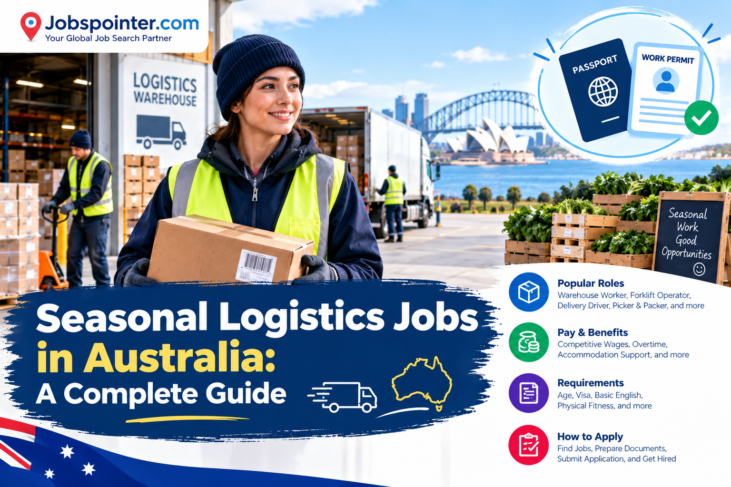
Seasonal Logistics Work in Australia: Everything You Need to Know
Seasonal logistics jobs in Australia, such as warehouse picking, packing, parcel sorting and dispatch, can be a practical way to earn short-term income. The most important point comes first: you can only take this work if your visa gives you the right to work, and not every visa does. This guide explains the job types, pay, hiring periods, how to apply, visa basics, and how to avoid scams.
No employer, agency or website can guarantee you a job, a visa or a fixed income. Use this guide to prepare, then confirm the details with official sources.
Quick answer
- What it is: temporary logistics work that rises when demand rises, for example around major retail sales and holiday shopping.
- Who can do it: people whose visa allows work, plus Australian citizens and permanent residents.
- Pay: set by the applicable award or agreement, never below the National Minimum Wage, which is $26.44 per hour from 1 July 2026.
- First step: use the Home Affairs Visa Finder to see which visa suits your situation. Our guide to work visas for Australia explains the main options.
What Is Seasonal Logistics Employment?
Logistics covers moving goods from suppliers to customers: receiving stock, storing it, picking and packing orders, sorting parcels, and dispatching them. Seasonal logistics employment adds short-term staff when volumes spike. Retail sales periods and holiday shopping typically increase parcel volumes, but timing and headcount differ by employer and location, so treat any pattern as a guide rather than a rule.
Many seasonal roles are casual or fixed-term. That affects pay (casual loading), hours (often variable) and how long the job lasts.
Types of Seasonal Logistics Jobs Available
Warehouse Picker, Packer and Parcel Sorter Roles
These are the usual entry points and are often described as entry-level logistics jobs in Australia.
- Pickers collect items from shelves, often guided by a handheld scanner.
- Packers check, wrap and box orders to a quality standard.
- Parcel sorters scan and route parcels by destination or delivery run.
These warehouse picker and packer jobs in Australia usually involve standing, walking and lifting for long periods, with fast, repetitive tasks.
Inventory, Dispatch and Distribution Centre Jobs
Warehouse assistant and distribution centre roles broaden the mix:
- Warehouse assistants support receiving, put-away and general housekeeping.
- Inventory or stock-control assistants count stock and update systems.
- Dispatch and delivery support staff prepare loads and check paperwork. Seasonal delivery and dispatch jobs may add driver roles with their own licence rules.
Forklift and Licensed Roles
Forklift operator jobs in Australia usually need a valid licence, often called a high risk work licence, issued under state or territory rules. A licence from another country may not be recognised as is. Check the regulator in the state where you will work. Experienced operators may find more choice and sometimes better pay, but a licence does not create work rights.
When Do Seasonal Logistics Employers Recruit?
Demand tends to build ahead of major retail sales and the holiday shopping period, so postings often appear weeks before the busy time. Recruitment schedules differ by employer, region and year. Watch employer career pages and agency listings through the year rather than waiting for one “hiring season”, and treat start dates as unconfirmed until written in a contract.
Skills, Qualifications and Physical Requirements
Australian warehouse job requirements vary, but commonly include:
- Right to work in Australia, which employers must check.
- Physical fitness: standing, repetitive movement, and lifting within safety limits.
- Reliability and speed, plus accuracy with scanning and counting.
- Basic English for safety instructions and labels.
- Safety induction, and sometimes a forklift licence or a White Card for some sites. Confirm what the employer needs [VERIFY by role].
Many entry roles do not need a university degree, but employers may ask for previous warehouse experience.
Seasonal Logistics Salaries and Working Hours
A single fixed figure for a logistics worker salary in Australia would be misleading. Pay depends on the award or enterprise agreement, job classification, age, casual status, shifts, weekends and overtime. The Fair Work Ombudsman is the authority for your exact rate.
| Item | Verified figure (from 1 July 2026) | Notes |
|---|---|---|
| National Minimum Wage, per hour | $26.44 | For adults not covered by an award or agreement |
| National Minimum Wage, per 38-hour week | $1,004.90 | Full-time basis |
| Casual minimum under the National Minimum Wage | $33.05 per hour | Includes the 25% casual loading |
| Award minimum wages | Increased by 4.75% | Applies from the first full pay period on or after 1 July 2026 |
Most warehouse staff are covered by an award, so your real rate may be higher than the National Minimum Wage and can include penalty rates for nights, weekends and overtime. Use the Fair Work pay and conditions tools with the employer’s name and your job duties [VERIFY the exact award for your job]. Compare the rate in your contract to your pay slips each pay period.
Hours can change week to week in casual roles. Ask about typical weekly hours before accepting and plan your budget around lower-hours weeks too.
How to Find Legitimate Seasonal Logistics Vacancies
- Government resources: Workforce Australia lists jobs and employment services.
- Employer career pages: retailers, couriers, third-party logistics providers and distribution centres.
- Licensed recruitment agencies: confirm the agency is a real business with an ABN and a clear contact address.
- Our own listings: see current warehouse and logistics jobs on Jobspointer and our Australia jobs hub.
Prefer the employer’s own website over a re-posted ad. If a vacancy appears only on social media with no company details, treat it with caution.
Step-by-Step Guide to Applying for Logistics Jobs
- Check your visa first. Confirm that it allows work and note conditions such as employer limits or hours caps.
- Prepare a one-page CV focused on reliability, safety, speed, and any warehouse or forklift experience. See our CV tips for overseas applicants.
- Gather documents: passport, visa grant notice or VEVO check, licences, references, and a tax file number (TFN) application if needed.
- Apply through trusted channels and tailor your note to each role.
- Prepare for a short interview or assessment covering availability, safety awareness and physical demands. Our interview guide can help.
- Read the contract fully before accepting: rate, award, hours, location, start date, and deductions.
- Keep records of the offer, contract and pay slips.
Reminder: how to apply for logistics jobs in Australia is simple in theory, but visa status decides whether an employer can legally hire you.
Work Visa Requirements for International Applicants
Temporary work visa requirements depend on your nationality, age, skills and circumstances. A tourist or visitor visa generally does not allow work, so do not assume it does. Start with the official Visa Finder and the Home Affairs list of work visa options.
| Visa situation | Can it support seasonal warehouse work? | Key points to check |
|---|---|---|
| Working Holiday (417) or Work and Holiday (462) | Often yes, for eligible nationals | Usually up to six months with one employer unless an exception applies; check subclass 462 conditions |
| Student visa | Sometimes, within limits | Work hour limits apply; check your visa conditions [VERIFY current limits] |
| PALM scheme | Only for eligible participants | Open only to workers from participating countries with approved employers; see PALM |
| Employer-sponsored visa | Only if the role and employer qualify | Not typical for short seasonal warehouse jobs |
| Citizen or permanent resident | Yes | No visa needed |
| Visitor or tourist visa | No | Work is generally not permitted |
The six-month rule for Working Holiday visas can matter a lot. If you start a seasonal role that could run longer, check whether you may stay with that employer. Home Affairs publishes the detail, and a registered migration agent can advise on your case.
Employer Sponsorship: What Applicants Need to Know
Searches for logistics jobs with visa sponsorship in Australia are common, but sponsorship is not a standard feature of seasonal warehouse work. Employer sponsorship is a formal process with eligibility rules for the employer and the worker, set out in the official employer sponsorship guidance. Sponsorship depends on occupation, skills, employer approval and the visa pathway, and approval is never guaranteed.
Be wary of anyone who:
- promises sponsorship for a fee,
- says a warehouse job automatically leads to a visa, or
- asks you to pay for a “guaranteed” visa.
For advice, use a registered migration agent. Our guide to skilled and sponsored work visas covers the wider picture.
Employment Contracts, Overtime and Worker Rights
Temporary and migrant workers have the same basic workplace rights as other employees in Australia, regardless of visa status. The Fair Work Ombudsman provides free information for visa holders and employees. Check that your agreement states:
- the employer’s legal name and ABN,
- casual, part-time, full-time or fixed-term status,
- the pay rate and the award or agreement that applies,
- how overtime, weekend and night work are paid,
- any deductions and the reason for each, and
- the start and end date, if fixed.
You should receive pay slips and be paid on time. Superannuation rules also apply. From 1 July 2026, employers must pay super at the same time as wages. If something looks wrong, contact the Fair Work Ombudsman. See our guide to workers’ rights in Australia.
Workplace Safety and Warehouse Training
Warehouses involve forklifts, conveyors, manual handling and tight schedules. A good employer will provide an induction, safe-lifting training, PPE (such as safety boots or hi-vis) and clear reporting channels. Safety rules differ by state or territory, so check your regulator or Safe Work Australia. If you cannot understand a safety instruction, ask for clarification before starting the task.
Common Recruitment Scams and How to Avoid Them
Scammers target overseas job seekers because the promise of overseas work is attractive. Check each of these before you pay or share documents:
- The employer is real. Search its ABN on the Australian Business Register.
- No fee for the job itself. Be very careful with anyone charging for a “guaranteed” job.
- Written contract first, with pay, hours and employer name.
- Visa claims are checkable on the Home Affairs site, not just the recruiter’s word.
- Official email domain, not a free webmail address pretending to be a company.
- No pressure to send passport scans or bank details before an offer.
- Pay matches the law, compared with Fair Work rates.
Report suspected scams to Scamwatch. Our job scam warning signs page has more examples.
Frequently Asked Questions
Can foreigners get seasonal logistics jobs in Australia?
Yes, if their visa allows work. Eligibility depends on the visa type and its conditions, not on the job being seasonal.
Are temporary warehouse jobs in Australia open to people with no experience?
Many entry-level roles accept beginners, but some employers prefer experience, and forklift roles need a licence.
Will a warehouse employer sponsor my visa?
Not as a rule for seasonal work. Sponsorship has formal requirements, and nobody can promise it.
How much do seasonal logistics workers earn?
It depends on the award or agreement, hours and casual status. The legal floor for most adults is the National Minimum Wage ($26.44 per hour, or $33.05 per hour for casuals on that rate), and award rates may be higher. Check Fair Work for your exact rate.
Can I work with the same employer for more than six months on a Working Holiday visa?
Only in limited cases. Check the Home Affairs conditions or ask a registered migration agent.
Is the PALM scheme open to everyone?
No. It is limited to eligible workers from participating countries under approved arrangements.
What rights do temporary workers have?
They are generally covered by the same workplace laws as other employees. Contact the Fair Work Ombudsman if you think you are underpaid.
Conclusion
Seasonal logistics work in Australia can be a useful short-term option when your visa permits it. Confirm your work rights, compare pay with Fair Work rates, verify the employer and read your contract before you commit. Then explore current logistics vacancies on Jobspointer and keep checking official sources, because visa and pay rules change.