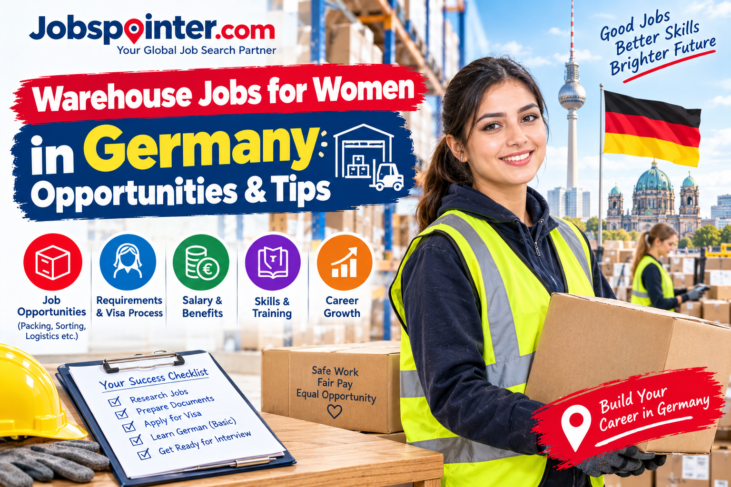
Women Working in Warehouses in Germany: Opportunities and Tips
Warehouse jobs for women in Germany span parcel hubs, supermarket distribution centres, online-shop fulfilment sites and factories. No law limits these roles to men, and the General Act on Equal Treatment protects employees from discrimination. What decides whether a job is realistic is the specific employer, the shift, the language level required and, above all, whether you have the legal right to work in Germany.
This guide covers common roles, requirements, pay factors, working conditions, how international applicants stand, and how to apply without falling for a scam. It makes no promise of a job, visa or income. Listings change daily, so always read each vacancy yourself.
The short answer: If you are a citizen of an EU/EEA country or Switzerland, or already hold a German residence permit that allows work, entry-level warehouse jobs are generally open to you. If you are a non-EU citizen abroad, a standard work visa for an unqualified warehouse role is usually not available, and only a few routes exist.
Why Consider Warehouse Jobs in Germany?
- Many employer types: retailers, logistics firms, e-commerce companies, manufacturers and temporary-work agencies run warehouses.
- Different entry levels: some ads ask for no experience, while others want forklift experience or stock-system skills.
- Progression options: workers can move into inventory control, equipment operation, shift leadership or vocational training.
- Large variation: pay, shifts and facilities differ by region and employer, so do not assume one site is like another.
Types of Warehouse Jobs Available for Women
| Role | German title | What you do | Good to know |
|---|---|---|---|
| Picker and packer | Kommissionierer/in; Versandmitarbeiter/in | Collect items for orders, pack, label, prepare shipments | Often scanner or voice-picking systems; target rates may apply |
| Warehouse associate | Lagermitarbeiter/in; Lagerhelfer/in | Receive, sort, store and dispatch goods | The most common entry-level title |
| Inventory and stock control assistant | Bestandsführung; Inventur | Count stock, scan barcodes, correct records | Attention to detail and basic IT skills help |
| Returns processing assistant | Retourenbearbeitung | Check returned goods, record defects, prepare resale or disposal | Common in e-commerce |
| Forklift operator | Staplerfahrer/in | Move pallets with trucks | Employers normally require training and written authorisation |
| Warehouse team leader | Teamleiter/in Lager | Assign tasks, monitor safety and quality, report to management | Usually needs warehouse experience and stronger German |
| Skilled warehouse worker | Fachlagerist/in; Fachkraft fuer Lagerlogistik | Trained roles with wider duties | Linked to vocational training (check BERUFENET for current training details) |
Browse live postings in our warehouse jobs and logistics jobs sections.
Requirements for Warehouse Jobs in Germany
Requirements differ by vacancy, so treat this as a guide, not a rule.
| Area | What ads commonly say | Reality check |
|---|---|---|
| Age | 18 or older appears in many ads | Check each ad |
| Education | Often none required for helper roles | Team-leader and skilled roles may ask for training |
| Experience | Some ads say “no experience”; others want warehouse or forklift experience | Do not assume every employer accepts beginners |
| German | Ranges from German numbers 0-100 (voice picking) to “German and/or English” to conversational German | Safety instructions are usually given in German, and basic German helps you progress |
| Physical work | Standing, walking, lifting; sampled ads mention up to 15 kg, and one parcel job up to 30 kg | Ask what you will lift and what aids exist |
| Training | Forklift or equipment authorisation | Often provided by the employer |
| Work permission | “EU citizens only” appears in some ads | Always check before applying |
Helpful German words: Schicht (shift), Frueh-/Spaet-/Nachtschicht (early/late/night), Stundenlohn brutto (gross hourly pay), befristet (fixed-term), Probezeit (probation), m/w/d (male/female/diverse, meaning the job is open to everyone).
Salary and Benefits for Warehouse Workers
Germany has a statutory minimum wage of EUR 13.90 gross per hour in 2026, rising to EUR 14.60 on 1 January 2027. At 40 hours a week, EUR 13.90 equals about EUR 2,410 gross a month. Some sectors have higher agreed rates, and some employers pay more.
Gross is not take-home pay. Income tax and social contributions are deducted, and the result depends on tax class, health insurance and other factors. Ask for a sample payslip or a clear net estimate.
| What affects pay | Why it matters |
|---|---|
| Location and employer | Rates vary across regions and companies |
| Experience and duties | Forklift or lead roles may pay more |
| Shift pattern | Night, Sunday and holiday supplements depend on contract or collective agreement |
| Overtime and hours | Check contracted monthly hours and how overtime is paid |
| Agency versus direct hire | Check who your employer is and what the contract says |
Ads sampled during research listed roughly EUR 14.50 to 19 gross per hour, but these are employer claims and not statistics. For occupation-level pay data, use the Federal Employment Agency’s Entgeltatlas and check the date shown.
Working Conditions and Safety for Women
| Topic | What to know and ask |
|---|---|
| Shifts | Early, late, night and rotating shifts are common. Ask for the rota, break rules and how night work is paid |
| Lifting and repetitive tasks | Ask about training, lifting aids and rotation between tasks |
| Protective equipment | Ask whether safety shoes, gloves and vests are provided, and in sizes that fit |
| Facilities | Ask about toilets, changing rooms and lockers at your specific site |
| Pregnancy and breastfeeding | Under the Maternity Protection Act, pregnant and breastfeeding employees generally may not work between 20:00 and 06:00, and employers must adjust risky tasks. Tell your employer so protections can start; see the BMFSFJ guide |
| Harassment or discrimination | The AGG gives employees the right to complain, and employers must act. The Federal Anti-Discrimination Agency offers advice, including free first legal advice (hotline 0800 546 546 5, per the agency’s published details). Write down dates, places and witnesses |
Conditions vary by site, so judge each employer on what it tells you in writing.
Can International Women Apply for Warehouse Jobs in Germany?
Finding a vacancy is not the same as being allowed to take it. Your nationality and circumstances decide.
| Your situation | What it generally means | Where to verify |
|---|---|---|
| Citizen of an EU/EEA country or Switzerland | You can work without a visa | Make it in Germany |
| Non-EU citizen abroad, no vocational qualification or degree | A standard work visa is usually not available. The German embassy site calls the chances very slim | Embassy visa page |
| Experienced worker in a non-regulated profession | A visa based on professional experience exists, with conditions | BAMF; Make it in Germany |
| Citizen of Albania, Bosnia and Herzegovina, Kosovo, North Macedonia, Montenegro or Serbia | The Western Balkans arrangement allows a residence permit for work without a recognised qualification, with a concrete job offer or contract | BAMF |
| Short-term peak-season work | BAMF describes visas for short-term employment of up to eight months with Federal Employment Agency approval. Employers initiate it | BAMF |
| Already living in Germany on a residence permit | Whether you may work depends on your permit. Check the work note on your document or ask your local immigration office | Your immigration authority |
Important: “Warehouse logistics is not a regulated profession” means you do not need formal recognition of a qualification, as the Recognition in Germany portal explains for non-regulated professions. It does not mean every visa route is open or that qualifications never matter.
Before paying an agency or booking travel: use the quick-check on Make it in Germany, confirm your visa category in writing, and be wary of anyone who guarantees a visa. Also see our Germany job listings for roles with stated eligibility.
How to Find Legitimate Warehouse Jobs in Germany
- Search the Federal Employment Agency. Use the Jobsuche with German job titles.
- Check employer career pages and established job portals.
- Use German search terms: Lagerhelfer/in, Kommissionierer/in, Fachlagerist/in, Lagermitarbeiter/in, Versandmitarbeiter/in, Staplerfahrer/in.
- Read each ad closely: location, shift schedule, pay (gross or net), duties and language requirement.
- Ask whether the employer considers applicants who need work authorization. Many say “EU citizens only”.
- Check the recruiter and contract. Temporary-work agencies in Germany generally need a licence from the Federal Employment Agency, so ask to see it.
Example searches: “Lagerhelfer m/w/d [city]”; “Kommissionierer Fruehschicht”; “Lagermitarbeiter ohne Erfahrung”; “warehouse associate English”.
How to Apply for Warehouse Jobs in Germany
- CV (Lebenslauf): one or two pages, reverse chronological, with dates. A photo is optional.
- Highlight: reliability, teamwork, accuracy, shift flexibility and any scanner, stock-system or forklift experience.
- Languages: state your level honestly (for example, German A2).
- Cover letter: keep it to a few lines unless asked, and name the role and location.
- Interview: expect questions on shifts, safety, teamwork and busy periods. Read our CV writing guide and cover letter guide.
Questions to ask the employer
- What is the gross hourly rate, and what are the contracted hours?
- How are night, Sunday and overtime hours paid?
- Is the contract fixed-term or permanent, and who is the employer?
- What training and safety briefing will I receive, and in which language?
- What will I lift, and what lifting aids are provided?
- Are protective equipment, lockers and changing rooms provided?
- If accommodation is offered, what does it cost and is it tied to the job?
Tips for Women Starting a Warehouse Career
- Learn core warehouse German before you start; a few weeks of practice helps with safety.
- Understand the physical duties before accepting; ask for a site visit or trial shift if possible.
- Confirm shifts and transport, since many sites are outside city centres.
- Keep copies of the contract, payslips and messages with the recruiter.
- Plan progression: inventory control, equipment training, team leadership or vocational training.
How to Avoid Warehouse Job Scams
| Warning sign | Why it is a concern |
|---|---|
| Guaranteed job or guaranteed visa | Neither employers nor agencies can guarantee visa approval |
| Fees for recruitment, “registration” or a work permit | Workers should not pay to be recruited; ask for fees in writing and verify them |
| No named employer or contract | You cannot check who is responsible |
| Contact only by WhatsApp or social media | Anyone can post an ad; it is not proof a job exists |
| Accommodation tied to the job with unclear costs | Housing deductions can reduce pay sharply |
| Pay that looks too high or vague (gross or net not stated) | Compare with the statutory minimum wage |
How to check: Find the employer’s official website independently, call its listed number, compare the vacancy with its careers page, and ask for a written contract in a language you understand before you travel. The Federal Employment Agency and Make it in Germany both offer official guidance on job searches and entry rules. For advice on labour rights for mobile workers, see Faire Mobilitaet (confirm languages offered). Our job scam prevention guide gives more checks.
Frequently Asked Questions
Can women work in warehouses in Germany?
Yes. No law reserves warehouse work for men, and the AGG protects employees from discrimination. Suitability depends on the job’s physical tasks, shift pattern and your right to work, not on gender.
Can I get a warehouse job in Germany without experience?
Sometimes. Some employers advertise entry-level roles with on-site training, while others require experience. Read each ad, and be ready to show reliability, attention to detail and shift flexibility.
Do warehouse workers need to speak German?
It varies. Some ads accept English, while others need German numbers or conversational German. Safety information is usually in German, so basic German helps you work safely and move up.
What qualifications are needed for warehouse work?
Helper roles often ask for none, though forklift work needs training and authorisation. Skilled roles may need vocational training. The profession is non-regulated, but immigration rules can still require qualifications.
How much can a warehouse worker earn in Germany?
Pay depends on employer, region, experience and shifts. The legal minimum is EUR 13.90 gross per hour in 2026 and EUR 14.60 from January 2027. Check the Entgeltatlas and ask for gross and net figures.
Can foreigners apply for warehouse jobs in Germany?
Yes, but legal eligibility varies. EU citizens can work freely, while non-EU applicants usually need a qualifying route. Check your nationality and options on Make it in Germany before applying.
Do German employers offer visa support for warehouse jobs?
Do not assume so. Many ads exclude non-EU applicants, and a few routes exist only under conditions. Treat any “guaranteed visa” claim with suspicion and verify it with official authorities.
Are warehouse jobs physically demanding?
Often yes. Expect long periods of standing and walking, lifting and repetitive tasks. Ask about weights, rotation, breaks and equipment, and request a trial or site visit if you can.
Where can I find legitimate warehouse vacancies?
Start with the Federal Employment Agency’s job search, official employer career pages and established portals. Browse Jobspointer’s Germany listings and verify each employer yourself.
What should I check before accepting a warehouse job?
Confirm the employer, written contract, gross pay and hours, shift pattern, training, safety equipment, any fees or housing costs, and your legal right to work. Keep copies of everything.
Conclusion: Start With the Facts, Then the Application
Warehouse jobs for women in Germany can offer a way into logistics, with routes toward inventory, equipment or team-lead roles. The best results come from checking working conditions, asking clear questions about pay and safety, and confirming work authorization before you commit money or travel plans.
Ready to look for openings? Explore current warehouse and logistics vacancies on Jobspointer.com. Listings are published for information, so check each employer, requirement and application detail yourself.