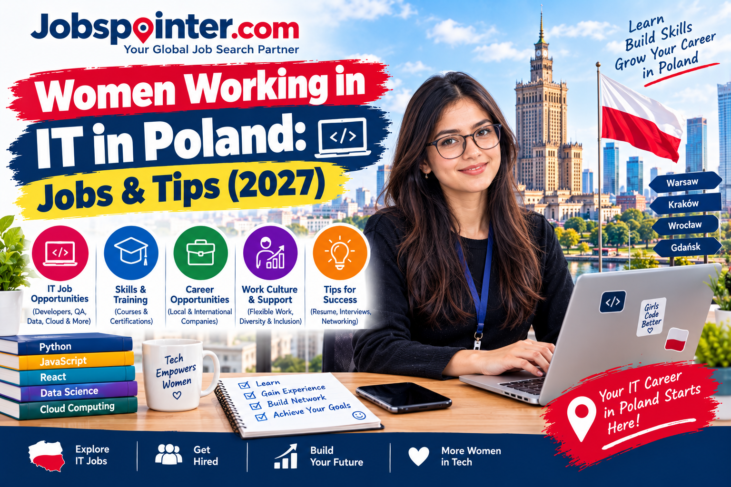
Women Working in IT in Poland: Opportunities, Salaries & Career Tips (2027)
Women working in IT in Poland can find roles in software development, testing, data analysis, cybersecurity and product work, and international applicants can work legally if an employer in Poland sponsors the right permit. Poland has a large tech sector with many international employers, but women are still a minority in technical roles, and no guide can promise you a job or a visa. This article explains where the opportunities are, what the money looks like, which work authorization routes exist, and how to search safely.
The figures here were checked against pages available in October 2026. Immigration rules and salary thresholds change every year, so confirm anything time-sensitive on the official sites linked in each section.
Where the opportunities are for women in technology in Poland
Poland’s IT jobs for women appear across several kinds of employers. Large international companies run engineering and support centres in Warsaw, Kraków, Wrocław, Gdańsk and Poznań. Product companies in e-commerce, gaming, fintech and health technology hire developers and analysts. Banks, consulting firms and shared-service centres hire data, testing and cybersecurity staff.
Women are underrepresented in technical roles across the European Union. Eurostat reported that women made up about 19% of employed ICT specialists in the EU in 2022, and that ICT specialists were only 3.6% of Poland’s workforce that year, one of the lowest shares in the EU. The Polish share of women is not stated in that release, and figures quoted elsewhere (about 30% to 36%) come without a primary source, so treat any single percentage with caution. [Verify with Eurostat dataset isoc_sks_itsps before quoting a Polish figure.]
The practical meaning: demand for skills is real, but you may be the only woman on a team. Many employers and communities now run programmes to change that, and we cover them below.
Common IT roles and how to enter them
| Role | Typical entry route | Notes for international applicants |
|---|---|---|
| Software developer (software engineer jobs in Poland) | Degree or portfolio, plus one main language such as Java, Python, C# or JavaScript | English-speaking teams are common in international companies |
| QA and test engineer | Testing certificates, manual testing experience, then automation | Often the easiest way into a first IT role |
| Data analyst (data analyst jobs in Poland) | SQL, Excel, a BI tool such as Power BI, and a small portfolio | Polish is sometimes needed for local business clients |
| Cybersecurity analyst (women in cybersecurity in Poland) | Networking basics, security fundamentals, entry certifications | Often needs some prior IT or support experience |
| Business or systems analyst | Degree plus domain knowledge in finance, retail or logistics | Good route if you are changing careers |
| Product or project manager | Prior delivery experience in tech or business | Usually needs stronger Polish or a client-facing record |
This table is general guidance, not a job list. Check live listings for current requirements.
Communities that help women build a network
Networking matters in a small, competitive market. Several groups run events, mentoring and meetups for women in tech in Poland, including Geek Girls Carrots, Girls Who Code, PyLadies and Women in Machine Learning and Data Science chapters, according to a regional recruiter’s overview. Event dates and chapters change, so check each group’s own website before planning to attend. Adding one or two communities to your plan also gives you contacts who can refer you to employers.
Skills employers look for
Employers in Poland generally weigh demonstrated skills heavily, and many hire people without a computer science degree if they can show practical work. Build a short, visible portfolio around these areas:
- One main programming language, plus Git and basic testing habits.
- SQL and a data tool if you target data analyst jobs in Poland.
- Cloud basics (AWS, Azure or Google Cloud) and DevOps tools for infrastructure roles.
- Security fundamentals for cybersecurity entry roles.
- Clear written English; Polish is a plus and sometimes a requirement for client-facing roles.
What IT pays: IT salaries in Poland
IT is among Poland’s better-paid sectors, but published figures vary a lot. The ranges below combine two commercial salary pages for 2026 and show gross monthly pay under an employment contract (umowa o pracę). They are indicative, not official statistics.
| Level | Gross monthly pay, employment contract (PLN) |
|---|---|
| Junior (0 to 2 years) | about 6,000 to 13,000 |
| Mid (2 to 5 years) | about 12,000 to 25,000 |
| Senior (5+ years) | about 18,000 to 40,000 |
Sources disagree on where each band sits, and pay depends on city, company, technology and negotiation. Many Polish developers also work on B2B contracts (self-employed invoicing), which can raise take-home pay but gives no paid leave or standard employee protections. Importantly for non-EU applicants, a B2B contract does not qualify for the EU Blue Card (see below). This guide did not find a reliable figure for the gender pay gap in Polish IT, so ask recruiters for the pay band of the role and compare it against several sources.
[Internal link: Jobspointer guide to cost of living and taxes in Poland]
Work authorization: IT jobs in Poland for foreigners
What you need depends on your passport.
- EU, EEA and Swiss citizens can work in Poland without a work permit.
- Most other non-EU citizens need permission to work before they start. The standard route is a Type A work permit, applied for by the employer through the praca.gov.pl portal, plus a national visa or residence permit to enter and stay. A work permit alone does not give a right to residence.
- Citizens of some countries, such as Ukraine, Belarus and Georgia, have simplified or special procedures; check the rules for your nationality.
Type A work permit: the usual route for IT jobs with visa sponsorship in Poland
There is no single “visa sponsorship” scheme. In practice the employer files the permit application, and you apply for the visa or residence document that matches it. Key points from advisory sources, which you should confirm on official pages:
- The permit is issued for a specific employer and position, usually for up to three years.
- Since 1 June 2025 the labour market test (employers proving no local candidate was available) is reported as abolished, and applications run online.
- Pay must be at least the national minimum wage and no lower than comparable local employees.
- Processing times range from several weeks to a few months depending on the voivodeship office. Changing employers normally needs a new permit.
Ask any employer who offers you a job: “Will you apply for the work permit, and who pays the fees?” A legitimate employer will answer clearly.
EU Blue Card for highly qualified IT professionals
The Blue Card suits experienced developers and specialists with higher salaries. Applications filed in 2026 need a gross salary of at least PLN 13,355.34 per month, which is 150% of the 2025 average wage published by Statistics Poland (GUS). Only the base salary counts, and the contract must be an employment contract, not B2B. Requirements also include higher education or equivalent professional experience, and the minimum contract length was reported as six months after the 2025 reform, though older sources say one year. The threshold changes yearly, so a 2027 filing will use a new figure after GUS publishes the 2026 average, expected around February 2027. A Blue Card offers more flexibility to change employers and to move within the EU than a standard permit.
Official starting points: the Office for Foreigners (gov.pl/web/udsc), the work permit portal (praca.gov.pl) and Statistics Poland (stat.gov.pl).
How to get an IT job in Poland: step by step
- Choose a target role and city. Pick one role from the table above and one or two cities. Warsaw, Kraków, Wrocław, Gdańsk and Poznań have the most international employers.
- Check your work authorization route. Decide whether you need a Type A permit, a Blue Card or neither, based on your passport and salary level. Read the official pages first.
- Prepare an English CV and portfolio. Keep the CV to one or two pages, list technologies near the top and link to code or projects. Add a short GDPR consent line, which Polish recruiters often expect.
- Search legitimate sources. Use employer career pages, established job boards such as No Fluff Jobs, Just Join IT and LinkedIn, and the jobs section of Careers in Poland. Filter for English as the working language.
- Ask about the permit early. In the first call, ask whether the company has hired non-EU staff before and who files the permit.
- Prepare for a technical interview. Expect a recruiter call, a technical task or live coding, and a team interview. Practise explaining your reasoning aloud.
- Compare offers carefully. Check contract type, probation period, notice, leave, health cover and relocation support. Remember a B2B contract cannot support a Blue Card.
If you are starting out: entry-level IT jobs in Poland
Entry-level roles exist in testing, support, junior data analysis and junior development, but competition is strong and some junior postings ask for Polish. Internships, bootcamp projects and open-source contributions help. If you are a student, look for trainee programmes at large companies, which often run in English. A work permit for a junior role still requires an employer willing to sponsor, so apply to international firms that already hire foreigners.
Remote IT jobs in Poland and English-speaking IT jobs in Poland
Remote roles exist, but a remote job for a Polish employer does not remove the need for legal work and residence status if you will live in Poland. If you work from abroad for a Polish company, tax and contract rules depend on your country, so get advice. For English-speaking IT jobs in Poland, target multinational firms, shared-service centres and startups with international teams, and read each posting to see whether Polish is required.
Career tips for women in IT in Poland
- Ask about team makeup, mentoring and promotion paths in interviews. These show how an employer treats women in technology.
- Join one community and attend at least one event before applying; referrals often move CVs forward.
- Negotiate pay using ranges from several sources and your expected gross monthly figure, not only the offer.
- Keep a record of your achievements for performance reviews.
- If you face unfair treatment, document it and use HR or, in Poland, the National Labour Inspectorate; seek legal advice for serious cases.
How to avoid job scams
- Never pay a recruiter or “agency” fee for a promised job or permit. Employers file work permits.
- Check that the company exists, has a verifiable website and email domain, and appears on its own careers page.
- Be wary of offers with no interview, unrealistic pay or requests for passport copies before a contract.
- Confirm contract terms in writing before you resign or travel.
Frequently asked questions
Do I need to speak Polish to work in IT in Poland?
Not always. Many international employers work in English, but Polish helps in client-facing and local-business roles and in daily life.
Can foreign women get IT jobs in Poland with visa sponsorship?
Some employers hire from abroad and file permits, but there is no guarantee, and the employer decides. Apply to companies that already employ foreign staff.
What is the minimum salary for the EU Blue Card?
For applications filed in 2026, PLN 13,355.34 gross per month, based on the GUS average wage. It changes each year.
Can I get a Blue Card on a B2B contract?
No. Advisory sources agree it needs an employment contract.
Are there remote IT jobs in Poland for people living abroad?
Yes, but legal status, taxes and contract type depend on where you live; check before accepting.
Is a degree required?
Not always for development roles, but a Blue Card needs higher education or equivalent experience, and the experience requirement should be checked on the official pages.