Job Fair Guide: How to Prepare and Stand Out in the UK
A job fair is one of the few places where you can meet several employers in one day, ask real questions and put a face to your CV. It is not a shortcut to a job. Meeting a recruiter does not guarantee an interview, an offer or permission to work in the UK. What it does give you is a head start on research, contacts and a stronger application afterwards.
This UK job fair guide follows the journey in order: choose a fair, research employers, prepare your CV and introduction, make a good impression on the day, and follow up properly. It also explains what international job seekers need to check first.
Quick answer: how do I prepare for a job fair in the UK?
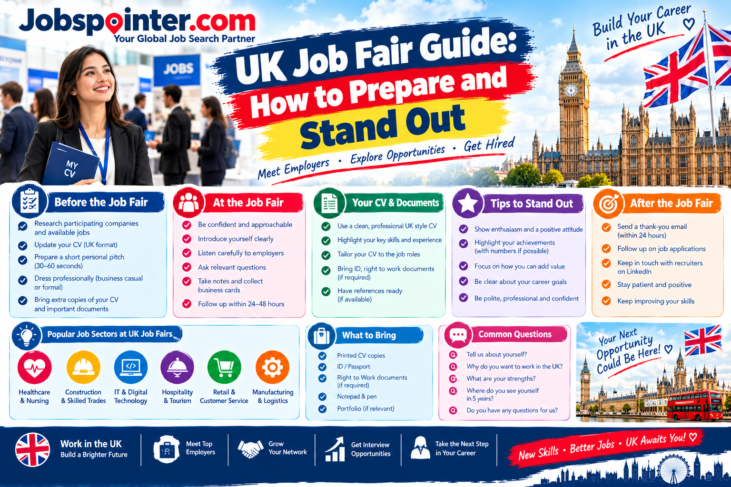
- Research the employers attending and pick five to eight priorities.
- Tailor your CV to the roles you are interested in, and keep a digital copy.
- Prepare a 30–60 second introduction and two or three questions per employer.
- Plan the practical details: registration, clothing, travel, notebook and documents.
- Follow up within a few days and apply through the employer’s official website.
1. What Is a Job Fair and How Does It Work in the UK?
The National Careers Service explains that careers fairs are also called job fairs or recruitment events. Employers and organisations set up stands, and you walk around, talk to representatives and learn about roles and application routes. Some fairs run in person, and others take place online.
| Type | What it is like | Best for |
|---|---|---|
| In-person general fair | Many employers in one venue; short conversations | Exploring options, first-time attendees |
| Graduate or university fair | Run by a university; focus on graduate schemes, placements and internships | Students and recent graduates |
| Industry-specific fair | Healthcare, engineering, technology, construction, hospitality and similar | People with a clear career target |
| Virtual fair | Chat, video sessions, employer profiles, webinars | Remote applicants and busy schedules |
Who should attend? Graduates, career changers, people returning to work and experienced professionals can all benefit. International job seekers can attend where the event allows it, but should read the eligibility section below first.
What employers and agencies usually offer: information about vacancies and application routes, advice on skills, and sometimes on-the-spot conversations. Do not expect a job offer at a stand.
2. Find the Right UK Job Fair for Your Career Goals
The National Careers Service says you can hear about local fairs through your school, college or university, your local Jobcentre Plus, and social media posts about work in your area. Prospects notes that universities hold careers fairs throughout the year, with many in the autumn, and that some are general while others focus on areas such as law, engineering or IT (see Prospects; the article is older, so confirm current dates).
Where to look
- Your university careers service, if you are a student or recent graduate
- Jobcentre Plus and local council employment pages
- Industry bodies and professional associations in your field
- Employer career pages that list recruitment events
Before you register, check:
- The organiser’s name and a working website.
- The list of exhibiting employers, and whether those employers also mention the event on their own sites.
- Registration rules, dates, venue and whether the event is open to people outside the host university.
- That you are not asked to pay to meet employers or to be “guaranteed” a job.
If you are exploring a specific sector, start with related Jobspointer guides such as airport jobs in the UK, then browse current UK job listings.
3. Research Employers Before Attending
The National Careers Service advises you to research the companies attending, decide who you want to speak to, and plan questions for them. A simple research sheet makes this fast:
| Employer | Roles that fit me | Requirements I meet | Gap to ask about | My question |
|---|---|---|---|---|
| (name) | (job titles) | (skills, qualifications) | (experience, licence, language) | (one specific question) |
What to look for
- Current vacancies and entry requirements on the company website
- Graduate or trainee schemes, if you are early in your career
- Whether the employer mentions visa sponsorship, and for which roles
- Recent company news you can mention naturally
If you need sponsorship, check whether an employer appears on the GOV.UK register of licensed sponsors. Being on the register means the employer is licensed. It does not mean every vacancy is sponsored.
4. Prepare a UK-Style CV for the Job Fair
The National Careers Service tells job seekers to tailor the CV to the job, remove out-of-date information and check contact details. For a job fair, that means preparing a main CV and one or two versions aimed at your target role types.
What to include
- Name, phone number, professional email address and city or region
- A two to three line profile that matches the role
- Work experience in reverse order, with achievements rather than a list of duties
- Education, qualifications and relevant training
- Skills that match the roles you are targeting
What to leave out: a photograph, date of birth and other personal details that are not needed at this stage. This is common UK practice rather than a legal rule, so follow any instruction in a specific employer’s advert.
CV checklist for fairs
- Keep it to a clear one to two pages.
- Use a simple layout that is easy to scan and prints well.
- Save a PDF copy on your phone and in cloud storage for virtual events.
- Print several copies in case a recruiter asks for paper.
Need help getting started? Use our step-by-step guide on how to write a UK CV, build one with the Jobspointer resume builder, and read our UK cover letter examples for the application you will send afterwards.
5. Prepare a Strong Personal Introduction
Recruiters may speak to dozens of people, so a short introduction helps. Aim for 30 to 60 seconds: who you are, what you have done, what you are looking for, and why this employer.
Simple formula: Present → Past → Future → Why them.
Example for a graduate (sample only, adapt to your own facts):
Hello, I’m Amira. I’ve just finished a BSc in Business Management and completed a placement in customer operations. I enjoy solving problems and working with data. I’m looking for a graduate role in operations or logistics, and I noticed your graduate scheme. Could you tell me what you look for in applicants?
Example for an experienced professional (sample only):
Hi, I’m David. I have eight years of experience in warehouse supervision, most recently managing a team of fifteen. I’m now looking for a team-leader role in distribution. I’ve read about your new site, and I’d like to understand which skills matter most for your supervisor roles.
Tailor the last sentence for each employer. Practise out loud until it sounds natural, not memorised.
6. Choose Professional Clothing and Essential Documents
What to wear: Choose smart, comfortable clothes that suit the sector. Business casual is a safe choice for most fairs, and more formal for finance, law or corporate roles. Comfortable shoes matter, because you may stand and walk for hours.
What to bring
| Bring | Why |
|---|---|
| Printed CV copies | Recruiters may ask for paper |
| Notebook and pen | Record names, advice and deadlines |
| Phone with digital CV and certificates | Easy to share when asked |
| Your research sheet and questions | Keeps you focused |
| Certificates (copies) | Only if the event or employer asks |
| Water and a small bag | You may be there for several hours |
What not to carry unnecessarily: original passports, visa documents and other sensitive papers are usually not needed for an initial conversation. Keep them safely at home unless the organiser specifically asks for ID at entry.
For virtual fairs, organise your files in one folder: CV, cover letter, certificates and a short portfolio link if relevant.
7. How to Make a Strong First Impression at a Job Fair
- Approach confidently and politely. Smile, greet the recruiter, and wait if they are speaking to someone else.
- Listen as much as you talk. Let the recruiter explain, then answer concisely.
- Show specific interest. Mention a role, project or programme you read about.
- Respect time limits. Keep it short when queues are long, and offer to follow up by email.
- Avoid asking what the website already says. Use the conversation for things you cannot easily find online.
- Take notes straight after. Write down the recruiter’s name, advice and any deadline.
Sample conversation
You: Hello, I’m Priya. I’m looking at your customer service advisor roles. I’ve got two years of call-centre experience. Recruiter: Good to meet you. We hire in waves, so please apply online. You: Thank you. Which skills matter most when you shortlist for that role? Recruiter: Clear communication and being comfortable with systems. You: That’s helpful. May I take your name so I can mention our conversation when I apply?
8. Smart Questions to Ask UK Recruiters
| Question | Why it works |
|---|---|
| Which skills matter most for this role? | Shows you want to match their needs |
| What does your recruitment process involve? | Helps you plan assessments and interviews |
| Are there entry-level or graduate opportunities? | Useful for freshers and career changers |
| What training and career development do you offer? | Shows long-term interest |
| Where can I find current vacancies and apply? | Gets the official route |
| Do you consider applicants who need visa sponsorship for this role? | A fair, direct question for international applicants |
Ask the visa question once, politely, after you have shown your interest in the role. Do not ask a recruiter to promise sponsorship.
9. How International Job Seekers Can Prepare for UK Job Fairs
Attending a job fair does not give you permission to work in the UK. Your right to work depends on your immigration status and, in many cases, on having a job offer from the right employer.
Checklist for overseas applicants
- Check whether the event accepts international attendees. Some university fairs are for enrolled students and graduates only.
- Understand your status. Use GOV.UK’s Check if you need a UK visa tool and read the conditions of your own visa.
- Research sponsorship rules. For the Skilled Worker route, GOV.UK explains that you need a job offer from an approved employer before you apply, and the employer must be on the licensed sponsor register. The job itself must also be eligible.
- Know how right-to-work checks work. GOV.UK explains how to prove your right to work to an employer, including online share codes for many people with digital status.
- Explain overseas qualifications clearly. Put the country, institution, level and dates on your CV, and be ready to say what the qualification covers.
- Be honest about relocation and start dates.
| Your situation | What to say at the stand | What not to do |
|---|---|---|
| Already have the right to work | Mention it briefly if asked | Do not offer passport photos or scans on the spot |
| Will need sponsorship | Ask whether the role is sponsored | Do not demand a promise of sponsorship |
| Not sure of your status | Say you are checking and ask about the process | Do not guess or exaggerate |
10. Networking Tips for In-Person and Virtual Job Fairs
In person
- Collect business cards or note names and roles.
- Ask permission before connecting on LinkedIn, and add a short personalised note.
- Talk to other attendees too, since they may share useful leads.
Virtual
TARGETjobs notes that virtual fairs depend more on written communication, so messages should be professional and written in full sentences. Join employer sessions, use any CV clinics, and test your camera and internet beforehand. If you are called for a video chat, read our guide on video interviews with overseas employers.
Keep a contact log
| Name | Employer | Date | What we discussed | Next step and deadline |
|---|---|---|---|---|
Build relationships without pressure. Share thanks, ask for advice, and respect a “please apply online” answer. Repeatedly asking for a job offer usually backfires.
11. What to Do After the Job Fair
| When | Action |
|---|---|
| Same day | Write notes while the conversation is fresh |
| Within 1–3 days | Send a short, personalised thank-you message (common practice, not a rule) |
| Within the employer’s deadline | Apply through the employer’s official recruitment portal |
| In your application | Mention the fair and what the recruiter told you |
| Ongoing | Track deadlines, status and follow-ups |
Sample follow-up message (adapt it):
Dear Ms Clark, thank you for speaking with me at the [event name] on [date]. I enjoyed learning about your graduate operations programme. I have applied through your careers portal and attached my CV. I would welcome any advice on next steps. Kind regards, [Name]
Prepare for assessments and interviews early. Our interview tips for international jobs can help, and you can upload your CV to Jobspointer while you apply elsewhere.
12. Common Job Fair Mistakes to Avoid
- Arriving without researching employers.
- Using one generic CV for every role.
- Skipping your introduction. Rambling at the stand wastes a short window.
- Asking for a guaranteed job or sponsorship.
- Sharing sensitive documents with unverified recruiters. Be cautious with passport scans, bank details and national insurance information.
- Paying anyone for a job or a stand-by “guaranteed” interview. DWP’s Find a job service warns that if a job looks too good to be true, it probably is. Take Five also advises you to research a recruiter and pause before sharing personal information.
- Not following up.
For more on avoiding fake offers, read how to find jobs abroad safely.
13. UK Job Fair Preparation Checklist
Save or print this list.
- Register for the event and check entry requirements.
- Research employers and target vacancies.
- Update and print the right CV versions.
- Practise a concise personal introduction.
- Prepare questions for recruiters.
- Plan clothing, transport and arrival time.
- Check your right to work or sponsorship position (international applicants).
- Prepare a contact log and follow-up notes.
- Note application deadlines.
Frequently Asked Questions
What should I bring to a job fair in the UK?
Printed CV copies, a notebook and pen, your research sheet, and a phone with a digital CV. Take copies of certificates only if requested. Leave original passports at home unless the organiser asks for ID.
Do I need to register before attending a UK job fair?
Many fairs ask you to register in advance, and some are limited to students or invited groups. Check the organiser’s page for rules.
Can you get hired at a job fair?
Sometimes you may be invited to an interview, but most employers ask you to apply through their official process. A fair conversation is not a job offer.
How many CV copies should I take?
Enough for your priority employers plus a few spares. Ten to fifteen is a common rule of thumb, but adjust to the size of the event. This is general advice rather than an official figure.
What should I say when approaching a recruiter?
Greet them, give your name, state the role you are interested in and one relevant strength, then ask a specific question.
Can international job seekers attend UK job fairs?
Often yes, but some events are restricted. Check the event page, and remember that attending does not give you the right to work.
Do UK employers offer visa sponsorship at job fairs?
Some employers recruit international candidates, but sponsorship depends on the employer’s licence, the specific role and your eligibility. Ask politely, and confirm details on GOV.UK.
How soon should I follow up after a job fair?
A short message within one to three days is a common approach. Apply through the official portal before the deadline.
Conclusion: Turn Job Fair Conversations into Career Opportunities
Preparation is what separates a forgettable chat from a useful one: research, a tailored CV, a clear introduction, thoughtful questions and a prompt follow-up. Keep your expectations realistic. A fair opens a door, but your application and your right to work decide what happens next. International applicants should check GOV.UK for their own situation before making plans.
When you are ready to apply, browse current UK vacancies on Jobspointer, and always check each employer’s eligibility requirements.