
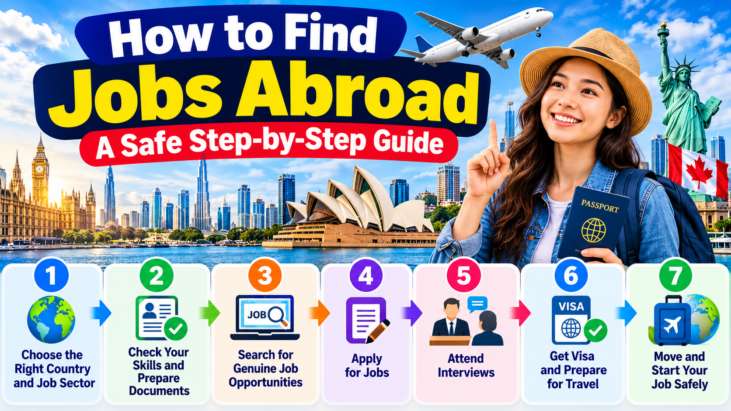
How to Find Jobs Abroad: A Practical, Scam-Aware Guide for International Job Seekers
Finding a job in another country is mostly a matter of searching in the right places and checking every claim before you act. This guide explains how to find jobs abroad through official channels, how to separate a job offer from permission to work, and how to spot recruitment scams before they cost you money.
Last researched: 16 October 2026. Immigration rules change. Always confirm current requirements on the official government page for your destination before you apply.
Key takeaways
- A job offer is not a work permit. In most countries you need separate legal permission to work, and a job offer does not automatically grant it.
- Start with official sources. Government job portals, public employment services and official sponsor lists are more reliable than social media posts.
- Never pay to get a job. The International Labour Organization’s fair-recruitment guidelines say workers and jobseekers should not be charged recruitment fees or related costs.
- Sponsorship is employer-specific. Being on a government sponsor list shows that an employer is allowed to sponsor. It does not mean they are hiring you, or that a given vacancy is sponsored.
- Verify before you commit. Check the employer, the contract and the visa route independently.
Contents
- Decide where and what to target
- Where to look for genuine overseas vacancies
- Job offer, sponsorship, work permit and visa: what’s the difference?
- How different countries handle it (verified examples)
- Step-by-step action plan
- How to verify an employer or recruiter
- Common mistakes
- Frequently asked questions
- Conclusion
1. Decide where and what to target
Applying to “any job, any country” rarely works. Narrow your search first:
- Your occupation and level. Skilled and regulated jobs (nursing, engineering, trades) often have clearer legal routes than general roles.
- Your qualifications. Some professions need local licensing or recognition of your foreign qualifications before you can work.
- Language. Check what language the workplace actually requires, not just what the job advert says.
- Legal route. Ask which route you could realistically qualify for: employer sponsorship, a points-based or job-search visa, a regional scheme, or free movement within a trading bloc.
- Total cost. Compare salary against rent, tax, health cover and the cost of the visa application itself.
Pick two or three destinations and research them properly instead of spreading yourself across twenty.
2. Where to look for genuine overseas vacancies
Use several channels, and treat official ones as your anchor.
| Channel | Best for | Main caution |
|---|---|---|
| Government job portals (for example Canada’s Job Bank) | Verified-employer listings, labour-market information | Not every posting accepts foreign applicants, so read the posting |
| Public employment networks (for example EURES in Europe) | Vacancies and adviser support across EU/EEA countries | EURES is designed around free movement within the EU/EEA, Switzerland, Iceland, Liechtenstein and Norway, so it suits some nationalities more than others |
| Official sponsor registers (for example the UK’s Register of Licensed Sponsors) | Building a target list of employers allowed to sponsor | Being listed does not mean the employer is hiring or sponsoring now |
| Employer career pages | Direct, trustworthy applications | You must still check whether the role is open to people who need a visa |
| Professional networks and industry bodies | Roles in your field, referrals | Verify any recruiter who contacts you |
| General job boards | Wide reach | Fake postings exist, so verify the employer before sharing documents |
Example: Canada. The Government of Canada’s Job Bank is the national employment service, offered as a website and mobile app and delivered by Employment and Social Development Canada. Search results can be filtered, and employers in some cases state whether they accept applicants who need a work permit.
Example: Europe. EURES is a cooperation network of public employment services covering the 27 EU member states plus Switzerland, Iceland, Liechtenstein and Norway. It offers a job mobility portal, information on living and working conditions, and a network of advisers you can contact.
Example: UK. The Home Office publishes the Register of Licensed Sponsors for workers as a downloadable spreadsheet on GOV.UK. Use it to check whether an employer holds a sponsor licence and for which routes. It does not tell you who is actively recruiting.
You can also browse vacancies on the Jobspointer job listings page. As with any listing, confirm the details with the employer’s official website before applying.
3. Job offer, sponsorship, work permit and visa: what’s the difference?
These terms are often used as if they mean the same thing. They don’t.
| Term | What it means |
|---|---|
| Job offer | An employer’s offer of work. It does not by itself give you legal permission to work abroad. |
| Sponsorship | An employer supporting your immigration application. Usually only employers approved by the government can do this. |
| Work permit / work authorisation | The legal permission to work in a country, often tied to a specific employer or occupation. |
| Visa | Permission to enter (and sometimes stay in) a country. Depending on the country, work permission and entry permission may be separate or combined. |
Canada’s immigration authority states plainly that a work permit on its own is not a job offer, even an open work permit. Its employer guidance also notes that candidates with a job offer do not automatically receive a work permit while an application is processed. The reverse also applies: a job offer does not grant permission to work.
4. How different countries handle it (verified examples)
These examples show how much routes differ. They are not a complete list of options, and requirements change, so always check the official page.
Canada
- Most employers hiring a foreign worker for a job that needs a Labour Market Impact Assessment (LMIA) must apply for one through Employment and Social Development Canada. Some jobs are exempt.
- IRCC states that for Express Entry, a job offer in most cases must be supported by an LMIA, with listed exceptions.
- Search the official Job Bank, and read each posting for whether the employer is open to hiring foreign workers.
United Kingdom
- Employers must hold a sponsor licence to sponsor workers who need a visa, and licensed employers appear on the official register.
- The register shows the routes each employer is licensed for. An employer licensed only for some routes (for example temporary worker routes) cannot sponsor you on another.
- Licence holders vary in how actively they sponsor, so use the register as a starting list, then check each employer’s own vacancies.
Australia
- Employer-sponsored work visas include the Skills in Demand visa (subclass 482), the Employer Nomination Scheme visa (subclass 186, permanent) and the Skilled Employer Sponsored Regional (Provisional) visa (subclass 494).
- The Australian Border Force states that the Skills in Demand visa replaced the Temporary Skills Shortage visa on 7 December 2024.
- Home Affairs lists the 482 as typically tied to the sponsoring employer and the nominated occupation, with applicants needing 12 months of work experience in the occupation or a related field.
Germany
- Germany’s Opportunity Card (Chancenkarte) has been available since 1 June 2024. It allows eligible non-EU applicants to enter Germany for up to 12 months to look for work, without a job offer.
- German foreign-ministry pages state that holders may work part-time (up to 20 hours per week) and do trial work while searching. Applicants must show they can support themselves financially.
- Eligibility runs through either recognised skilled-worker status or a points system (a minimum of 6 points). The official Make it in Germany portal has a self-check.
- A job offer does not automatically convert the card into a work permit. You may need to apply for a suitable residence permit for work.
EU/EEA
- For citizens of EU/EEA states, EURES supports moving to another member state for work under free-movement rules. Nationals of other countries should check the immigration rules of the specific destination instead.
5. Step-by-step action plan
- Choose two or three target countries and read each government’s official work-visa page.
- Check your route. Ask: Do I need employer sponsorship? Is there a job-search visa? Do my qualifications need recognition or licensing?
- Prepare your documents. Update your CV to local conventions, collect certificates, references and passport details, and keep copies in a secure place. The Jobspointer Resume Builder can help you create a clean CV draft.
- Build a target employer list from official portals, sponsor registers and industry sources.
- Verify each employer (see Section 6) before sending personal documents.
- Apply directly through the employer’s career page or official portal where possible. State your work-authorisation status honestly and ask early whether the role is open to people who need a visa.
- Prepare for video interviews. Test your connection, research the employer, and prepare questions about contract terms, relocation and legal sponsorship.
- Review any offer in writing. Check the job title, pay, hours, location, probation, termination terms and who covers which costs.
- Confirm the legal route with the official immigration authority or a qualified adviser before resigning from your current job or paying for travel.
- Keep records of every application, email and offer.
6. How to verify an employer or recruiter
Before sharing your passport, bank details or paying any fee, check:
- Existence: Does the employer have an official website, a business registration, and a verifiable address and phone number?
- The vacancy: Does the same job appear on the employer’s own career page?
- Sponsor status: Where a register exists (such as the UK sponsor register), is the organisation listed for the right route?
- Recruiter legitimacy: Is the recruiter licensed or registered where your home country or the destination country requires it? Check with the relevant government labour authority (Editor note: add the correct authority for each target country).
- Contract: Is there a written contract that matches the advert, and does it come with a clear explanation of who pays which costs?
- Communication: Be cautious of free email addresses used for official hiring, pressure to decide quickly, or refusal to do a video call.
Fees. The ILO’s general principles for fair recruitment say no recruitment fees or related costs should be charged to workers or jobseekers. National rules vary, so check what your home and destination countries allow. Treat any demand for an upfront “job fee”, “visa guarantee” or “slot booking” payment as a serious warning sign.
Common warning signs of job scams
The US Federal Trade Commission’s guidance on job scams and similar consumer warnings consistently flag these:
- You are asked to pay to get the job, or for training, equipment or placement.
- The offer arrives unexpectedly for a job you never applied for.
- It promises high pay for little work, or guarantees a job or visa.
- You are pressured to act fast.
- You receive a cheque and are asked to send part of the money elsewhere.
- Onboarding requests your bank or identity details before you have verified the employer.
If you suspect a scam, stop contact, keep the messages and report it to your national consumer-protection or police authority.
7. Common mistakes
- Treating a job offer as permission to work. Confirm the work permit route first.
- Assuming a sponsor list means active hiring. It shows eligibility to sponsor, not current vacancies.
- Paying an agent for a guaranteed job or visa. Nobody can guarantee either.
- Using one generic CV everywhere. Adjust format, length and keywords for each country and role.
- Ignoring licensing or qualification recognition. Regulated professions often need it before you can work.
- Not checking the total cost of moving. Include visa fees, health cover, rent deposits and the cost of living.
- Relying on old information. Rules, fees and thresholds change, so use current official pages.
8. Frequently asked questions
Can I get a job abroad without a visa?
You generally need legal permission to work in the country. Some people have it through free movement (for example within the EU/EEA for citizens of member states), a work-and-travel scheme, or another route. Most others need a work permit or visa.
Do I need a job offer before I apply for a work visa?
Often yes, especially for employer-sponsored routes. Some countries offer job-search routes instead. Germany’s Opportunity Card, for example, allows eligible applicants to enter and search for work for up to 12 months without a job offer. Check the specific route.
Does a job offer guarantee a work permit?
No. A job offer may be one requirement, but the immigration authority decides the application.
How can I tell if a company can sponsor visas?
Where a government register exists, check it. In the UK, the Register of Licensed Sponsors lists licensed employers and their routes. Then confirm directly with the employer that the specific role is sponsored.
Should I pay a recruitment agency?
Be very cautious. ILO guidelines say workers should not bear recruitment fees or related costs. Check the rules in your home and destination countries, and never pay before verifying the agency and receiving a written contract.
What is the best website to find jobs abroad?
There is no single best site. Combine official portals (such as Canada’s Job Bank or EURES), employer career pages and professional networks for your field.
How long does it take to find a job abroad?
No reliable universal timeline exists, because it depends on your occupation, destination, qualifications and visa processing times. Check official processing-time tools for the visa you need.
9. Conclusion
The safest way to find a job abroad is to use official sources first, understand which legal route fits you, and verify every employer and recruiter before you share documents or money. Your next step is to choose one target country and read its official work-visa page this week. Then build a shortlist of employers you can verify.
This guide is general information, not legal or immigration advice. Always confirm current rules with the official immigration authority or a qualified professional.
| Anchor text | URL | Status |
|---|---|---|
| Jobspointer job listings | https://jobspointer.com/job-openings/ | Verified (live in site navigation) |
| Jobspointer Resume Builder | https://jobspointer.com/resume-builder/ | Verified (live in site navigation) |
| Jobspointer FAQ | https://jobspointer.com/faq/ | Verified (linked from homepage) |