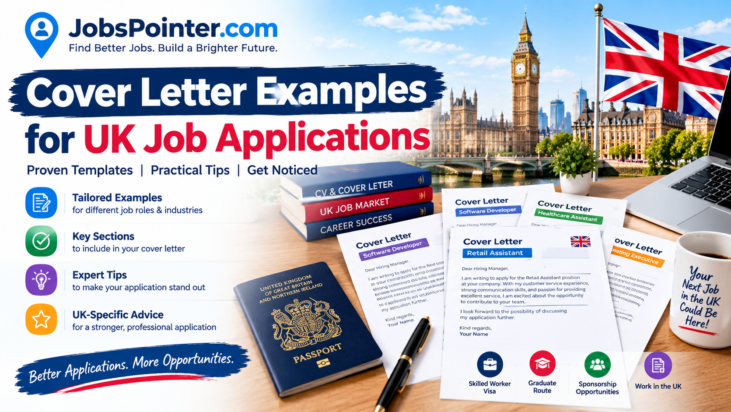
Cover Letter Examples for UK Job Applications
A good cover letter can be the difference between a CV that is skimmed and one that is read properly. This guide gives you cover letter examples for UK job applications that you can adapt, plus the formatting rules, a reusable template and a pre-send checklist. Every example is fictional and clearly marked, so you can see the structure without copying someone else’s story.
In short: UK cover letters are usually one page, three to five paragraphs, addressed to a named person where possible, and tailored to the specific job. Use “Yours sincerely” if you know the name and “Yours faithfully” if you start with “Dear Sir or Madam”.
What Is a Cover Letter for a UK Job Application?
A cover letter introduces you to an employer and asks them to consider your application. The National Careers Service describes it as a short letter, usually three to five paragraphs long (National Careers Service). In the UK you will also hear it called a covering letter. The two terms mean the same thing.
Cover Letter vs CV: What Is the Difference?
Your CV lists what you have done. Your cover letter explains why that experience fits this job.
| CV | Cover letter | |
|---|---|---|
| Purpose | Summarise your history, skills and qualifications | Show why you suit this role and this employer |
| Format | Structured sections, often two pages | Short letter, usually one A4 page |
| Tailoring | Adjusted lightly for each job | Rewritten for every job |
| Tone | Factual and concise | Professional but personal |
University careers services make the same point: the CV should relate to the type of work, while the covering letter should relate to the particular job (University of Dundee Careers Service).
When Should You Include a Cover Letter?
- When the advert asks for one. Always follow the employer’s instructions.
- When you apply with a CV. The National Careers Service advises including a cover letter whenever you apply for a job using a CV.
- When you send a speculative application. If you are contacting an employer with no advertised vacancy, a letter explains why you are writing.
- When the online form has no upload box. Some university guidance says a separate letter is less necessary if your CV goes into an online portal or recruitment site (University of Aberdeen Careers Service). In that case, use any “supporting statement” box to make the same points.
There is no UK law requiring a cover letter. Whether you need one depends on the employer, so treat this as general guidance and follow each advert.
How to Format a UK Cover Letter
Contact Details and Date
- Put your name, address, phone number and email at the top. Make sure the details match your CV.
- Add the date in full, day then month then year, with no commas (for example, 19 October 2026).
- Add the recipient’s name, job title and company address if you have them.
- Services differ on layout: some place your address top right, others align everything left. Pick one layout and stay consistent.
If you upload the letter to an online application, some careers services say you can leave out the address blocks, but keep your name and contact details.
Professional Greeting and Job Reference
Address the letter to a named person whenever you can. Check the advert, the company website or LinkedIn.
| Situation | Greeting | Sign-off |
|---|---|---|
| You know the name | Dear Ms Patel | Yours sincerely |
| You do not know the name | Dear Sir or Madam | Yours faithfully |
This rule is consistent across the National Careers Service and several university careers services. Add a bold subject line, such as Application for Retail Assistant (Ref: RA-102), so the reader sees at once what the letter is about. Always quote any reference number from the advert.
Opening Paragraph, Main Body and Closing
A reliable four-part structure:
- Opening: the job title, where you saw it and one line on why you are a good match.
- Skills and experience: two or three of the employer’s key requirements, each backed by a short real example.
- Why this employer: one or two sentences showing you have researched them.
- Closing: thank the reader, mention your CV is attached, and say you would welcome an interview.
Length, Font and Layout
- Length: one side of A4. One university guide suggests roughly 400 words at most (University of the Arts London). If you paste the letter into an email, aim shorter.
- Font: use the same font and size as your CV so the application looks consistent. A plain font at 11 to 12 point is easy to read.
- Layout: clear margins, short paragraphs, left-aligned text and space to sign if you print it.
- Spelling: use British spelling throughout.
Cover Letter Examples for Different UK Job Applications
Important: all names, companies and addresses below are illustrative and fictional. Text in [square brackets] is a placeholder. Replace it only with details that are true for you. Never copy an achievement you have not earned.
| # | Example | Best for | Greeting style |
|---|---|---|---|
| 1 | Experienced professional | Mid or senior roles | Named person |
| 2 | Entry-level applicant | First job, little paid experience | Dear Sir or Madam |
| 3 | Graduate | Recent degree holders | Named person |
| 4 | Career changer | Moving to a new field | Named person |
| 5 | Care assistant | Adult social care roles | Named person |
| 6 | Warehouse operative | Logistics and distribution | Dear Sir or Madam |
| 7 | Retail assistant | Shop-floor and customer service | Named person |
| 8 | International applicant | Applying from outside the UK | Named person |
Example 1: Experienced Professional
Who it suits: Someone with several years in a similar role who wants to show results, not just duties.
[Your name] [Your address] | [Phone] | [Email]
[Date]
Ms Priya Nair (illustrative) Head of Operations, Harbourview Logistics Ltd (fictional) [Address]
Application for Operations Manager (Ref: OPS-214)
Dear Ms Nair,
I am writing to apply for the Operations Manager role advertised on [website] on [date]. With [number] years managing [type of team or site], I believe I can help Harbourview improve efficiency while keeping its team engaged.
In my current role at [employer], I lead [number] staff and am responsible for [main responsibility]. Your advert asks for experience in process improvement. At [employer], I [describe one real project, for example “reviewed our dispatch routine and introduced a new checking step”], which resulted in [real, measurable outcome if you have one; otherwise describe the practical benefit].
You also ask for strong stakeholder management. I regularly [real example, such as “meet suppliers weekly to resolve delivery issues”], and I am comfortable reporting to senior leaders.
I was particularly interested to read on your website that Harbourview is [real fact from the employer’s website]. I would welcome the chance to discuss how my experience could support that goal.
Thank you for considering my application. I have attached my CV and am available for interview at short notice.
Yours sincerely, [Signature if printed] [Your full name]
What to customise: the job title and reference, the two requirements you mirror from the advert, one real result, and the employer fact. If you have no figures, describe the outcome honestly instead.
Example 2: Entry-Level Applicant
Who it suits: A first-time job seeker with school, volunteering or informal experience.
[Your name] | [Address] | [Phone] | [Email]
[Date]
The Recruitment Team Greenfield Garden Centre (fictional) [Address]
Application for Customer Assistant (Ref: CA-07)
Dear Sir or Madam,
I am applying for the Customer Assistant position advertised on [website]. I am [age or status, e.g. “a college leaver”] looking for my first permanent role, and I am keen to learn in a busy, friendly workplace.
Although I have not held a paid job before, I have built useful skills elsewhere. [Real example, e.g. “I volunteered at a local charity shop for six months, where I welcomed customers and tidied displays.”] This taught me to be punctual, polite and willing to help wherever needed.
I live in [area], and I can reach your garden centre by [transport]. I am available for [days and hours] and can start on [date].
Thank you for reading my application. I have enclosed my CV and would be grateful for the chance to meet you.
Yours faithfully, [Your full name]
What to customise: your real volunteering, school, family-business or community experience; your availability; and, if you can, replace “Dear Sir or Madam” with a name, then switch to “Yours sincerely”.
Example 3: Graduate
Who it suits: Recent graduates applying for graduate schemes or entry-level professional roles.
[Your name] | [Address] | [Phone] | [Email]
[Date]
Mr Daniel Hughes (illustrative) Graduate Recruitment Manager, Northbridge Finance (fictional) [Address]
Application for Graduate Analyst Programme
Dear Mr Hughes,
I am a [degree and subject] graduate from [university, expected or actual grade], and I am applying for your Graduate Analyst Programme, which I found through [source].
Your advert asks for analytical thinking. In my final-year project on [real topic], I [real action, e.g. “collected and analysed survey data using Excel”] and presented my findings to [audience]. For teamwork, I [real example, such as “co-ordinated a group assignment with four classmates”].
I am drawn to Northbridge because [real, specific reason from your research, such as a training programme or a service the company offers]. I would like to build a career where I can [honest career aim].
I have attached my CV and would be delighted to discuss my application further.
Yours sincerely, [Your full name]
What to customise: your degree, one academic example and one non-academic example (society, part-time job, volunteering), and a specific reason for choosing this employer.
Example 4: Career Changer
Who it suits: Someone moving sectors who needs to show transferable skills.
[Your name] | [Address] | [Phone] | [Email]
[Date]
Ms Hannah Reid (illustrative) Office Manager, Brightside Dental Practice (fictional) [Address]
Application for Receptionist (Ref: RC-33)
Dear Ms Reid,
I am applying for the Receptionist role at Brightside Dental Practice. After [number] years working in [previous field], I am moving into a patient-facing administrative role, and I would like to explain why my background is a good foundation.
In [previous job], I [real task, e.g. “handled customer enquiries by phone and email”] and [second real task, e.g. “kept accurate records using a booking system”]. These skills map directly onto your requirement for friendly communication and careful record-keeping.
To prepare for this change, I have [real step, such as “completed an online course in customer service” or “shadowed a receptionist for a day”]. I am attracted to healthcare administration because [honest reason].
I have attached my CV and would welcome an interview.
Yours sincerely, [Your full name]
What to customise: two or three transferable skills taken from the job advert, one real step you have taken towards the new field, and your honest reason for changing. Do not apologise for the change; explain it positively.
Example 5: Care Assistant
Who it suits: Applicants for adult social care roles who already have the right to work in the UK. (For overseas applicants, see the note after the letter.)
[Your name] | [Address] | [Phone] | [Email]
[Date]
Mrs Angela Brooks (illustrative) Registered Manager, Willowbrook Care Home (fictional) [Address]
Application for Care Assistant (Ref: CARE-18)
Dear Mrs Brooks,
I am writing to apply for the Care Assistant role at Willowbrook Care Home. I am a patient, reliable person who enjoys helping others, and I would value the chance to support your residents.
[Choose what is true: “I have [number] years of experience in care, including [tasks]” or “Although I am new to formal care work, I have supported [a family member or neighbour] with [real tasks].”] I understand that dignity, privacy and clear communication are central to good care, and I am happy to work shifts, including weekends and nights.
I hold [real qualifications or training, e.g. “a Level 2 certificate in Adult Care” or “up-to-date first aid training”], or I am willing to complete the training you provide. I understand that care roles usually involve pre-employment checks, and I am happy to co-operate with them.
I have attached my CV and would be glad to meet you.
Yours sincerely, [Your full name]
What to customise: your real experience, qualifications and shift availability. Mention a value from the provider’s website, such as person-centred care, only if it is genuinely listed there.
Note for overseas applicants: According to the Royal College of Nursing and an immigration-law firm, the care worker and senior care worker visa routes closed to new applicants from outside the UK on 22 July 2025 (RCN; Davidson Morris). Check GOV.UK’s Health and Care Worker visa page and the employer’s advert before applying. Do not assume sponsorship is available.
Example 6: Warehouse Operative
Who it suits: Applicants for picking, packing, loading and stock roles, with or without previous warehouse experience.
[Your name] | [Address] | [Phone] | [Email]
[Date]
The Hiring Team Eastgate Distribution Centre (fictional) [Address]
Application for Warehouse Operative (Ref: WH-512)
Dear Sir or Madam,
I am applying for the Warehouse Operative position advertised on [website]. I am hard-working, careful with detail and comfortable with physical work.
[Choose what is true: “For [number] years I worked as [role] at [employer], where I picked and packed orders, checked stock and followed safety procedures.” or “I have not worked in a warehouse before, but in my previous role as [role] I [real, relevant task].”] I understand the importance of accuracy, safe lifting and meeting daily targets.
[If true: “I hold a [forklift or other certificate].”] I can work early, late or rotating shifts and [can or cannot] travel to your site by [transport].
Thank you for your time. My CV is attached, and I would be pleased to attend an interview.
Yours faithfully, [Your full name]
What to customise: any real certificates, your shift flexibility, your commute and the specific tasks listed in the advert (for example, picking, packing, loading).
Example 7: Retail Assistant
Who it suits: Applicants for shop-floor roles in clothing, grocery, home or specialist retail.
[Your name] | [Address] | [Phone] | [Email]
[Date]
Mr Samir Khan (illustrative) Store Manager, Maple & Co. (fictional) [Address]
Application for Retail Assistant (Ref: RT-90)
Dear Mr Khan,
I am writing to apply for the Retail Assistant role at Maple & Co. I enjoy helping customers find what they need, and I have a friendly, organised approach to shop-floor work.
In my [current or most recent] role at [employer], I [real task, e.g. “served customers at the till, replenished stock and kept displays tidy”]. I am confident handling cash and card payments, and I understand the value of a calm, polite manner when a customer is unhappy.
I shop at Maple & Co. and admire [real observation, e.g. “how clearly your stores are laid out”]. I am available for [days, evenings and weekends] and can start on [date].
I have attached my CV and look forward to hearing from you.
Yours sincerely, [Your full name]
What to customise: your real till, stock or customer-service experience, one honest observation about the shop, and your availability. Retail employers often want flexibility, so be clear about it.
Example 8: International Applicant
Who it suits: Someone applying from outside the UK to a role where the advert says sponsorship may be available, or someone already in the UK whose permission to work is limited or needs updating.
[Your name] | [Address, including country] | [Phone with country code] | [Email]
[Date]
Ms Olivia Grant (illustrative) HR Manager, Lakeside Engineering (fictional) [Address]
Application for Mechanical Technician (Ref: ME-77)
Dear Ms Grant,
I am writing to apply for the Mechanical Technician vacancy advertised on [website]. I am currently based in [country] and have [number] years of experience in [field].
In my current role at [employer], I [real task] and [second real task]. These match the requirements in your advert for [two requirements]. My English language level is [real level or test result, if you have one], and I am confident working in English.
I understand the role would need sponsorship, and that your advert states this is available for this vacancy. [Use only if true and relevant: “I do not currently hold permission to work in the UK.” or “I currently hold [visa type] with permission to work until [date].”] I will provide any documents you need and understand that right-to-work checks apply.
I am available for a video interview and could start on [date, allowing for notice and visa processing].
Yours sincerely, [Your full name]
What to customise: your real work status, English evidence and availability.
Key points on visas and right to work:
- State your status factually and briefly. Never say you hold a visa or a right you do not have.
- Mention sponsorship only if the advert or application form addresses it.
- GOV.UK says you must prove your right to work to an employer before you start working for them (GOV.UK). Proof is a separate step from your cover letter.
- A Skilled Worker visa requires a job offer from an approved employer, a certificate of sponsorship, an eligible job, a minimum salary and English language ability (GOV.UK). Rules change, so always check the current page.
UK Cover Letter Template You Can Customise
Copy-and-Edit Cover Letter Template
[Your full name]
[Your address]
[Phone number] | [Email address]

[Date: day month year]

[Recipient's name]
[Job title]
[Company name]
[Company address]

Application for [Job title] (Ref: [reference, if any])

Dear [Mr/Ms/Dr Surname],    (or "Dear Sir or Madam,")

OPENING
I am writing to apply for the [job title] position advertised on [where you saw it].
I am [one-line summary: who you are and why you fit].

SKILLS AND EXPERIENCE
The advert asks for [requirement 1]. In my role as [role] at [employer], I [real
example], which [real result or benefit]. You also mention [requirement 2]. I [real
example for requirement 2].

WHY THIS EMPLOYER
I was interested to learn that [real fact about the employer]. This appeals to me
because [honest reason].

CLOSING
Thank you for considering my application. I have attached my CV and would welcome the
opportunity to discuss the role. I am available [availability and start date].

Yours sincerely,    (or "Yours faithfully," if you used "Dear Sir or Madam")
[Your full name]
How to Personalise the Template for a Job Advert
- Highlight the essentials. Mark every skill, qualification or duty listed as essential in the advert or person specification.
- Pick your best three. Choose the three requirements you can prove most strongly.
- Match their wording. Use the same terms as the advert where they are accurate. For example, if they say “customer service”, do not write “client relations”.
- Add one employer fact. Find it on their website, social media or news page.
- Delete every bracket. Then read the letter aloud to catch awkward phrases.
- Save a copy. The National Careers Service suggests keeping a copy, as the employer may ask about it at interview.
How to Write a Strong UK Cover Letter Step by Step
1. Research the Employer and Job Description
Read the advert twice. Then visit the employer’s website and look at their values, services and recent news. The National Careers Service says showing you have researched the company signals real interest. A careers blog from the University of Bath also suggests checking who will read the letter, which skills are required and what the company culture is like (University of Bath Careers).
2. Match Your Skills to the Essential Criteria
Create a two-column list: the employer’s requirements on the left, your matching evidence on the right. Gaps are fine. If you lack one requirement, focus on your strongest ones and show willingness to learn.
3. Prove Your Skills With Real Examples
A claim such as “I am a good communicator” proves little. A short, true example does more. Some universities suggest the STAR method (Situation, Task, Action, Result) to structure it (York St John University). Keep each example to two or three sentences, and describe the outcome if you can do so truthfully.
4. Explain Why You Want the Role
A helpful prompt from one university careers service: ask yourself why this role, why this organisation and why you (University of Essex). Answering all three in a sentence or two makes your motivation clear.
5. Finish With a Professional Closing
Thank the reader, mention your attached CV, state your availability and close with the correct sign-off. Include your phone number and email, and check they match your CV.
Common UK Cover Letter Mistakes to Avoid
Using the Same Letter for Every Job
Careers services consistently advise writing a new letter for each application. A generic letter shows no research and no motivation.
Repeating the CV
Do not copy bullet points from your CV into full sentences. Add context: the “why” and “how” behind your experience.
Unsupported Claims
Words such as “excellent”, “hard-working” and “passionate” mean little without evidence. Back each claim with a real example. Never invent qualifications, results or employers. Interviewers may ask about any statement in your letter.
British English and Spelling Errors
Use British spelling (organisation, programme, colour, centre). One university careers service specifically reminds applicants to use British spelling for UK jobs. Proofread carefully, check the employer’s name and read the letter aloud. If English is your second language, ask a friend or a careers adviser to review it.
Incorrect Visa or Work-Eligibility Claims
Do not say you have a right to work that you do not have, and do not guess about visa rules. Immigration rules change. Refer to current official guidance on GOV.UK and, where needed, speak to an authorised immigration adviser. Employers carry out right-to-work checks separately before someone starts work.
UK Cover Letter Checklist Before You Apply
| ✓ | Check |
|---|---|
| ☐ | Job title and reference number are correct |
| ☐ | Addressed to a named person, or “Dear Sir or Madam” |
| ☐ | Sign-off matches the greeting (sincerely / faithfully) |
| ☐ | Date is in UK format, with no commas |
| ☐ | One A4 page, 3 to 5 short paragraphs |
| ☐ | Two or three essential criteria answered with real examples |
| ☐ | One specific fact about the employer |
| ☐ | Contact details match your CV |
| ☐ | No placeholders left in square brackets |
| ☐ | British spelling and no typos |
| ☐ | Work-status statements are accurate and necessary |
| ☐ | Same font as your CV |
| ☐ | File named clearly (for example, Firstname-Surname-Cover-Letter.pdf) |
| ☐ | A copy saved for interview preparation |
Frequently Asked Questions
Do UK employers require a cover letter?
Not by law, but many do. Always follow the advert. The National Careers Service advises including a cover letter whenever you apply with a CV, and some university guidance relaxes this where your CV goes straight into an online portal.
How long should a UK cover letter be?
One side of A4, usually three to five paragraphs. One university suggests about 400 words as an upper guide. A shorter letter is better if you paste it into an email.
Can I reuse one letter for several jobs?
No, rewrite it each time. You can reuse your structure and some strong examples, but the opening, the matched skills and the employer-specific paragraph must change for every job.
How do I write a cover letter without experience?
Use experience from outside paid work. School projects, volunteering, caring responsibilities, clubs and short courses all show skills. Be specific, be honest and show enthusiasm to learn. See Example 2 above.
Should I mention visa sponsorship?
Only if the advert or form raises it, and only truthfully. State your status factually and briefly. Check the current rules on GOV.UK and the employer’s own guidance. This article does not give immigration advice.
Should I send a PDF or email?
Follow the advert first. If it says nothing, either works. Universities suggest two options: paste the letter into the body of the email with your CV attached, or write a brief email and attach the letter as a separate file (without repeating the same content). A PDF keeps your layout fixed unless the employer asks for Word.
What is the correct UK sign-off?
“Yours sincerely” if you began with a name; “Yours faithfully” if you began “Dear Sir or Madam”. This matches National Careers Service guidance.
Final Tips for a Successful UK Job Application
- Follow instructions exactly. Word limits, file types and deadlines matter.
- Keep your tone professional but human. Write the way you would speak to a respected colleague.
- Disclose a disability only if you choose to. The National Careers Service says you may wish to discuss it in your letter if it appears on your CV. Under the Equality Act 2010, employers generally must not ask about health or disability before a job offer, with limited exceptions, and must make reasonable adjustments (Acas).
- Use AI tools carefully. If you use them to draft, rewrite the result in your own voice and check every fact. Prospects, the graduate careers site, has guidance on this.
- Keep records. Save each version of your letter with the job title and date.
- Prepare for interview. Re-read your letter and CV before you go. Be ready to expand on every example.
- Get a second opinion. The National Careers Service offers free advice to people in England, and many universities review letters for alumni.
Ready to apply? Browse current UK vacancies on Jobspointer and build your CV with the Jobspointer Resume Builder.
Disclaimer: This article offers general guidance, not legal or immigration advice. Employers set their own requirements, and visa rules change. Always check the advert and current GOV.UK guidance.