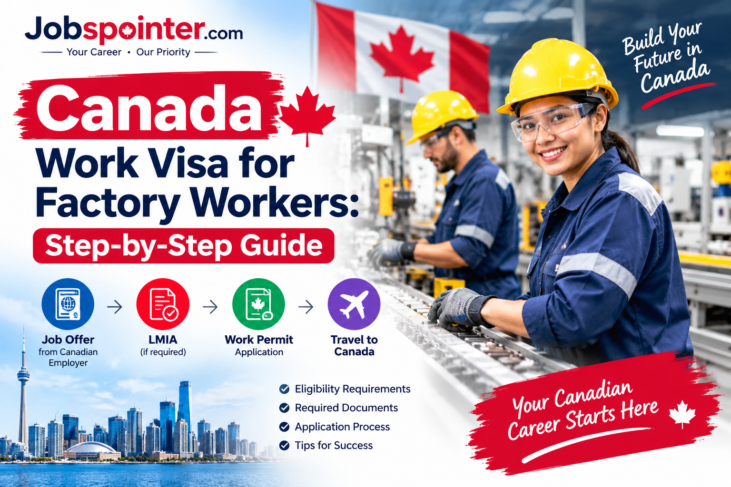
Canada Work Visa for Manufacturing Workers: Step-by-Step Process (2027)
Canada hires people from abroad for production lines, packing plants and food processing facilities every year. But there is no “factory visa.” Most overseas applicants need a job offer from an eligible employer, and in many cases a Labour Market Impact Assessment (LMIA), before they can apply for an employer-specific work permit. This guide explains the Canada work visa for manufacturing workers in the order things actually happen, so you know who does what.
Quick answer: Find a genuine employer, get a written job offer, ask whether the job needs an LMIA or is exempt, collect the documents your employer gives you, apply online through IRCC, and travel only when you are authorized. A job offer alone does not guarantee a permit, and nobody can promise approval.
Can Foreigners Work in Manufacturing in Canada?
Yes, but only with the right authorization. IRCC states that if you need a work permit and do not have one, you cannot legally work in Canada, and you cannot write on a job application that you are legally allowed to work there (IRCC: employer-specific work permits).
Eligibility depends on four things: the job, the employer, your qualifications and the immigration pathway. This article covers temporary work permits. It does not suggest that a factory job leads to permanent residence.
Types of Manufacturing Jobs Available in Canada
Requirements differ by role. Some jobs need only on-the-job training; others need certificates or experience.
| Job type | Typical duties | Usually needs |
|---|---|---|
| Production / assembly line worker | Assemble parts, operate simple equipment | Basic training; sometimes none |
| Packaging and labelling worker | Pack, seal, label products | Basic training; physical stamina |
| Food and meat processing worker | Cut, clean, process and pack food | Food safety training; cold or wet environments |
| Machine operator | Run and monitor machinery | Experience or technical training |
| Quality control inspector | Check products against standards | Experience; attention to detail |
| Industrial maintenance worker | Repair and maintain plant equipment | Trade or technical qualification |
Warehouse and manufacturing jobs in Canada often overlap, so read the duties in each advertisement. IRCC also lists some food-processing occupations (for example, labourers in food and beverage processing, NOC 95106) among those it prioritizes for work permit processing (IRCC: apply from outside Canada). Priority processing is not a guarantee of approval.
Browse current openings in our factory jobs in Canada section.
Which Canadian Work Permit Do Manufacturing Workers Need?
| Permit route | What it means | Common for factory workers? |
|---|---|---|
| Employer-specific work permit | Tied to one employer, location and occupation, listed on the permit | Yes, the usual route |
| LMIA-based | Employer first obtains a positive LMIA, then you apply | Yes, for most jobs |
| LMIA-exempt | Only when a specific exemption applies | Less common for overseas factory hires |
IRCC notes that most jobs need an LMIA, and that your employer must find out whether the job needs one or is exempt before you apply (IRCC). You can use IRCC’s tool to find which type of work permit you need.
Because an employer-specific permit lists the employer, location and occupation, you must follow those conditions. Changing employer generally requires a new permit, so do not assume you can switch freely.
What Is an LMIA, and Why It Matters in 2026–2027
An LMIA is a document showing there is a need to hire a foreign worker for the job. It is the employer’s application, not yours. The employer pays any LMIA processing fee. Employers must not recover recruitment costs from temporary foreign workers, so anyone asking you to pay for an LMIA is a red flag.
A change that affects factory jobs: since 26 September 2024, Employment and Social Development Canada (ESDC) has refused to process low-wage LMIA applications for work locations in census metropolitan areas (CMAs) with unemployment of 6% or higher. The list is updated about every three months. Reports on the current update say it covers applications submitted from 9 October 2026 to 7 January 2027 and includes about 30 CMAs, among them Toronto, Vancouver, Calgary, Edmonton and Montréal.
ESDC’s official page lists exemptions, and secondary sources report that food manufacturing (NAICS 311), primary agriculture, construction and some health sectors are among them. ESDC also applies caps on the share of low-wage workers and, until 31 December 2026, a separate refusal for certain low-wage jobs in Montréal and Laval. Check the official ESDC refusal-to-process page for the current table and exemptions.
What this means for you: a packaging or assembly role in a high-unemployment city may be harder to sponsor right now, while a food processing employer may still be able to apply. This is general guidance, and your employer must confirm it for the specific job and postcode.
Canada Work Visa Requirements for Manufacturing Workers
Requirements vary by application, but commonly include:
- A genuine job offer from an employer not on IRCC’s list of non-compliant employers.
- A positive LMIA with its letter and Annex A, or the offer details for an LMIA-exempt job.
- A valid passport and completed forms.
- Evidence that you meet the job’s requirements (training, experience, certificates).
- Biometrics, and in some cases a medical exam or police certificates, if your checklist asks for them.
- Proof that you are admissible to Canada.
- For jobs in Quebec, a Certificat d’acceptation du Québec (CAQ) is also required (confirmed by CanadaVisa.com; check Quebec’s immigration site for current rules).
See IRCC’s list of forms and documents. More background is in our guide to Canada work permit requirements.
Step-by-Step Process to Get a Canadian Manufacturing Work Permit
- Find a legitimate job. Search official employer career pages and the Job Bank for foreign candidates. Check location, wages, duties and how to apply.
- Receive a written job offer. Verify the company’s name, address and website. Read the contract for wages, hours, duties and start date.
- Ask if an LMIA is required. Your employer decides whether the job needs an LMIA or is exempt. Ask which route applies and, for low-wage roles, whether the city is open for processing.
- Get your employer’s documents. For an LMIA job, this includes the LMIA letter and Annex A. For an exempt job, you need the offer details the employer submitted.
- Create your IRCC account and answer the questionnaire. You will receive a personalized document checklist.
- Upload documents and pay fees. As of IRCC’s August 2026 update, the work permit processing fee is CAD $155 and the biometrics fee is CAD $85 for an individual (up to $170 for a family). Confirm on the IRCC fee page before paying.
- Give biometrics if asked. Wait for your biometrics instruction letter, then book your appointment promptly.
- Wait for a decision. Respond quickly to any request for more documents. See IRCC’s decision-wait page.
- Travel only when authorized. Follow your approval letter and see IRCC’s arrival guidance. Do not start work before you are legally allowed to.
IRCC applications from outside Canada are made online; paper applications are allowed only in limited cases, such as a disability that prevents applying online (IRCC).
Documents Manufacturing Workers May Need
| Document | Notes |
|---|---|
| Valid passport | Check expiry against the permit length you expect |
| Job offer / contract | Must match what the employer filed |
| LMIA letter and Annex A, or offer details | Provided by the employer |
| CV and references | Helpful for machine operator or technician roles |
| Training certificates | If the job requires them |
| Biometrics | If requested |
| Medical exam / police certificate | Only if your IRCC checklist requires them |
Not every applicant needs every item. Follow your personal checklist, and keep names, dates and job titles consistent across documents. Our Canadian CV guide can help you prepare.
How to Find Manufacturing Jobs With LMIA Support
- Use the Job Bank’s foreign candidate search and filter by occupation and province.
- Look for wording such as “LMIA” or “temporary foreign workers” in the advertisement, but treat it as a prompt to ask, not as proof.
- Apply directly through the employer’s official channels.
- Confirm in writing who is applying for the LMIA and that you will not be charged.
- Do not resign, sell property or book flights until your permit is approved.
An LMIA, even a positive one, is not a work permit. You must still apply and be approved. See current LMIA-supported vacancies and our manufacturing and production vacancies.
Salary and Working Conditions
We do not quote a single wage because pay varies widely. Check the Job Bank wage data at jobbank.gc.ca for your occupation and province, and note whether figures are hourly or annual and whether they are gross.
| Factor | Why it matters |
|---|---|
| Occupation and skill level | Technical roles usually pay more than entry-level packing |
| Province and city | Local wages and living costs differ |
| Shifts and overtime | Night shifts and overtime can raise earnings |
| Union agreements | Collective agreements can set wage scales and benefits |
| Housing or transport support | Some employers offer it; get details in writing |
The wage in your offer also affects the LMIA stream (high-wage or low-wage), which is why it matters to the employer’s application.
Work Permit Fees and Processing Time
| Fee | Amount (IRCC page updated Aug 2026) | Who pays |
|---|---|---|
| Work permit processing | CAD $155 | All applicants |
| Biometrics | CAD $85 individual / up to $170 family | If biometrics are required |
| Open work permit fee | CAD $100 | Open permit applicants only |
Processing times vary by application type, country and workload, and no date is guaranteed. Use IRCC’s processing-time tool and the fee page for current figures. Some applicants may be exempt from fees.
Common Mistakes to Avoid
| Mistake or red flag | What to do instead |
|---|---|
| Paying an agent for a “guaranteed” job or visa | Walk away; no one can guarantee approval |
| Paying an employer for an LMIA | Report it; employers must not recover these costs from workers |
| Accepting an offer without checking the company | Verify the business, address and contact details independently |
| Assuming every factory job is open to overseas hires | Ask whether the employer is recruiting abroad and can sponsor |
| Submitting inconsistent documents | Cross-check names, dates and job titles |
| Travelling before approval | Wait for written authorization |
Frequently Asked Questions
Can I get a Canadian work visa for a factory job without experience?
Some entry-level jobs do not require experience, but the employer’s requirements and your own eligibility for the work permit still apply.
Do manufacturing workers need an LMIA?
IRCC says most jobs need an LMIA, though exemptions exist. Your employer must determine which process applies.
Can I apply for factory jobs in Canada from Nepal?
You can apply to legitimate vacancies from abroad. Whether you can get a permit depends on the job, the employer’s documents and your eligibility. Depending on nationality, you may also need a visitor visa or eTA. Your IRCC checklist will show what applies to you.
Does an LMIA guarantee a work permit?
No. You must submit your own application and meet the requirements.
Can an employer charge me for an LMIA?
No. Employers must not recover LMIA-related recruitment costs from temporary foreign workers. Be cautious about anyone selling guaranteed approvals.
Can I bring my family?
It depends on your permit and current rules. Do not assume family members will receive work or study authorization. See IRCC’s page on family members of foreign workers.
Conclusion
The Canada work visa for manufacturing workers is really a sequence: a real employer, a written offer, a confirmed LMIA or exemption, a complete IRCC application, and authorization before you travel. Keep your costs low, your documents consistent and your expectations realistic, especially for low-wage jobs in cities currently restricted.
Ready to look? Explore manufacturing and production vacancies on Jobspointer.com, check each employer’s requirements, and apply using their official instructions. Jobspointer does not guarantee employment, sponsorship or visa approval.