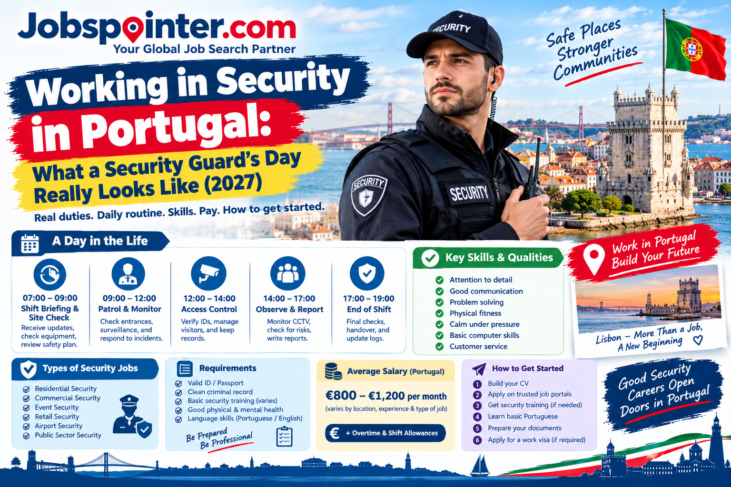
Working in Security in Portugal: What a Security Guard’s Day Really Looks Like (2027)
Working in security in Portugal is not like the movies. There are no car chases. Most of the job is watching, checking, greeting, writing things down, and staying calm when something unusual happens. It can be quiet and steady, or busy and tiring, depending on the site and the shift.
If you are searching for security guard jobs in Portugal, you probably want three honest answers: what do guards actually do, what do they earn, and can someone from outside Portugal do this job? This guide covers all three. It also covers a point many articles skip: the licensing and nationality rules that decide whether you can legally be hired as a guard at all.
Please note: Laws and pay tables change. This article reflects the official sources listed at the end, checked for the 2026 position. Confirm every figure with the PSP and your employer before you act on it, especially for 2027.
1. A Typical Day (Illustrative)
No two sites are the same, so treat this as one realistic example, not a rule. It describes a day shift at an office or retail site.
| Stage | What it often involves |
|---|---|
| Before the shift | Travel in, put on the uniform, and make sure your professional card is visible and valid. |
| Start of shift | Handover from the previous guard: incidents, keys, visitors expected, anything broken or out of place. You read the log. |
| During the shift | Greeting people, checking access, patrolling set routes, watching cameras, receiving deliveries, answering questions. |
| When something happens | Following the site’s written procedure: call the right person, keep people safe, note times and facts, and call the emergency services where needed. |
| End of shift | Complete the written report, hand over to the next guard, and return keys and equipment. |
Most days, honestly, are uneventful. The skill is staying alert through the quiet hours.
2. Where Security Guards Work
The law that regulates private security in Portugal (Lei 34/2013) names several specialities. The list shows how varied the work is:
- Vigilante (general guard)
- Segurança-porteiro (door and entrance security)
- Personal protection and escort guard
- Sports venue assistant
- Entertainment venue assistant
- Port and airport assistant
- Cash-in-transit guard
- Public transport inspector
- Alarm monitoring operator
In everyday terms, these roles tend to turn up in:
- Offices and corporate buildings: reception-style duties, access control, patrols.
- Shopping centres and shops: visible presence, helping the public, dealing with theft or disturbances.
- Hotels and tourism sites: especially in Lisbon, Porto and the Algarve. Guest-facing and often needs English.
- Warehouses, factories and construction sites: quieter, often at night, with more patrol work.
- Events, stadiums and venues: crowd flow and entry checks. These need the specific venue-assistant title.
- Airports, ports and transport: more regulated, with extra categories and often higher pay bands.
A note on those site types: the speciality list comes from the law. Which sites hire most in a given city changes, so check current vacancies.
3. Hours, Night Shifts and Rotating Schedules
There is no single “standard” pattern. Shifts vary by employer, contract and site. What the sector collective agreement (2025 to 2026, between security companies and the STAD union) says:
| Rule | What the agreement says |
|---|---|
| Normal working time | 8 hours a day, 40 hours a week |
| Flexible (adaptability) regime | Up to 10 hours a day and 50 hours a week, averaged over up to six months |
| Night work | 21:00 to 06:00, paid at a 25% increase on the daytime hourly rate |
| Shift work | Allowed, with specific rules |
So yes, night shift security jobs in Portugal exist and pay more per hour. But a long day under the flexible regime can feel heavy. Always read the contract to see which regime applies.
Check: the agreement was published for 1 January 2025 and runs to 31 December 2026, then renews for equal periods unless changed. Confirm the 2027 terms before publishing.
4. Salary and Benefits
First the floor. Portugal’s national minimum wage is €920 gross a month from 1 January 2026, paid 14 times a year, according to DECO PROTESTE. The same source reports a proposed rise to €970 in 2027 in the draft State Budget. That is a proposal, not a confirmed figure, so verify it before you publish the 2027 version.
The sector collective agreement sets base pay for guards above that floor:
| Category | Monthly base pay 2025 | Monthly base pay 2026 |
|---|---|---|
| Vigilante | €960.62 | €1,015.95 |
| Airport guard (vigilante aeroportuário) | €1,076.00 | €1,137.98 |
| Port guard (vigilante portuário) | n/a (new in 2026) | €1,137.98 |
| Chief guard / controller | €1,063.27 | €1,124.51 |
| Cash-in-transit guard | €1,338.06 | €1,415.13 |
At €1,015.95 a month over 14 payments, a vigilante’s base pay comes to roughly €14,223 gross a year before supplements. That calculation is mine, not the agreement’s.
Benefits and extras in the agreement:
- A Christmas subsidy of one month’s pay, due by 15 December.
- A holiday subsidy, paid before the first holiday period.
- The 25% night-work increase.
Gross vs take-home: these are gross figures. Social security contributions and income tax withholding come off your payslip, and the exact result depends on your personal situation. Ask the employer for a sample payslip or use the official Portuguese tax authority simulator.
Caution: the agreement is a sector floor. Individual employers may pay more, and some sites or companies may be covered by a different agreement. Do not treat these numbers as an offer.
5. Skills That Help
- Calm under pressure. Most of the job is judgement.
- Clear communication. Reports, radio calls, talking to the public. Portuguese is essential; English helps in hotels, airports and tourist areas.
- Observation and patience. Noticing small changes during long, quiet hours.
- Physical fitness. The licence requires you to pass a physical, mental and psychological assessment.
- Reliability. Turning up on time, every time, including nights and holidays.
- Basic IT and writing. Logs and reports are mostly digital now.
6. Licensing and Legal Requirements
You cannot just start work as a guard. Under Lei 34/2013, private security staff need a professional title (a card) issued by the PSP, the national police. The PSP service page says the card is valid for five years and can be renewed.
What you generally need:
- The right nationality (see the next section).
- Completed compulsory schooling and full legal capacity.
- No final conviction for an intentional crime, proven by a special criminal record certificate.
- Passing the physical, mental and psychological assessment (a doctor and a PSP-designated psychologist).
- Completing the approved training courses, or equivalent courses recognised from an EU or EEA state.
- Submitting the application, usually online through SIGESP, or by post.
| Item | Detail (PSP service page) |
|---|---|
| Standard processing | €20, 10 working days |
| Urgent processing | €40, 4 working days |
| Card validity | 5 years |
| Renewal | Needs an update course and a re-check of requirements |
The fee and time figures come from the gov.pt service page and may change, so check the live page.
7. Can Foreigners Work as Security Guards in Portugal?
This is the section most readers need. There are two separate questions, and people often mix them up.
Question 1: Can you legally live and work in Portugal? This is the immigration question. It is handled through visas and residence permits.
Question 2: Can you hold the security professional card? This is the licensing question, handled by the PSP.
Having an answer to the first does not give you the second. A work visa does not give you a security title.
Under Lei 34/2013 (Art. 22), the professional title is open to:
- Portuguese nationals
- Nationals of an EU member state or an EEA state
- Nationals of Portuguese-speaking states, on a reciprocity basis
The PSP service page also asks foreign applicants for a copy of their residence permit, a criminal record certificate (translated if needed) and proof of Portuguese at B1 level, except for nationals of Portuguese-speaking countries.
In plain terms:
| Your situation | What it generally means (confirm with the PSP) |
|---|---|
| Portuguese citizen | Standard route |
| EU/EEA citizen | May use qualifications from your home state. Contact the PSP about recognition (Circular 7/SP/2014 is referenced on the service page). Portuguese is still needed. |
| Citizen of a Portuguese-speaking country | Possible on a reciprocity basis. Language proof is not required, per the service page. |
| Other non-EU nationals | The law text we reviewed does not list your nationality. Ask the PSP directly before spending money on training or moving. |
About visa sponsorship: we found nothing verified showing that security companies routinely sponsor visas. Treat any advert promising a guaranteed job plus visa with caution. Never pay anyone to “secure” a security job or licence.
For the immigration side, see our Portugal work permit guide.
8. The Challenges Nobody Mentions
These are commonly reported in the profession, not measured in this research:
- Long periods of boredom, followed by sudden pressure.
- Night and weekend work, which affects sleep and family time.
- Standing and walking for most of a shift.
- Difficult people. Guards sometimes deal with arguments or aggression, and must follow procedure rather than react.
- Pay near the sector floor at the start, with progress mainly through specialist categories.
9. How to Apply for Security Guard Jobs in Portugal
- Check your eligibility first. Nationality, residence status and language. Contact the PSP if unsure.
- Get the training. Only through a course approved for the PSP route.
- Do the medical and psychological assessment and collect your criminal record certificate.
- Apply for the professional card via the PSP.
- Prepare a short, clear CV in Portuguese, plus English if useful. See our guide on how to write a CV for jobs abroad
- Search by city. Security guard jobs in Lisbon and Porto are the most visible, and there is also demand around airports and tourist regions.
- Read the contract. Check the collective agreement that applies, the shift system, night pay and the site address.
For role-specific expectations, see security guard job requirements.
10. Frequently Asked Questions
1. How much does a security guard earn in Portugal?
Under the 2025 to 2026 sector agreement, a vigilante’s base pay is €1,015.95 a month in 2026, above the €920 national minimum. Extras like night pay and subsidies apply. These are gross figures.
2. Can foreigners work as security guards in Portugal?
Only if they can hold the PSP professional title. The law text lists Portuguese, EU/EEA and (on reciprocity) Portuguese-speaking-country nationals. Others should ask the PSP first.
3. Do I need a licence to work as a security guard?
Yes. A PSP professional card, valid for five years, plus approved training and a fitness assessment.
4. Is Portuguese required?
The law requires sufficient Portuguese for vigilance staff, and the PSP service page asks foreign applicants for B1 proof (except Portuguese-speaking nationals).
5. Are night shifts common?
They exist, especially at industrial sites and transport hubs. Night work (21:00 to 06:00) carries a 25% pay increase under the sector agreement.
6. Can a security company sponsor my visa? Nothing verified suggests this is common. Even with a visa, you would still need the PSP card.
11. Conclusion
Working in security in Portugal can be a steady, structured job with regulated pay and clear rules. It rewards patience and reliability. But it is also a licensed profession, so the first step is checking your eligibility, not sending applications.
If you qualify, start by preparing your documents and searching current openings. Browse the latest security and guard vacancies on Jobspointer.com and apply to employers directly.