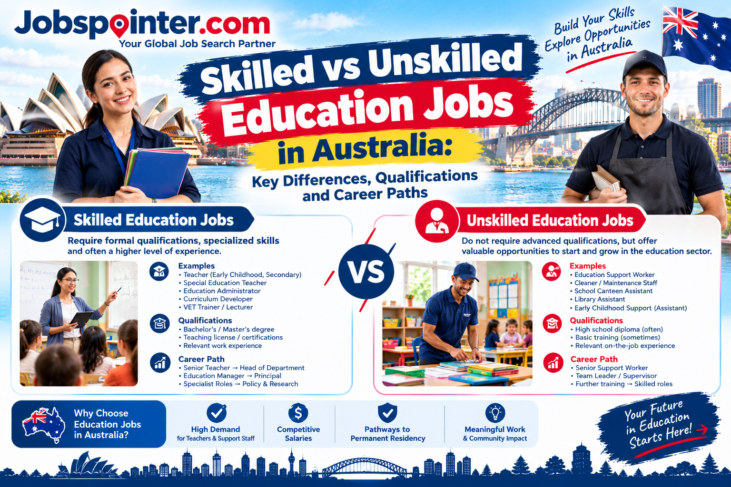
Skilled vs Unskilled Education Jobs in Australia: Key Differences, Qualifications and Career Paths
Australia’s education sector is large and varied. It covers schools, early childhood centres, universities, TAFE and private training providers, and the support services around them. For a job seeker, the key question is not “skilled or unskilled?” but “which roles match my qualifications, what checks do I need, and can I legally work in Australia?”
Short answer: “skilled” education jobs, such as teachers and lecturers, normally require a recognised degree and, for school teaching, teacher registration. Entry-level and support roles, such as teacher aides and childcare assistants, usually have lower formal entry requirements, but many still need a certificate, a child-safety check and the right to work. “Unskilled” is not an official Australian job category. Employers and visa rules look at the specific occupation, not a general label.
Skilled vs Entry-Level Education Jobs: Quick Comparison
| Factor | Skilled education roles | Entry-level / support roles |
|---|---|---|
| Typical roles | Teachers, early childhood teachers, special education teachers, lecturers, vocational trainers | Teacher aides, education assistants, childcare educators, school admin staff, learning-centre assistants |
| Main duties | Planning, teaching, assessing, specialist services | Supporting a teacher, supervising, administration, practical help |
| Qualifications | Usually a relevant degree or higher | Often a certificate, short training or relevant experience; varies by employer |
| Registration | Required for most school teaching | Depends on the role and the state |
| Child-safety check | Required where working with children | Required where working with children |
| Pay | Varies by experience, employer and location | Varies by classification, hours and employment type |
| Career path | Senior teacher, specialist, leadership | Experienced aide, team leader, or study towards a teaching qualification |
| Visa | Must be checked per occupation and visa | Must also be checked; a job offer alone does not equal a visa |
Pay differs widely. Do not assume every skilled role pays more than every support role, because hours, location and agreements all matter.
What Are Skilled Education Jobs in Australia?
Skilled education jobs need specialised knowledge, a recognised qualification or registration. In practice, the following are the main groups.
- Primary and secondary school teachers. They plan and deliver lessons and assess students. Teachers must be registered with the teacher regulator in the state or territory where they work.
- Early childhood teachers. They teach in preschools and long day care. An early childhood teacher needs an approved bachelor degree or higher with an early childhood specialisation, as listed by ACECQA (source).
- Special education teachers. They support students with additional learning needs, often after extra study.
- University lecturers and vocational education trainers. Lecturers usually hold a higher degree. Vocational trainers generally need industry experience plus a training qualification [VERIFY current VET trainer requirements with ASQA].
- Education managers and specialists. These include principals, curriculum leaders and counsellors, who usually need years of experience and further study.
If you are looking for classroom or school vacancies, search the Jobspointer jobs page with keywords such as “teacher” or “lecturer” and check each listing’s location and requirements.
What Are Entry-Level or Support Education Jobs?
Entry-level roles offer a way into the sector without a teaching degree. “Lower-qualification” does not mean “no requirements.”
- Teacher aides and education assistants. They help teachers prepare materials, support small groups and assist students with additional needs. Jobs and Skills Australia describes teachers’ aides as assisting teaching staff with materials and general classroom tasks (JSA occupation profile). Many employers prefer or require a Certificate III or IV in Education Support, but this varies by employer [VERIFY].
- Childcare educators and trainees. Services must employ staff who hold, or are studying towards, a nationally approved qualification. There are generally three levels: Certificate III, Diploma and Bachelor (source). To look for current openings, try keywords like “childcare”, “early childhood” or “teacher aide” on the Jobspointer jobs page.
- School administration assistants. They handle reception, enrolments and records.
- School operational and general support staff. These include grounds, cleaning and canteen roles.
- Learning-centre and tutoring assistants. Requirements depend entirely on the provider.
Duties and requirements differ by employer, state or territory and the age group supported.
Qualifications and Checks You May Need
- Recognised qualifications. For childcare, check that your course is on the ACECQA approved list. If it is not, educators can apply to ACECQA for an individual assessment of their qualification.
- Teacher registration. School teachers register with the regulator in their state or territory. Rules differ between jurisdictions [VERIFY by state].
- English communication. Teaching and care roles depend on clear communication. Skills assessment bodies and visas set their own English requirements.
- Child-safety screening. NSW, NT, Queensland, SA, Victoria and WA call it a Working With Children Check; the ACT and Tasmania use a Working With Vulnerable People check (AIFS). Each state sets its own rules, and you generally apply in the state where you will work.
- Role-specific training. Childcare services often expect current first aid, asthma and anaphylaxis training. The ACECQA list also covers approved first aid qualifications (ACECQA).
Salaries: What the Official Data Shows
Treat these as indicators, not promises.
| Role group | Indicator | Source |
|---|---|---|
| Education aides | Median full-time earnings about A$1,342 per week (about A$37/hour), versus A$1,852 per week across all occupations | JSA / ABS SEEH, May 2025 |
| Early childhood teachers | Median about A$1,906 per week (roughly A$99,000 a year) | Secondary summary of JSA data; [VERIFY on JSA] |
What shifts pay:
- Hours: full-time, part-time or casual.
- Sector: government school, independent school or childcare centre.
- Instrument: modern award or enterprise agreement. School support staff are often covered by the Educational Services (Schools) General Staff Award, and teachers by the Educational Services (Teachers) Award, unless an enterprise agreement applies.
- Location and experience.
Check current pay rates on the Fair Work Ombudsman site, because award rates change each July.
Can International Applicants Get Education Jobs in Australia?
Sometimes yes, but work rights come first. A job offer does not guarantee a visa.
Roles that may suit overseas-qualified applicants
Qualified teachers and some vocational trainers are the most common sponsored roles. For example, a third-party tracker of the Home Affairs list shows Vocational Education Teacher (ANZSCO 242211) as eligible for Skills in Demand, Core Skills [VERIFY on Home Affairs]. Commentary from migration advisers describes teaching occupations as in shortage across states, but that is not a guarantee for any individual.
How employer sponsorship works
- The Skills in Demand visa (subclass 482) replaced the Temporary Skill Shortage visa on 7 December 2024.
- For the Core Skills stream, your occupation must be on the Core Skills Occupation List (Home Affairs).
- The sponsor must nominate you at or above the Core Skills Income Threshold or the market salary rate, whichever is higher. For nominations lodged from 1 July 2026, reports put it at A$79,423 [VERIFY on Home Affairs].
Many entry-level support roles pay below that level, which is one reason they are rarely sponsored. Whether any particular childcare or aide occupation is on the list must be checked on the official occupation lists page.
Skills assessments
Teachers on a skilled migrant visa must complete a skills assessment through AITSL. From 7 December 2024, ACECQA assesses the Early Childhood Teacher occupation. AITSL’s fee was reported to rise to A$1,198 on 7 September 2026 [VERIFY on aitsl.edu.au]. A positive assessment helps but does not guarantee a visa.
For more on how work rights affect your options, browse our Visa & Immigration articles.
Best Education Jobs for Freshers
“Fresher-friendly” does not mean qualification-free or visa-ready. Good starting points include:
- Childcare trainee or assistant educator. Services can employ staff who are studying towards an approved qualification.
- Teacher aide or education assistant. A common way to build classroom experience.
- School administration assistant. Useful if you prefer office work.
- Tutoring support. Often flexible, but check pay and contract terms.
If you want to become a teacher later, ask a university whether your certificate or diploma earns credit towards an early childhood degree. Education departments suggest this route (source).
Career Growth in the Education Sector
- Support to qualified. Move from aide to teacher via part-time study.
- Childcare ladder. Certificate III to Diploma to Bachelor, then room leader, director or teacher.
- Specialisation. Early childhood and inclusive education have strong demand. Jobs and Skills Australia’s 2025 shortage work still flags early childhood teachers and child carers as facing persistent pressures (summary).
- Regional work. Shortages are often sharper outside capital cities, but conditions and housing vary.
Demand can change, so no occupation is guaranteed to stay in shortage.
How to Find Legitimate Education Jobs in Australia
- Use official and employer sites first: state education departments, universities, TAFEs and large childcare providers.
- Read the qualification line closely. If you lack it, do not assume the employer will waive it.
- Prepare an Australian-style CV and cover letter. You can build one with the free Jobspointer Resume Builder, which includes a single-column ATS-friendly template, and find more tips in our CV & Resume guides.
- Verify sponsorship claims. Ask which visa, which occupation and which nomination salary. Check a migration agent is registered.
- Watch for scams. Never pay a “recruitment fee” or “visa fee” to a private person for a job. Our guide to finding verified jobs is written for Canada, but its checks for genuine offers are still a useful reference.
How to Choose: A Quick Decision Guide
| If you… | Consider… |
|---|---|
| Hold a teaching degree | Teacher registration and an AITSL or ACECQA skills assessment |
| Hold a childcare certificate or diploma | Checking it on the ACECQA list, then childcare roles |
| Have no qualification and no work rights | Fix work rights first; unsponsored entry-level roles are hard to access |
| Have work rights but no qualification | Trainee childcare or aide roles while you study |
| Want long-term growth | A plan from support work to a recognised qualification |
Frequently Asked Questions
1. What is the difference between skilled and unskilled education jobs in Australia?
Skilled roles, such as teaching, require professional qualifications and often registration. Entry-level roles support learning with fewer formal requirements. “Unskilled” is not an official label.
2. Can foreigners work in Australian schools without a teaching degree?
Only in non-teaching or support roles, and only with the right to work in Australia. Employers set their own requirements.
3. Are education assistant jobs available to international applicants?
Possibly, if you already hold valid work rights. Sponsorship for such roles is uncommon, so verify the occupation against the Home Affairs lists.
4. Do childcare workers need qualifications in Australia?
Services must employ staff who hold, or are studying towards, a nationally approved qualification (source).
5. Can an education job provide employer visa sponsorship?
Some can, mostly qualified roles on the Core Skills Occupation List. Never assume it.
6. Which education jobs are suitable for freshers?
Childcare trainee, teacher aide and school administration roles, subject to qualifications, checks and work rights.
7. How can overseas teachers get their qualifications recognised?
Through the migration skills assessment with AITSL, or ACECQA for early childhood teachers, plus state registration to teach.
8. Where can applicants find reliable education job listings?
State education department sites, university and TAFE career pages, large childcare providers, and verified listings on Jobspointer.com.
Conclusion
The skilled versus entry-level split is useful, but your real checklist is simpler: qualification, safety checks and work rights. Use official tools before you apply, ignore anyone who promises a visa for a fee, and treat entry-level work as a step towards a recognised qualification. Browse current openings on the Jobspointer jobs page, or read our seasonal logistics jobs in Australia guide if you also want short-term work options.
This article is general information, not legal or migration advice. Confirm visa details with the Department of Home Affairs or a registered migration agent.