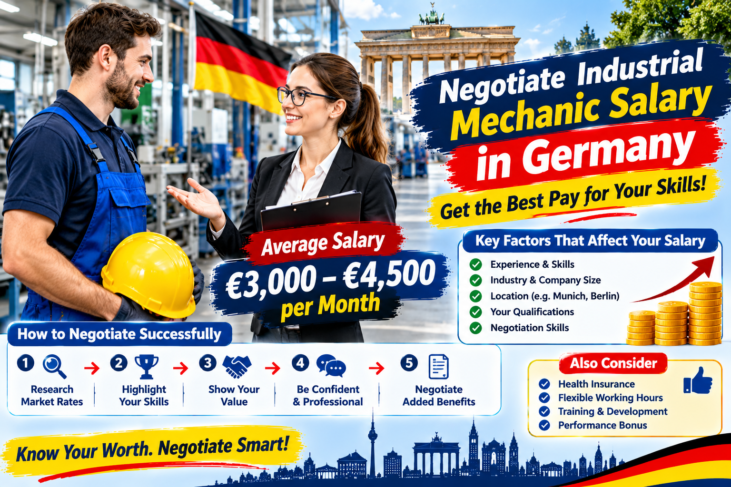
How to Negotiate Your Industrial Mechanic Salary in Germany
Salary negotiation for industrial mechanics in Germany works differently from many countries. Many employers pay by a collective agreement (Tarifvertrag), job ads often leave pay out, and the number that matters is the gross annual salary. If you want to know how to negotiate your industrial mechanic salary in Germany, start with your market value, then work out what you can and cannot move: the amount, your pay group, allowances, leave or training. This guide gives the 2026 salary benchmarks we could verify, the skills that strengthen your case, scripts in English and German, and a checklist to run before you sign.
Quick answer: Sources we checked in 2026 put typical full-time gross pay for industrial mechanics at roughly €35,000 to €49,000 a year, depending on the source, region, employer and agreement. Ask in gross annual terms, give a range backed by two or three sources, and find out early whether a Tarifvertrag applies. If it does, negotiate your pay group (Entgeltgruppe), allowances and review date rather than haggling over the base figure. Get the final terms in writing.
How industrial mechanics are paid in Germany
German contracts and job ads talk about gross pay (Brutto): the amount before income tax and social-insurance contributions. What reaches your bank account is Netto. Compare and negotiate gross figures only.
| Term | What it means | Why it matters to you |
|---|---|---|
| Brutto / Netto | Before / after tax and social contributions | Never compare your net pay with someone else’s gross pay |
| Bruttojahresgehalt | Gross annual salary, paid in 12 or more instalments | Ask whether holiday or Christmas pay is included or paid on top |
| Tarifvertrag | Collective agreement between a union and employers | Can fix pay groups, weekly hours, leave and allowances |
| Entgeltgruppe (EG) | Pay group set by your actual duties | Your classification can matter more than a negotiated base figure |
| Zulagen / Zuschläge | Allowances and premiums, such as shift, night or weekend work | Can add meaningfully to monthly pay |
Why a Tarifvertrag changes your strategy
In the metal and electrical industry (about 3.8 million employees, according to IG Metall), pay is looked up in tables by region, pay group and step rather than invented for each hire. IG Metall describes the base tariff pay (Eckentgelt) as what a person gets after completed vocational training in a matching job; the other groups are calculated from it (IG Metall tariff tables). Which group applies depends on your real duties and the employer’s classification, not on your job title.
Three practical consequences:
- Ask in the first conversation: Is this role covered by a Tarifvertrag, and which pay group do you plan for me?
- If the base figure is fixed, your leverage moves to classification, allowances, hours, leave, training and the date of your first review.
- IG Metall states that only its members have a binding legal claim to tariff benefits, although many employers apply them to everyone. Check whether your contract expressly refers to the agreement.
Agency (Zeitarbeit) jobs follow different tariff tables (IG Metall temporary-work tables). Ask whether you would be hired directly by the factory or through an agency, because the pay logic differs.
What is moving in 2026
- Monthly tariff pay in the metal and electrical industry rose 3.1% from April 2026, and special payments such as holiday and Christmas pay rise with it (IG Metall).
- The agreement negotiated by the Bavaria and Küste districts ran until 31 October 2026 (IG Metall press release). A new bargaining round is under way. IG Metall demands 5% and says employers offered 1.3%, effective only in July 2028, followed by warning strikes (IG Metall). We found no settlement when we checked on 1 November 2026, so ask HR which tariff table applies on your start date.
What industrial mechanics earn in Germany: 2026 benchmarks
There is no single official number. These are the figures we could verify, with their limits stated. Searching in German helps: Industriemechaniker Gehalt.
| Source | What it measures | Gross figure | Notes |
|---|---|---|---|
| Federal Employment Agency Entgeltatlas, as reported by mystipendium.de | Average monthly gross pay | €4,064 per month, about €48,768 per year | Highest reported for Bremen (€4,442) and Hamburg (€4,434) per month. No publication date shown, so check the Entgeltatlas yourself |
| StepStone salary planner | Estimated annual gross | €40,900 average, range €34,500 to €49,200 | Leipzig €41,800, Dortmund €41,500. No date shown on the page |
| jobvector salary analysis | Annual gross, 2,012 salary reports | €39,672 average, range €35,496 to €45,351 | Updated 3 August 2026. Roles with staff responsibility average €51,216 |
| Payscale | Self-reported base salary | €34,800 average | 2026 figure. Use as a cross-check only |
How to read these numbers
- They measure different things. Official statistics, advert-based estimates and self-reported data will never match. Do not quote the highest one.
- The gap is about €9,000. The Entgeltatlas-based figure sits roughly €9,000 above the portal averages around €40,000. A plausible explanation, which we have not verified, is that official data reflects full-time employees where tariff-covered industrial employers weigh heavily, while portals mix in estimates and self-reports. For you the lesson is practical: tariff-covered employers tend to sit in the upper part of the range, so find out early whether one applies.
- Experience and responsibility move pay. The jobvector split between skilled-worker and staff-responsibility pay (€39,672 versus €51,216) shows what taking on a lead role can mean.
- Region and sector matter. Bremen and Hamburg lead in the Entgeltatlas figures above; automotive, machinery and plant construction, and maintenance contractors each pay differently. Compare job ads in your target region before you set a number.
- Ads may mislead. Ranges inside advertisements are often estimates. Treat them as one input and ask the employer what the real band is.
Hourly wage versus annual salary: the hours trap
To convert, divide annual gross pay by 52 times the weekly hours. The example uses the StepStone average of €40,900 purely to show the arithmetic. It is not a market quote.
| Weekly hours | Hourly gross for €40,900 a year |
|---|---|
| 40 hours | about €19.66 |
| 38 hours | about €20.70 |
| 35 hours | about €22.47 |
The same annual salary means a very different hourly rate depending on contractual hours, and many tariff tables assume a 35-hour full-time week. Always compare hours alongside pay.
The legal floor
The statutory minimum wage is €13.90 per hour gross since 1 January 2026 and rises to €14.60 on 1 January 2027 (Federal Government). For a 40-hour week that is about €28,900 a year in 2026 and about €30,400 in 2027 (our arithmetic). An offer for a qualified mechanic close to those figures deserves questions, not a quick yes.
Skills and experience that increase your negotiating power
Employers pay for skills they can verify. Bring proof rather than adjectives.
| Skill or credential | Why it supports a higher offer | Proof to bring |
|---|---|---|
| Installation and maintenance of industrial machinery | Reduces downtime and outside service costs | Machine types, years, plant size |
| Preventive and corrective maintenance | Shows you can plan work, not only repair | Maintenance routines you ran or improved |
| CNC operation and troubleshooting | Scarcer than basic assembly skills | Control systems you know (for example Siemens, Fanuc, Heidenhain) |
| Electrical and mechanical troubleshooting | Useful on automated lines | Fault cases you solved, described honestly |
| Automated production systems and PLC basics | Fits modern plants | Courses, projects, supervised work |
| Vocational qualification and certificates | Shows formal level | Certificates and, if trained abroad, the recognition notice |
| German language and workplace communication | Safety instructions, documentation, teamwork | Language certificate and level (A2 to B2) |
If you trained abroad: Germany’s recognition procedure decides how your vocational qualification is treated. German missions have said visa applications can be accepted only after recognition, and some routes allow recognition to start after arrival, so confirm your route on Make it in Germany and the recognition portal. A recognition notice is also strong evidence when you ask an employer to classify you as a skilled worker. For the wider basics, see our guide to Germany work visa and qualification recognition basics.
Choose the right time to negotiate
| Moment | Your leverage | Tip |
|---|---|---|
| Offer stage | Highest: the employer wants you and nothing is signed | Discuss pay after the offer. If asked earlier, give a range |
| Changing employers | A new contract resets pay | Compare the total package, not only the base |
| After probation | You have proven yourself | Probation can last at most six months, with two weeks’ notice (§ 622 BGB). Agree a review date in writing at the start |
| Annual review | Moderate | Bring a log of what you took on |
| More responsibility | Strong, if the duties are real | Ask whether re-grading is possible |
| New qualification | Strong | Ask for the date the new qualification is recognised in your pay |
For international applicants, the offer stage is almost always the strongest moment. Once your residence permit is tied to a job, it is usually harder to walk away.
How to prepare your salary expectations
- Collect two or three benchmarks from the table above and note the date of each.
- Adjust for your case: region, sector, employer size and whether a Tarifvertrag applies.
- Set three numbers: your walk-away figure (the lowest gross annual pay that still works after rent, relocation and family costs), your target, and an opening ask in the upper part of the range you can defend.
- Convert to hours and compare with the contractual weekly hours.
- Write an evidence sheet: machines, systems, tasks, certificates and results you can explain.
- Ask about the agreement before you name a number.
Offer a range rather than a single figure, and make sure you would be happy at the bottom of it.
How to negotiate your industrial mechanic salary with a German employer
- Start professionally. Thank them for the offer and show interest in the role.
- Explain your technical value in two or three concrete examples.
- State expectations as gross annual salary and say how many payments it includes.
- Support the figure with benchmarks and, if relevant, your recognised qualification.
- Discuss extra duties such as CNC, shift leadership or training new colleagues.
- Answer counteroffers calmly. Ask what they are based on before you react.
- Ask for time and for the terms in writing.
| Situation | What to say | Deutsch |
|---|---|---|
| Opening the pay discussion | Based on my experience and the market figures I have seen, I am looking for a gross annual salary between €[X] and €[Y]. | Auf Basis meiner Erfahrung und der marktüblichen Gehälter stelle ich mir ein Bruttojahresgehalt zwischen [X] und [Y] Euro vor. |
| Checking the agreement | Is this role covered by a collective agreement, and which pay group do you plan for me? | Gilt für diese Stelle ein Tarifvertrag? In welche Entgeltgruppe würden Sie mich einordnen? |
| Low offer | Thank you for the offer. Is there room to improve the base salary? | Vielen Dank für das Angebot. Gibt es noch Spielraum beim Grundgehalt? |
| Experienced candidate | I have [X years] in [task], for example [result]. I would like that reflected in my classification. | Ich habe [X Jahre] Erfahrung in [Aufgabe], zum Beispiel [Ergebnis]. Das möchte ich bei der Einstufung berücksichtigt sehen. |
| No room on base pay | If the base is fixed, could we agree on [allowance or training] and a salary review after six months? | Wenn beim Grundgehalt kein Spielraum ist, könnten wir [Zulage oder Weiterbildung] und ein Gehaltsgespräch nach sechs Monaten vereinbaren? |
| Buying time | May I review the offer until [date]? Could you send the terms in writing? | Darf ich mir das Angebot bis [Datum] ansehen? Können Sie mir die Konditionen schriftlich schicken? |
A short example of how the first minutes can go (replace the brackets with your real facts):
- Employer: What are your salary expectations?
- You: After [X] years in industrial maintenance and CNC troubleshooting, and given the figures for this region, I am looking for a gross annual salary between €[X] and €[Y]. Is the role covered by a collective agreement?
- Employer: We pay by tariff group [group].
- You: Thank you. How is the group decided, and could my [skill] be considered in the classification?
Negotiate more than the basic salary
| Item | What to ask | Note |
|---|---|---|
| Overtime | Paid or time off? Which premium? | German law sets no general overtime premium, so it comes from your contract or agreement. Ask |
| Night, shift and weekend allowances | Rates and when they apply | Often set in the Tarifvertrag |
| Holiday and Christmas pay, special payments | Amount and payment month | Tariff increases raise these in the metal and electrical industry |
| Paid leave | Contractual days | The statutory minimum is 24 working days on a six-day week, which is 20 days on a five-day week (§ 3 BUrlG). Contracts and agreements often give more |
| Training | Paid courses toward Techniker or Meister | Ask for it in writing |
| Pension | Employer contribution to a company pension | Check amount and conditions |
| Transport and relocation | Travel costs, moving allowance, temporary housing | Often negotiable for international hires |
| Review date | A date for the next pay talk | Put it in the contract or a letter |
What to do if your German employer rejects your request
- Stay professional. A calm reply keeps the relationship intact.
- Ask whether the figure comes from a fixed pay scale.
- Explore alternatives: allowance, extra leave, training, relocation help.
- Ask for a salary review after six months and get it in writing.
- Compare the whole package, including hours and total pay.
- Know your walk-away number. If the final offer is below it, it is reasonable to decline.
Common salary negotiation mistakes industrial mechanics should avoid
- Accepting the first offer without checking it against benchmarks and hours.
- Naming a number without research. Use at least two sources.
- Comparing net with gross. Keep every figure gross.
- Ignoring the Tarifvertrag. It can decide your pay group, hours and allowances.
- Overlooking overtime and shift pay. They can change your real monthly income.
- Exaggerating technical experience. Tests and trial days expose it quickly.
- Looking only at salary. Hours, leave, training and relocation matter too.
- Leaving agreed terms unwritten. In Germany the main contract terms, including pay and how it is made up, should be recorded in writing (§ 2 NachwG).
Salary negotiation checklist before you accept a job in Germany
- Research the current salary benchmark and note its date
- Confirm the gross annual salary and the number of payments
- Check weekly working hours
- Review overtime compensation
- Confirm shift, night and weekend allowances
- Check probation period conditions
- Review paid leave entitlement
- Understand collective agreement coverage and your pay group
- Confirm additional benefits, relocation help and review date
- Obtain the final offer in writing
Before you pay anyone or travel, check that the offer is real. Our guide on how to find jobs abroad safely explains how.
Frequently asked questions
How much does an industrial mechanic earn in Germany?
The 2026 sources we checked range from about €35,000 to €49,000 gross a year. Region, sector, experience and tariff coverage explain much of the difference.
Can foreign workers negotiate salaries in Germany?
Yes. Nothing prevents it, but your visa route and recognition status can limit your options, and tariff-bound employers have less room.
Is an industrial mechanic salary negotiable in Germany?
Often, when pay is not fixed by an agreement. Where it is fixed, negotiate classification, allowances, hours and the review date.
Should I negotiate gross or net salary in Germany?
Gross. Contracts and job ads use gross figures, so net comparisons mislead.
Do German industrial mechanics receive overtime payments?
It depends on the contract and any agreement. Ask whether overtime is paid or taken as time off, and at what premium.
Does German language proficiency affect industrial mechanic salaries?
No official pay rate is tied to a language level. Language affects which duties you can take on, so it often influences classification and progression.
Can I negotiate my salary after the probation period?
Yes. Ask for a review date at signing. The probation period is limited to six months by law.
What benefits can industrial mechanics negotiate in Germany?
Allowances, special payments, extra leave, training, pension contributions, transport help and relocation support.
Conclusion
Negotiating well comes down to knowing your market value, knowing what is fixed, and getting the final terms in writing. Match your experience, skills, region and the employer’s pay policy to a defensible range, and read your contract carefully before you accept. When you are ready, browse current Germany job listings on Jobspointer and prepare your application with the free resume builder. Listings change often, and no article can promise a job or a visa.