Best Cities in Germany for Recruiter Jobs in 2027
Germany is Europe’s largest economy, and every growing company in it needs one thing above all else: people. That is why recruiter jobs in Germany in 2027 remain a realistic and promising career path — but the right city matters enormously. A technical recruiter in Stuttgart faces a completely different market than a financial services recruiter in Frankfurt.
This guide compares the best German cities for HR jobs based on actual hiring industries, employer presence, salary expectations, and language requirements — so you can choose a location that matches your specialisation rather than relocating blindly.
Understanding Germany’s Recruitment Job Market in 2027
Germany’s labour market is defined by one persistent challenge: a shortage of skilled workers. The Federal Government’s official portal for skilled workers from abroad, Make it in Germany, exists precisely because employers cannot fill roles domestically. For recruitment professionals, this is good news — companies that struggle to hire are the companies that invest most in talent acquisition.
A few structural points define the market:
- In-house vs. agency split. Corporate recruiters (Talent Acquisition Specialists) work inside one employer. Recruitment consultants work for recruitment agencies in Germany, managing multiple client accounts and usually earning commission on top of a base salary.
- Industry concentration. Recruiter demand follows industry: automotive in the south, finance in Frankfurt, logistics in Hamburg, startups in Berlin.
- Digitalisation. AI-assisted sourcing, ATS platforms, and LinkedIn Recruiter have changed the daily work — but they have increased, not reduced, the value of skilled human recruiters.
- Language reality. International recruitment teams exist in English, but German language proficiency significantly widens your options, especially in agency recruitment.
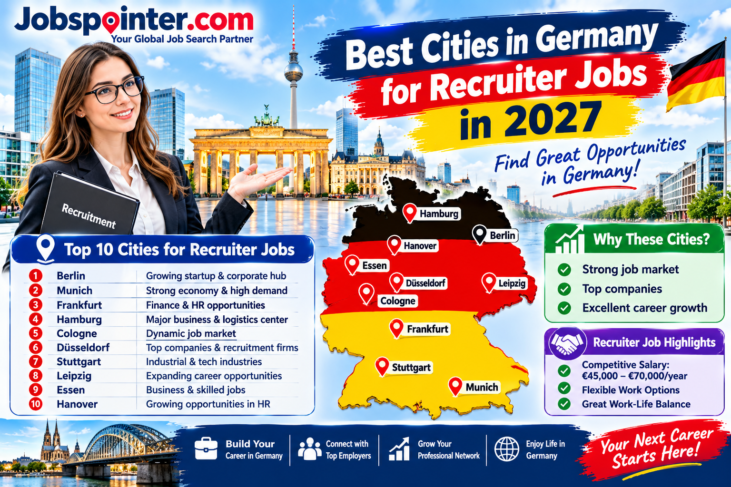
Best Cities in Germany for Recruiter Jobs in 2027
Berlin – Technology and International Recruitment
Berlin is Germany’s startup capital and its most international city. English-speaking workplaces are common, which makes recruitment jobs in Berlin the most accessible entry point for international candidates.
- Who hires: Tech startups, scale-ups (Zalando, N26-type fintechs), global companies’ German HQs, and a dense ecosystem of international recruitment agencies.
- Specialisations: IT recruitment, startup talent acquisition, international candidate sourcing.
- Reality check: Competition is the highest in the country, and salaries are lower than in Munich or Frankfurt — though living costs are also more moderate than Munich’s.
Munich – Corporate Recruitment and Technology Hiring
Munich consistently records Germany’s highest salaries. The Stepstone Salary Report 2026 found a gross median salary of €64,750 in Munich, the highest of any German city — driven by Bavaria’s corporate giants.
- Who hires: BMW, Siemens, Allianz, Munich Re, plus a strong semiconductor and tech sector.
- Specialisations: Engineering recruitment, technical talent acquisition, executive search, insurance and finance hiring.
- Reality check: Germany’s highest living costs. German language skills are expected in most corporate HR roles.
Frankfurt – Banking, Finance, and Professional Recruitment
As Germany’s financial centre, Frankfurt offers the strongest concentration of recruitment consultant jobs in Germany within banking and professional services.
- Who hires: Deutsche Bank, Commerzbank, ECB, Big Four consultancies, international law firms, and executive search firms.
- Specialisations: Financial services recruitment, executive search, accounting and compliance staffing.
- Language: English is widely used in international finance; German strongly preferred for agency roles.
Hamburg – Logistics, Trade, and Corporate HR Jobs
- Who hires: Shipping and logistics leaders (Hapag-Lloyd, Airbus operations), media companies, and consumer brands.
- Specialisations: Logistics and supply chain recruitment, media and digital hiring, corporate talent acquisition.
- Salary context: Gross median of €60,000 (Stepstone 2026) — strong, with more moderate living costs than Munich.
Düsseldorf – Recruitment Consulting and Business Services
- Who hires: Corporate headquarters (Henkel, Vodafone Germany), professional services firms, and — notably — major recruitment agencies themselves. Stepstone Group is headquartered in Düsseldorf.
- Specialisations: Sales recruitment, consumer goods hiring, agency recruitment consulting.
- Advantage: The Rhine-Ruhr region is Germany’s largest urban area — a massive client base within commuting distance.
Stuttgart – Automotive and Engineering Recruitment
- Who hires: Mercedes-Benz, Porsche, Bosch, and hundreds of automotive suppliers (the Mittelstand backbone).
- Specialisations: Engineering recruitment, technical talent acquisition, skilled trades and manufacturing workforce hiring.
- Reality check: Excellent for engineering recruiters; fewer English-only roles than Berlin or Frankfurt.
Cologne – Media, Technology, and Corporate Recruitment
- Who hires: Media and entertainment companies, insurers (Generali Deutschland, AXA), trade fair and events businesses, and a growing tech scene.
- Specialisations: Sales and marketing recruitment, media hiring, corporate HR.
- Note: Proximity to the Rhine-Ruhr market gives agency recruiters a wide territory.
Leipzig – Emerging Opportunities at Lower Cost
- Who hires: Logistics operators (DHL’s major hub), BMW’s plant, Amazon, and expanding business services firms.
- Specialisations: Logistics recruitment, manufacturing hiring, high-volume staffing.
- Advantage: Leipzig’s median salary is €51,250 (Stepstone 2026), but living costs are among the lowest of the cities listed — strong purchasing power for early-career recruiters.
Comparing the Best German Cities for Recruiter Jobs
| City | Main Hiring Industries | Best-Fit Recruitment Specialisations | Language Expectation | Living Cost (relative) |
|---|
| Berlin | Tech, startups, media | IT recruitment, international TA | English widely accepted | Moderate–high |
| Munich | Automotive, insurance, tech | Engineering, executive search | German usually required | Very high |
| Frankfurt | Banking, finance, consulting | Financial services, executive search | English accepted in international firms | High |
| Hamburg | Logistics, shipping, media | Supply chain, corporate HR | German preferred | Moderate–high |
| Düsseldorf | HQ corporations, agencies | Sales, agency consulting | German preferred | Moderate–high |
| Stuttgart | Automotive, engineering | Technical/engineering recruitment | German usually required | High |
| Cologne | Media, insurance, events | Sales & marketing recruitment | German preferred | Moderate |
| Leipzig | Logistics, manufacturing | High-volume staffing | German usually required | Low |
Opportunity ratings are qualitative and based on job listings observed in October–November 2026. They indicate current market direction, not guaranteed 2027 vacancy numbers.
Recruiter Salary Expectations Across German Cities in 2027
There is no single “recruiter salary in Germany” — it depends on city, sector, and whether you are in-house or agency-based.
Verified context (Stepstone Salary Report 2026, published 7 January 2026, based on 1.3 million data sets):
| City | Gross Median Salary (all professions) |
|---|
| Munich | €64,750 |
| Frankfurt | €64,000 |
| Hamburg | €60,000 |
| Leipzig | €51,250 |
| Germany (national) | €53,900 |
What this means for recruiters specifically:
- In-house recruiters typically earn a stable gross annual salary near their city’s median, plus benefits.
- Recruitment consultants often start lower (€40,000–€48,000 base is common in agency listings) but add uncapped commission — experienced consultants in Munich or Frankfurt commonly out-earn in-house peers.
- Experience premium: Across all professions, career starters earn a median of €46,250 while those with 6+ years of experience earn €55,500+ (Stepstone 2026).
- Compare salary to rent. A €55,000 salary in Leipzig delivers far more disposable income than the same salary in Munich.
Which Recruitment Specialisations Have Strong Career Potential in Germany?
- IT and technology recruitment – chronic developer shortage nationwide.
- Engineering and manufacturing recruitment – concentrated in Bavaria and Baden-Württemberg.
- Healthcare recruitment – nurses and doctors are officially sought-after occupations.
- Finance and banking recruitment – Frankfurt-centred.
- Executive search – high-margin, senior-only, German-language territory.
- International talent acquisition – growing as employers target global hiring pipelines.
- Sales and commercial recruitment – steady demand in every major city.
Skills and Qualifications Needed to Become a Recruiter in Germany
- Proven candidate sourcing and interviewing skills
- Applicant Tracking Systems (ATS) such as SAP SuccessFactors or Workday
- LinkedIn Recruiter and boolean sourcing techniques
- Understanding of German employment law basics (works councils, notice periods, fixed-term rules)
- German (B2+) and English (C1) for most roles
- Data-driven, AI-assisted hiring literacy — the 2027 recruiter uses automation for screening, not instead of judgement
Can International Candidates Find English-Speaking Recruiter Jobs in Germany?
Yes — with realistic expectations:
- English-first hiring exists in Berlin startups, Frankfurt’s international finance sector, and global tech companies.
- German multiplies your options — especially for agency recruitment consultant jobs, where client-facing work is often German-language.
- Work authorisation: Germany’s Skilled Worker visa (Sections 18a/18b of the Residence Act) requires a concrete job offer and a recognised qualification. Full official guidance: Make it in Germany – Visa for Skilled Workers. Note the minimum salary threshold of €55,770 applies to applicants over 45.
- Where to search: the Make it in Germany job listings database, LinkedIn, and EnglishJobs.de.
How to Choose the Right German City for Your Recruitment Career
- Match your specialisation to the city’s industries (see table above)
- Compare salary against rent — use Stepstone’s salary comparison tool (German)
- Check language requirements in actual job ads, not assumptions
- Consider hybrid recruitment roles — many agencies now hire recruiters for national coverage regardless of office location
How to Find Recruiter Jobs in Germany in 2027
- Search German and international portals (StepStone, Indeed Germany, EnglishJobs.de)
- Explore recruitment agency career pages directly — Hays, Robert Walters, PageGroup, and Michael Page all maintain German offices
- Optimise your LinkedIn with recruitment metrics (time-to-fill, placements per quarter, source-of-hire data)
- Prepare a Germany-focused CV (photo optional, no personal details like age, concise format)
- Apply directly to employer career portals for in-house roles
- Prepare for interviews in German or English depending on the posting
Frequently Asked Questions
1. Which city in Germany has the most recruiter job opportunities?
Based on current listings, Berlin leads in total volume, followed by Munich and Frankfurt — though the best city for you depends on your specialisation.
2. Are recruiter jobs in demand in Germany in 2027?
Yes. Persistent skilled-worker shortages mean employers continue investing in talent acquisition; recruitment roles consistently appear across all major job portals.
3. Can foreigners work as recruiters in Germany?
Yes, with a job offer and appropriate work authorisation, typically via the Skilled Worker visa. See the official Make it in Germany portal.
4. Which German city offers the highest recruiter salaries?
Munich records the highest gross median salary of any German city at €64,750 (Stepstone 2026), though it also has the highest living costs.
5. Can I get a recruiter job in Germany without speaking German?
Yes — primarily in Berlin’s tech sector, Frankfurt’s international finance industry, and global companies — but German skills at B2 level significantly expand your options.
6. What qualifications are required to become a recruiter in Germany?
There is no regulated licence. Employers typically look for recruitment experience, ATS/sourcing tool proficiency, and communication skills; an HR or business degree is advantageous but not mandatory.
7. How much does a recruiter earn in Germany?
In-house recruiters typically earn near their city’s median (€52,000–€65,000 gross depending on location); agency consultants combine a lower base with commission.
8. Which industries hire the most recruiters in Germany?
IT/technology, engineering and manufacturing, healthcare, finance, and professional services.
9. Are recruitment consultant jobs available in English?
Some — particularly international agencies in Berlin and Frankfurt — but the majority of agency consulting roles require German for client management.
10. Is Berlin or Munich better for HR jobs?
Berlin for volume, international exposure, and English-speaking roles; Munich for salary and corporate/engineering specialisation. Choose based on your language skills and industry focus.
Conclusion
There is no single “best” city — there is only the best city for your profile. IT recruiters should start with Berlin; engineering recruiters with Stuttgart or Munich; finance recruiters with Frankfurt; cost-conscious newcomers with Leipzig or Cologne. Compare real vacancies, verify salaries against living costs, and be honest about your German level before relocating. Ready to start your search? Explore current recruiter and HR opportunities across Germany on Jobspointer.com.