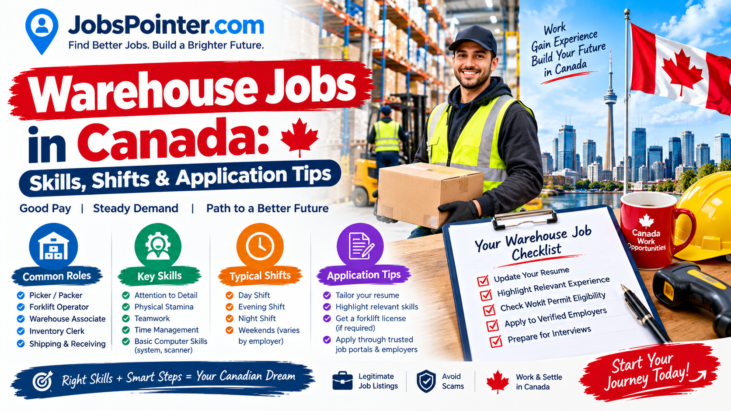
Warehouse Jobs in Canada: Skills, Shifts and Application Tips
Warehouse jobs in Canada cover a wide range of work, from picking and packing orders to operating a forklift or supervising a team. Employers set their own requirements, and the rules for who may work in Canada depend on each person’s situation. That is why it helps to understand the roles, skills, shift patterns and application steps before you apply.
This guide explains what warehouse workers do, which skills and training employers may ask for, how shifts work, where to look for genuine vacancies and how to prepare an honest application. It also explains the difference between a job offer and permission to work in Canada, and how to spot misleading visa sponsorship claims. The information was checked against Government of Canada sources on 19 October 2026. It is general guidance, not legal or immigration advice.
What Are Warehouse Jobs in Canada?
What Does a Warehouse Worker Do?
Job Bank, the Government of Canada’s job site, groups much of this work under material handlers (NOC 75101). Material handlers load, unload and move products by hand or with equipment, and count, sort, pack and unpack goods. Some drive industrial trucks to move and store items. Job Bank lists “forklift truck operator” and “warehouseman/woman” among the job titles for this group (Job Bank: Material handlers).
Related work falls under shippers and receivers (NOC 14400). These workers check incoming goods against invoices, prepare shipping documents, record shortages, direct stock to storage areas and keep records (Job Bank: Shipper-receiver).
NOC stands for National Occupational Classification, the system Canada uses to describe occupations. Knowing the code helps you search Job Bank accurately.
Industries That Hire Warehouse Workers
Job Bank says material handlers work for transportation, storage and moving companies, manufacturers, processors, and retail and wholesale warehouses. Shippers and receivers appear in the public sector, retail, wholesale and manufacturing. In practice, that means online retail fulfilment, grocery and food distribution, trucking and logistics, and factories.
Entry-Level and Experienced Warehouse Positions
Many roles are entry level, such as general warehouse associate or picker and packer. More experienced roles include forklift operator, inventory control and supervisor positions. Job Bank’s pages for these two occupations did not state formal education requirements, so check each advert. Employers may ask for experience, safety certificates or both.
Common Types of Warehouse Jobs in Canada
Requirements vary by employer and position. Treat the table as a guide, not a rule.
| Role | Typical responsibilities | What employers may ask for |
|---|---|---|
| Warehouse associate | Load and unload, sort, stock shelves, general support | Ability to lift safely, reliability, teamwork |
| Order picker and packer | Pick items from orders, pack, label, meet accuracy targets | Attention to detail, scanner or system use |
| Shipping and receiving clerk | Check goods against paperwork, prepare shipping documents, record damage or shortages | Basic computer and record-keeping skills |
| Inventory control assistant | Count stock, update records, investigate discrepancies | Numeracy, spreadsheet or inventory software skills |
| Forklift operator | Move pallets and stock safely with a forklift | Valid forklift training or certification, as required where you work |
| Warehouse supervisor | Lead staff, plan tasks, enforce safety rules | Previous warehouse experience, leadership skills |
Job titles differ between employers. “Material handler”, “warehouse worker” and “order selector” can describe similar work.
Skills and Qualifications Required for Warehouse Jobs
Physical Stamina and Safe Manual Handling
Many roles involve standing, walking and lifting for long periods. Employers value people who lift safely, follow procedures and report hazards. Be honest about what you can do, and ask about any physical requirements before you accept an offer.
Communication and Teamwork
Warehouses depend on clear communication, including with supervisors, drivers and colleagues. Basic spoken English or French, depending on the region, helps you understand safety instructions and labels. Employers set their own language expectations.
Attention to Detail and Basic Numeracy
Picking the wrong item or miscounting stock costs time and money. Employers look for accuracy with quantities, product codes and dates.
Computer and Inventory System Skills
Many warehouses use handheld scanners and inventory software. Shipping and receiving work may also involve invoices and electronic records. If you have used scanning or stock systems before, say so.
Education, Experience and Training Requirements
There is no single national requirement. Some adverts ask for no experience, others ask for a secondary school diploma, forklift certification or previous warehouse work. Read each advert and match it honestly to your background.
Workplace Safety and Equipment Training
Occupational health and safety rules are set by federal, provincial and territorial authorities, so training requirements can differ by where you work. The Canadian Centre for Occupational Health and Safety (CCOHS) publishes forklift safety fact sheets covering pre-use checks, load handling, traffic and operator competence (CCOHS forklift safety). For the rules that apply to you, check your provincial workplace safety regulator and ask the employer what training they provide.
Warehouse Work Shifts in Canada
Shift patterns depend on the employer, the product and the season. The descriptions below are general and are not industry standards. Always confirm hours, days and notice periods in the job advert or offer.
Day Shifts
Day shifts usually run during daytime business hours. They can suit people with childcare or study commitments, and they are often busy with deliveries and administration.
Evening Shifts
Evening shifts often cover order picking, sorting and loading for next-day delivery. Check how you will travel home if public transport is limited late at night.
Night Shifts
Some warehouses operate around the clock, so night work does exist, but not every employer offers it. Ask whether a night premium applies and how many consecutive nights you would work.
Rotating Shifts, Weekend Work and Overtime
Some employers rotate workers between day, evening and night shifts, and some ask for weekend work during busy periods. Overtime rules depend on the province. In Ontario, for example, most employees get overtime pay at one and a half times their usual rate after 44 hours in a week, though some jobs are exempt (Ontario overtime pay). Check your own province’s rules.
How to Find Warehouse Jobs in Canada
Search on Reputable Canadian Job Websites
Start with Job Bank, which lets you search by keyword and location and filter by hours of work, benefits and salary. Large commercial job boards can also be useful. You can browse current openings on the Jobspointer job listings page.
Check Employer Career Pages
If you see a vacancy on a job board, look for the same posting on the employer’s official website. Genuine employers usually list roles on their own career pages.
Use Relevant Job Titles and Keywords
Try these search phrases, with your city or province added:
- warehouse associate
- material handler
- order picker
- picker packer
- shipper receiver
- forklift operator
- inventory clerk
Check Location, Duties, Pay and Employment Type
Before applying, confirm the work location, main duties, hourly pay, expected hours, and whether the job is full time, part time, temporary or permanent. Be cautious if an advert leaves these details out.
Verify Whether the Employer Can Hire Foreign Workers
Job Bank states that if you are not legally authorised to work in Canada, you cannot apply for every job on the site, and most employers will not hire you without a valid visa or work permit. An employer’s willingness to consider foreign applicants must be stated or confirmed by the employer. Do not assume it.
How to Apply for Warehouse Jobs in Canada
Prepare a Canadian-Style Resume
Keep it to one or two pages, in plain formatting. List your name, city or province, phone and email, then work history in reverse order (newest first), skills, certificates and education. Canadian resumes generally leave out a photo, date of birth and marital status. For more help, read our practical CV guide or try the Jobspointer Resume Builder.
Write a Short, Job-Specific Cover Letter
Three or four short paragraphs are enough. Name the job, mention one or two relevant strengths, and state your availability. Our UK cover letter guide shows the structure, which you can adapt for Canada.
Highlight Relevant Skills and Transferable Experience
Retail, farm, factory, driving and delivery work can all show transferable skills. Here is a short example you can adapt only if it accurately describes your experience:
Picked and packed [number] orders per shift using a handheld scanner, checking items against pick lists to keep errors low.
Replace the details with your own facts. Never invent a job, a certificate or a result.
Complete the Application Carefully
Answer every question, use the same name as on your identity documents, and upload the file type requested. Be accurate about your work eligibility. If a form asks whether you are legally able to work in Canada, answer truthfully.
Prepare for Warehouse Job Interviews
Expect questions about safety, teamwork, reliability and past experience. Prepare a few real examples, such as how you handled a mistake or a tight deadline. See Canada job interview questions and sample answers for practice.
Follow Up Professionally
If the advert allows it, send a brief, polite email a few days after your interview to thank the interviewer and restate your interest. Do not send repeated messages.
Can Foreigners Apply for Warehouse Jobs in Canada?
In short: Some can, but a job offer is not the same as permission to work. Eligibility depends on your circumstances, the job, the employer and current rules.
Applying from Outside Canada
You can apply from another country, including Nepal, but you must be legally authorised to work in Canada before you start. Whether you need a work permit, and which type, depends on your situation. Use official tools rather than an agent’s claim.
Understanding Work Permit Requirements
Immigration, Refugees and Citizenship Canada (IRCC) describes two main kinds of work permit. An employer-specific permit requires a job offer. An open work permit does not require one (IRCC: Work in Canada). IRCC provides a tool to help you find the permit that matches your circumstances.
Employer-Specific Work Permits and LMIA
A Labour Market Impact Assessment (LMIA) is a document an employer may need from Employment and Social Development Canada (ESDC) before hiring a temporary foreign worker. ESDC says the low-wage stream applies to positions paid below the provincial or territorial hourly wage threshold (ESDC: Hire a foreign worker).
Two points matter for warehouse applicants:
- An LMIA does not guarantee a work permit. It is one step in the employer’s process.
- Some low-wage LMIA applications are refused processing. ESDC says it refuses low-wage applications in a census metropolitan area when that area’s unemployment rate is 6% or higher at the time of submission. ESDC’s list is updated every three months, and its current period runs from 9 October 2026 to 7 January 2027. Exceptions include primary agriculture, construction, food manufacturing and certain care sectors. Warehousing is not on that list of exceptions (ESDC: Refusal to process). Rules change, so check the page before relying on this.
How to Check Visa Sponsorship Claims
“Visa sponsorship” is used loosely in job adverts, and none of the official pages above use it to describe work permits, so ask exactly what the employer means. Use this checklist:
- Ask whether the employer has applied for, or holds, an LMIA, or whether the job is exempt from one.
- Check that the job advert is on Job Bank or the employer’s official website.
- Ask for the offer in writing. ESDC says the employment agreement must match the offer in occupation, wages and working conditions.
- Never accept a promise that a permit is guaranteed.
- Confirm any paid representative is authorised. IRCC says consultants, lawyers and Quebec notaries must be licensed to give immigration advice (IRCC: Protect yourself from fraud).
Warehouse Jobs in Canada: Pay and Employment Benefits
What Affects Warehouse Worker Wages?
Pay depends on the province or city, the employer, the skills required (forklift work often pays differently from general labour), the shift and your experience. Unionised workplaces may follow a collective agreement.
Hourly Pay, Overtime and Shift Premiums
Job Bank publishes wage ranges for material handlers (NOC 75101). The figures below are gross hourly wages in Canadian dollars, from Statistics Canada’s Labour Force Survey for 2023–2024, last updated by Job Bank on 19 November 2025.
| Area | Low | Median | High |
|---|---|---|---|
| Toronto region (Ontario) | $17.95 | $21.00 | $29.00 |
| Ontario | $17.95 | $21.50 | $29.96 |
| Canada | $16.55 | $22.00 | $30.29 |
Source: Job Bank wages, Material handler, Toronto. These are published ranges, not a guarantee of what any employer will pay, and wages differ by province. “Gross” means before tax and deductions, so your take-home pay will be lower. Ask whether the job includes shift premiums or overtime.
Benefits, Paid Leave and Employment Conditions
Ask about paid vacation, public holidays, health or dental benefits, pension or savings plans, breaks, uniform and safety equipment, and probation periods. Entitlements vary by province and employer.
How to Compare Job Offers
| Question | Why it matters |
|---|---|
| What is the hourly rate, and how often is it paid? | Lets you compare real earnings |
| Are overtime and shift premiums stated in writing? | Avoids surprises |
| How many hours per week are guaranteed? | Part-time hours may vary |
| What benefits start immediately, and which start after probation? | Affects total value |
| How will I get to work, and at what cost? | Travel can reduce your income |
| Does the contract match the advert? | A mismatch is a warning sign |
Tips to Avoid Warehouse Job Scams
Verify the Employer and Job Advertisement
Search for the company’s official website and phone number, then contact it directly, not through details in a message. The Canadian Anti-Fraud Centre lists warning signs including a free web email address instead of a company domain, an offer for a job you never applied for, and pay that seems too high for little work (Canadian Anti-Fraud Centre: Job scams).
Be Careful with Upfront Recruitment Fees
The same centre lists requests for upfront fees or deposits as a warning sign. For temporary foreign workers, ESDC says employers and their recruiters cannot charge or recover recruitment fees from workers, though workers still pay government fees for visas and permits (ESDC: regulatory amendments). If someone asks you for money to “secure” a job, stop and verify.
Never Trust Guaranteed Visa or Job Claims
No private agent can guarantee a work permit, a visa or a job. Official decisions are made by the Government of Canada.
Verify Immigration Advice Through Official Sources
IRCC says scams can arrive through fake websites, social media, email, phone calls and AI-generated content. Use canada.ca pages directly and confirm that any paid adviser is authorised. If you suspect fraud, contact your local police or the Canadian Anti-Fraud Centre at 1-888-495-8501. For more on safe searching, see our guides on checking a genuine job offer (the checks apply to Canada too) and finding jobs abroad safely.
Practical Checklist Before Applying
| ✓ | Check |
|---|---|
| ☐ | I know whether I am legally allowed to work in Canada, or what permit I would need |
| ☐ | I have read the official IRCC and ESDC pages for my situation |
| ☐ | My resume is accurate, one to two pages, and tailored to the job |
| ☐ | I have matched my experience to the advert’s requirements |
| ☐ | I found the job on Job Bank or the employer’s official site |
| ☐ | I checked the location, duties, hourly pay, hours and employment type |
| ☐ | The employer has a verifiable website, address and phone number |
| ☐ | Nobody has asked me for money to secure the job |
| ☐ | I will keep copies of the advert, messages and any offer in writing |
Frequently Asked Questions
Can I get a warehouse job in Canada without experience?
Often yes for entry-level roles, but it depends on the employer. Some adverts ask for no experience, while others require previous warehouse work or safety certificates. Highlight transferable skills such as reliability, teamwork and physical stamina, and apply for roles that clearly accept beginners.
Can I apply for warehouse jobs from Nepal?
You can apply, but employers can only hire you if you are legally authorised to work in Canada. Requirements depend on your circumstances and the job. Check IRCC’s work permit pages and verify the employer before sharing documents or paying anyone.
Do Canadian warehouse jobs offer visa sponsorship?
Some employers may hire foreign workers, but many do not, and the term “sponsorship” is often used loosely. An employer may need an LMIA, and some low-wage LMIA applications are currently refused processing in high-unemployment areas. Ask for details in writing and check official sources.
Do I need IELTS for a warehouse job in Canada?
Employers usually set their own language expectations, and the Job Bank occupation pages I reviewed did not list IELTS as a requirement. Some immigration programs do require language tests, so check the rules for your permit type on the IRCC website.
What skills are most important for warehouse workers?
Safe lifting, attention to detail, reliability, teamwork and basic communication matter most. Experience with scanners, inventory systems or forklifts can help. Employers vary, so match your skills to each advert and be ready to give a real example of each.
Are night shifts common in Canadian warehouses?
Night shifts exist, particularly in facilities that run around the clock, but not every employer offers them. Patterns differ by company and season. Ask about shift hours, notice periods, rotations and any night premium before accepting a job.
How can I verify a warehouse job offer?
Find the employer’s official website and contact it using details you found yourself. Check whether the job appears on Job Bank or the employer’s career page. Be wary of free email addresses, requests for money or promises of guaranteed visas. Get the offer in writing.
Final Thoughts
The strongest applications match your real skills to real vacancies. Read each advert closely, prepare an honest resume, check the shift pattern and the pay, and verify the employer through official channels before you share personal documents. If you are applying from outside Canada, remember that a job offer and permission to work are different things. Check the current IRCC and ESDC pages for your situation, and treat any promise of a guaranteed visa or job as a warning sign.
Disclaimer: This article offers general information, not legal or immigration advice. Employer requirements, wages and immigration rules change. Verify details with official Government of Canada sources.