How to Check Whether a Job Offer in Poland Is Genuine
Jobseekers from Nepal, India, Bangladesh, the Philippines and other countries are sometimes asked to pay for Polish jobs that are misdescribed, unconfirmed or simply do not exist. The cost can be heavy: lost savings, a refused visa, or a journey with no legal work waiting at the end. Learning how to check whether a job offer in Poland is genuine takes a little time, and most of the tools are free public registers. This guide walks you through ten practical checks: confirming the employer, searching the official agency register (KRAZ), reading the advertisement and contract, understanding work permits and visas, handling fees, recognising scams and reporting fraud. No single check proves an offer is real, so use them together.
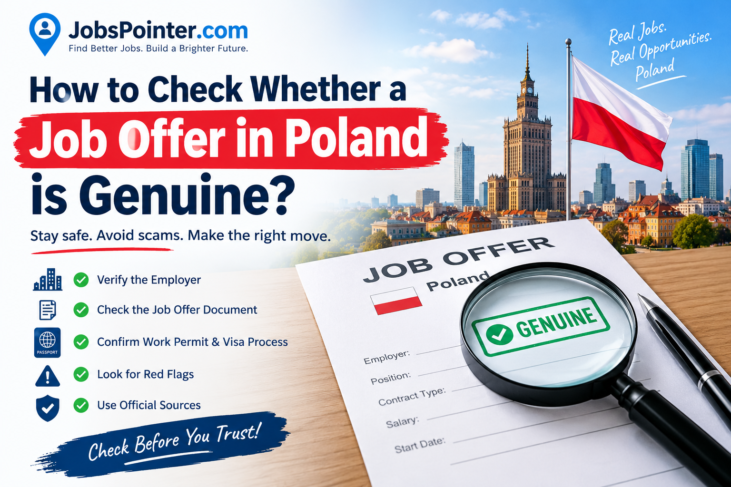
The short answer: five checks before you pay or travel
| Step | What to do | Official tool |
|---|---|---|
| 1 | Confirm the employer exists and matches the offer | biznes.gov.pl (CEIDG and KRS company searches) |
| 2 | If an agency is involved, check it is registered | KRAZ register |
| 3 | Compare the vacancy with public listings | Central job offers database |
| 4 | Ask for a written contract and read every term | Your own review; free advice from PIP |
| 5 | Never pay or send passport scans until steps 1 to 4 are done | Your own rule |
1. Check Whether the Employer Is a Real Company
A genuine offer starts with a genuine employer. Spend time here before you speak to any agent.
Find the Official Website and Contact Details
Look for a company website with a full legal name, a physical address in Poland, a Polish tax number (NIP) and a working phone number. A free email address (Gmail, Yahoo) as the only contact is a warning sign, though not proof of fraud on its own. Note down the exact company name from the offer letter; you will need it for the next step.
Verify the Registered Business Information
Poland keeps two main public registers of businesses:
- KRS (National Court Register): the main register for companies such as limited liability companies and joint-stock companies. Search it at the Ministry of Justice KRS search.
- CEIDG: the register of sole traders. Search it through biznes.gov.pl, which also covers company searches.
Search by the NIP or KRS number rather than only by name, because names can be similar. Check that the registered name, address and status match the documents you received. Polish tax authorities also publish a VAT taxpayer ‘White List’ on podatki.gov.pl, which can help confirm a business’s tax identity.
Important: a real company does not automatically mean a real job offer. Scammers sometimes copy the details of genuine businesses.
Contact the Employer Independently
Do not use only the phone number or email supplied by the agent. Find the company’s contact details yourself from its official website or the register entry, then ask whether the vacancy exists and whether the person recruiting you represents them. Send the message to a general or HR address, not to a private number.
2. Verify the Recruitment Agency in Poland
What Is the KRAZ Register?
KRAZ (Krajowy Rejestr Agencji Zatrudnienia) is Poland’s National Register of Employment Agencies. According to the EURES guidance on working in Poland, an employment agency providing job placement services must hold a KRAZ entry to operate legally. Those services include referring foreigners to employment in Poland, referring people to work abroad for foreign employers, collecting and sharing vacancy information through ICT systems, and temporary work. The register is kept by provincial marshals, who issue a certificate of entry (Your Europe, gov.pl).
Two cautions apply:
- Registration depends on the entity and the service it provides. Not every website that shows job adverts must be registered as an employment agency.
- Some foreign entities may offer placement in Poland without a KRAZ entry if they are authorised in their home country. These appear on a separate list of foreign entities.
How to Search the Official Register
- Open the KRAZ register (the site is mainly in Polish; your browser’s translate function helps).
- Search for the agency’s exact legal name or registration details.
- Compare the entry with what the recruiter gave you: legal name, address, the services listed, and the certificate number if one is shown.
- Ask the recruiter for a copy of the certificate of entry and check that the details match the register.
If the person contacting you uses a different company name from the registered one, or works from a brand you cannot link to any entry, ask them to explain in writing.
What to Do if the Agency Cannot Be Verified
An agency missing from KRAZ is not automatically illegal (see the exceptions above), but it is a reason to pause. Ask which legal basis allows it to operate, check whether it appears on the foreign entities list, and contact the relevant provincial marshal’s office or PIP for clarification. Do not pay while this is unresolved.
3. Check the Job Advertisement Carefully
Review the Job Description and Workplace
A genuine advertisement usually states:
- The employer’s legal name and location of work
- The job title and main duties
- The contract type
- Pay, working hours and any accommodation terms
- How to apply, through an official channel
Compare the vacancy with listings on the government’s job offers database, where district employment offices publish offers, and with the employer’s own careers page.
Compare Salary, Working Hours and Benefits
Poland has a statutory minimum wage. For 2026 it is PLN 4,806 gross per month for full-time work, and PLN 31.40 gross per hour for certain civil-law contracts (DLA Piper summary of the government regulation). Pay far below this for full-time work deserves a written explanation. Remember that quoted salaries are usually gross, so the amount you receive after tax and social contributions will be lower.
Identify Unrealistic Promises
| Claim in the offer | Why to be careful |
|---|---|
| ‘Guaranteed visa’ | No agent or employer controls visa decisions |
| ‘No experience, very high salary’ | Pay that looks far above the market for the role needs evidence |
| ‘Free accommodation, food and flights’ with no written terms | Costs may be hidden in deductions |
| ‘Pay today to hold your place’ | Pressure to pay quickly is a common fraud pattern |
4. Verify the Job Offer Letter and Employment Contract
Check Employer and Position Details
The employer named in the offer letter should match the register entry exactly. Check the job title, workplace address, start date, contract type, working hours and pay. Official guidance on work permits notes that the employer must conclude a written contract with the foreigner consistent with the permit conditions (Polish migrant information site). Since 1 June 2025, employers using the online work permit route must also upload a copy of the signed contract before the foreigner starts work (TGC publication).
Review Salary, Deductions and Accommodation
Ask for these terms in writing:
- Gross monthly or hourly pay and how often you are paid
- Overtime and night-work rules
- Any deductions for housing, transport, equipment or insurance, with amounts
- Whether accommodation is arranged by the employer or a third party, and whether it is optional
- Notice period and termination terms
Understand the Difference Between an Offer Letter and a Contract
| Document | What it is | What it does not do |
|---|---|---|
| Job offer letter | An invitation or proposal to employ you | It is not a work permit or visa |
| Employment contract | The legal agreement setting duties, pay and conditions | It does not by itself give you the right to enter or work in Poland |
| Work permit | Authorisation to work for a named employer, issued to the employer’s application | It is not a visa or residence permit |
| Visa or residence permit | Permission to enter or stay | It does not authorise work unless the basis of stay allows it |
If you cannot read the language of the contract, ask for a translation and keep both versions.
5. Check Work Permit and Visa Claims
Determine Whether Work Authorisation Is Required
Requirements depend on your nationality, your basis of stay and the type of work. Many non-EU nationals need a work permit or another form of authorisation, but some categories are exempt, such as holders of certain residence permits. Do not rely on an agent’s word; check your own case with the Polish work-permit information page or the voivodeship office.
Understand the Employer’s Responsibilities
In the standard route, the work permit is requested by the employer, not by the worker. The permit is issued by the voivode and names the employer, the position and the validity period (Public Employment Services, work permits). Since 1 June 2025, applications and declarations for entrusting work to foreigners are filed through the praca.gov.pl portal (ATL Law summary). A different route, the temporary residence and work permit, is applied for by the foreigner in the MOS system, with the employer completing an annex (gov.pl guide).
The key point for jobseekers: an agent should not need to charge you to ‘buy’ a work permit on your behalf. Ask which route applies and who is the applicant.
Verify Supporting Documents Through Appropriate Authorities
This is a limitation worth stating clearly. We could not confirm a single public tool that lets any jobseeker look up a work permit by number. Instead:
- Ask the employer for the case reference and which voivodeship office handled it.
- Contact that voivodeship office to ask how a document can be confirmed.
- For visas, contact the Polish embassy or consulate that processes visas in your country.
- Treat any ‘verification service’ that charges a fee and is not an official government body with suspicion.
Understand Why a Job Offer Does Not Guarantee a Visa
A work permit and a visa are decided by different authorities. Even with a valid permit, the visa application is a separate procedure, and appointment availability and processing are separate from the employer’s permit case. A genuine employer cannot promise a visa outcome.
6. Be Careful With Recruitment Fees and Advance Payments
Understand the Rules on Recruitment Agency Fees
Official Polish guidance says employment agencies may not charge fees to people for whom they find work, with limited exceptions for costs actually incurred, listed as travel abroad and back, medical examinations, document translation and visa costs (Your Europe, gov.pl). That wording appears in the context of referral to work abroad. For foreigners recruited to work in Poland, exact rules and exceptions can differ, so ask any agency to cite the specific legal basis in writing and check with PIP or the provincial marshal.
Recognise Suspicious Payment Requests
- Fees described as ‘registration’, ‘job guarantee’, ‘permit processing’ or ‘slot booking’
- Payment to a personal bank account, mobile wallet or cryptocurrency address
- No receipt, invoice or written agreement
- Pressure such as ‘only two places left’
Check Any Permitted Expenses and Written Agreements
If any expense is requested, ask for an itemised written agreement showing what each amount covers, who receives it, and whether it is refundable. Pay the actual provider (for example, a clinic or visa centre) directly where possible, and keep receipts.
7. Identify Common Poland Job Offer Scams
Guaranteed Visa and Guaranteed Job Claims
No private party can guarantee either. Treat these phrases as a signal to verify, not to pay.
Fake Work Permits and Forged Documents
If you are sent a permit or visa document, do not assume it is real because it has stamps or a logo. Ask which office issued it and follow the confirmation steps in Section 5. Never use or submit documents you believe are false: doing so can lead to refusal, removal or legal trouble.
Impersonated Employers and Suspicious Email Addresses
Check that the sender’s email domain matches the company’s official website. Look for slight misspellings, or a real company name used with a free email address. Confirm the recruiter’s identity through the company’s published contacts.
Urgent Payment Demands and Unnecessary Data Requests
Share a passport copy, bank details or ID only after you have confirmed who is receiving them and why. A genuine employer does not need your online banking login or card PIN.
8. Contact the Employer Before Accepting the Offer
Questions to Ask the Hiring Manager
- What is the company’s legal name and registered number?
- Who will be my direct employer: your company, or a staffing agency?
- What is my exact job title, workplace address and contract type?
- What will I be paid, and what deductions apply?
- Which work authorisation route will you use, and who is the applicant?
- Can I speak with someone in HR by video?
Confirm the Vacancy Independently
Use the employer’s official contacts to ask whether the position exists and whether the named recruiter is authorised. Check the government job offers database and the employer’s own careers page.
Respond to Inconsistent or Evasive Answers
If details change between messages, the recruiter avoids written answers, or refuses a video call, stop and wait. A genuine employer will accept a reasonable request for verification.
9. What to Do if You Suspect a Fake Job Offer
Stop Payments and Preserve Evidence
Stop sending money. Save messages, screenshots, receipts, bank details, phone numbers, email headers, the advertisement and any documents you received. Do not delete the chat.
Contact Your Bank if Money Has Been Sent
Contact your bank or payment provider immediately, explain it is a suspected fraud, and ask whether the transfer can be recalled or flagged. Success is not guaranteed, and speed matters.
Report the Suspected Fraud to Appropriate Authorities
- Report to the police in the country where you paid or live, and to Polish police if you are in Poland (emergency number 112).
- If the matter involves employment in Poland, you can seek free advice from the State Labour Inspectorate (PIP), which offers legal advice to interested parties (PIP news).
- Inform your own country’s foreign employment authority or embassy, if one exists, and the Polish embassy or consulate if a visa is involved.
- Report the advertisement to the platform that hosted it.
10. Genuine Poland Job Offer Verification Checklist
Use this before you accept an offer, pay any fee, send sensitive documents or travel.
Employer
- Registered name, address and status confirmed in KRS or CEIDG
- Contact details found independently, not just from the recruiter
- Vacancy confirmed by the employer directly
Agency (if any)
- Name found in the KRAZ register, or a clear legal basis for not being listed
- Certificate details match the register
- Recruiter’s identity linked to the agency in writing
Offer and contract
- Written contract received and read in full
- Pay, hours, deductions, housing and notice terms are clear
- Pay is at or above the statutory minimum for the work described
Work authorisation and visa
- You know which permit route applies and who applies
- No one has guaranteed a visa
- Documents can be confirmed with the issuing authority
Money and data
- No fee paid before verification
- Any expense is itemised, written and receipted
- Payment goes to a verifiable business account, not a person
- Sensitive documents sent only after identity checks
If any box stays unchecked, pause. A genuine employer or agency should understand.
Frequently Asked Questions
1. How can I verify a job offer in Poland online?
Check the employer in the KRS or CEIDG registers via biznes.gov.pl, search the agency in KRAZ, compare the vacancy with the government job database, and contact the employer through contacts you found yourself.
2. How can I check whether a Polish recruitment agency is genuine?
Search its exact legal name in the KRAZ register. Registration is not required for every entity, and it does not prove every offer is honest, so also verify the specific job and contract.
3. Can I get a Poland job offer without paying an agency fee?
Yes. Official guidance says agencies may not charge jobseekers for finding work, apart from limited documented costs such as travel, medical exams, translation and visa. Ask for the legal basis of any charge in writing.
4. How can I check whether a Poland work permit is genuine?
Ask for the issuing office and case reference, then confirm with that voivodeship office. We could not confirm a public number-lookup tool, so do not rely on an unofficial service.
5. Can I trust a job offer sent through WhatsApp?
Not on that basis alone. Messaging apps are easy to impersonate. Confirm the sender with the employer’s official contacts and move important terms into a written contract.
6. What should I do if I have already paid a fake recruiter?
Stop further payments, keep all evidence, contact your bank quickly, and report to the police and relevant authorities as set out in Section 9.
7. Does a genuine job offer guarantee a Poland work visa?
No. An offer, work permit, visa and contract are separate, and visa decisions are made by the relevant authorities.
8. Can foreigners apply for jobs in Poland directly?
Yes, jobseekers can apply directly to employers, and the government’s job offers database is open to all people interested in work in Poland. Your legal right to work still depends on your permit or residence basis.
Conclusion
Knowing how to check whether a job offer in Poland is genuine comes down to independent verification. Confirm the employer in the official registers, check any agency in KRAZ, read the contract before you commit, understand that a permit, a visa and an offer are different things, and refuse pressure to pay in advance. No single step proves an offer is genuine, but several consistent checks make fraud much easier to spot. Rules on foreign employment change, so confirm current requirements with the official sources linked here or with a qualified adviser before you act. If something feels rushed or unclear, pause and ask for it in writing.