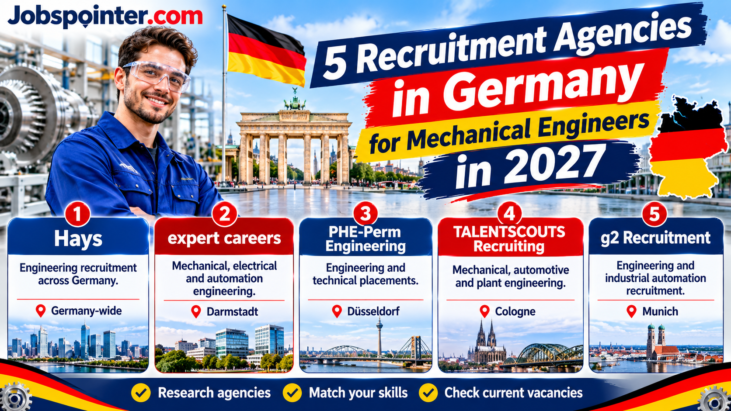
Recruitment Agencies in Germany That Hire Mechanical Engineers in 2027
Germany’s machinery, automotive, energy and manufacturing sectors keep demand for mechanical engineers steady, and many employers hand part of their hiring to specialist recruiters. So yes: mechanical engineering recruitment agencies in Germany, including Hays, Brunel, Unique Engineering, YER and Kontrast Personalberatung, do place engineers in design, production, automation and project roles. The fuller answer is more practical. Agencies are paid by employers, not by you. Most advertised roles are written in German. And no agency can give you the right to work in Germany: that comes from an employer’s job offer plus a visa or residence permit you apply for yourself. This guide explains how each agency works, what international applicants should expect, where the EU Blue Card fits, and how to approach recruiters without wasting applications.
The five engineering recruiters at a glance
| Agency | What it is | How you would be employed | Best suited to | Language signal |
|---|---|---|---|---|
| Hays Germany | Large recruiter with an engineering division | Permanent placement, temporary or freelance | Engineers with some experience who read German | English site; many ads in German |
| Brunel Germany | Engineering and IT service provider | Mostly employed by Brunel for customer projects; some placements | Project, plant and development engineers | An example ad required fluent German and good English |
| Unique Engineering | Engineering brand of Unique Personalservice (RGF Staffing) | Placement or temporary, depending on the role | Mechanical, automotive and aerospace engineers | Website in German |
| YER Germany | Staffing and recruitment firm for engineering, IT and more | Permanent, temporary or freelance | Mobility, tech and energy engineers | German and English site versions |
| Kontrast Personalberatung | Headhunting firm | Permanent placement through direct search | Experienced specialists and managers | German and English site versions |
Based on each agency’s own website, reviewed on 2 November 2026. Open vacancies and overseas hiring must be confirmed with the agency.
Why do mechanical engineers use recruitment agencies in Germany?
Specialist recruiters know which employers are hiring and what a hiring manager will accept. They can put your CV in front of companies you would not find on a job board, and they typically screen CVs, brief you before interviews and handle early salary talks. The catch is that the agency’s client is the employer, not you.
Before contacting anyone, work out which model you are dealing with:
| Model | German term | Who employs you | What to expect |
|---|---|---|---|
| Direct placement | Personalvermittlung | The client company | Usually a permanent contract with the employer |
| Temporary employment | Arbeitnehmerüberlassung (Zeitarbeit) | The agency, which assigns you to a client | Agency contract, work at the customer’s site |
| Freelance contracting | Freelance-Vermittlung | You, as a self-employed person | Project-based and needs its own legal basis to work |
Apply directly when you already know the employer. Use an agency when you want access to many employers at once or to roles that are not widely advertised. In the usual case you do not pay the agency (see the FAQ).
Top recruitment agencies in Germany for mechanical engineers in 2027
1. Hays Germany
Hays is the German arm of an international recruitment group. Its engineering page presents it as a partner for engineers and technicians, from multinational groups to regional market leaders, and says it places people as permanent employees, freelancers and temporary specialists.
What you may find. Postings reviewed while preparing this guide included special-machine design, maintenance engineering, technical quotation work and project management, mostly with machinery and plant manufacturers. Most ads were in German and several named tools such as NX, Creo and SAP. Some roles mean employment with a Hays company for work at the client; others are permanent positions at the client itself, so read the contract line in each ad.
How to apply. The English-language site offers job search, job alerts, a CV upload page, free career services and a salary checker. Hays lists offices in Berlin, Düsseldorf, Frankfurt, Hamburg, Hanover, Cologne, Mannheim, Munich and Stuttgart.
Watch for: the pages reviewed make no visa promise, and many ads expect German.
2. Brunel Germany
Brunel’s job ads describe it as an engineering and IT service provider with more than 35 locations across the DACH-CZ region and a network of about 2,000 engineers and other specialists. The model is largely project-based: engineers are hired by Brunel and work on customer projects, although individual ads can also be direct placements.
What you may find. The Jobs in Engineering & IT section includes mechanical and plant-engineering project roles. At the time of writing, vacancies included project engineers in Düsseldorf and Mannheim, which may have closed by the time you read this. Brunel’s own page sets out its process: application review, an introductory conversation, a project discussion with the customer, then a decision.
How to apply. Use the job search or send an unsolicited application.
Watch for: one mechanical project-engineer posting asked for fluent German and good English and described a permanent contract under Brunel’s own collective agreement. Treat such details as examples, because every posting differs.
3. Unique Engineering
Unique Engineering is the engineering brand of Unique Personalservice GmbH, part of RGF Staffing. Its website names aviation, space, defence, embedded systems, mechanical engineering and automotive as its focus, and mentions development engineers, designers and project leaders. It offers placement and, depending on need, temporary employment.
What you may find. Profession pages cover mechanical engineers, designers, quality engineers and project engineers. The company says its network gives candidates access to positions that are often not advertised publicly. That is its own claim, so ask what is open now.
How to apply. Browse the job listings or send a job enquiry.
Watch for: the site is in German, which is a fair hint about the language of the roles. Ask early whether a project carries extra eligibility conditions, as some defence-related work can.
4. YER Germany
YER Deutschland says it has operated since 2007 and joined the international YER Group in 2024. It recruits for engineering, IT and other fields, mainly for companies in mobility, tech and energy, and offers permanent placement, temporary employment and freelance projects. Its site quotes a talent pool above 300,000, more than 500 client companies, more than 850 open positions and ten locations. These are self-reported marketing figures.
What you may find. The job board mixes permanent and temporary roles; at the time of writing it included a senior mechanical aerospace systems engineer position offered through temporary employment. Reference clients named on the site include BMW Group, Airbus and Bosch.
How to apply. Use the job board, set a job alert or send an unsolicited application. An English version of the site exists.
Watch for: check which legal entity would employ you. A temporary role means a contract with the agency, not the customer.
5. Kontrast Personalberatung
Kontrast is a headhunting and executive-search firm based in Hamburg, with an office in Berlin. Engineering is one of ten sector focuses, alongside medicine, IT, public administration and management. Its engineering page lists mechanical engineering among the fields it covers, next to architecture, construction, electrical, energy and environmental engineering, and says it fills positions through direct approach and executive search for permanent employment.
What you may find. Clients include public employers, mid-sized companies, industrial firms, engineering offices and universities. The engineering vacancies and success stories posted in 2026 leaned towards civil, geotechnical and public-sector roles, so check the vacancies page before assuming a mechanical match.
How to apply. Join the talent pool or respond if a consultant contacts you, which can happen through professional networks.
Watch for: Kontrast works on permanent placements, so it suits experienced specialists more than fresh graduates. Its pages do not say whether it places candidates from outside Germany. Ask.
Editorial note: listing these agencies does not mean each has an open mechanical engineering vacancy today, hires from overseas or sponsors visas. Confirm each point directly.
Types of mechanical engineering jobs available through German recruiters
| Role | Typical work | Skills often requested |
|---|---|---|
| Mechanical design engineer (Konstrukteur) | CAD models, technical drawings, product development | CAD such as SolidWorks, CATIA, NX, Creo or AutoCAD; drawing standards |
| Production engineer | Manufacturing processes, production planning, process optimisation | Process knowledge, ERP/SAP |
| Automotive mechanical engineer | Vehicle components, automotive manufacturing, mechanical systems development | Component design, parts-list and PDM systems |
| Mechanical project engineer | Project coordination, engineering documentation, technical implementation | Project management, specifications, customer and supplier communication |
| Quality engineer | Quality assurance, inspection procedures, manufacturing standards | Inspection methods, quality-management standards |
| Maintenance and service engineer | Industrial machinery maintenance, troubleshooting, preventive maintenance | Diagnostics, willingness to travel, on-site customer contact |
Useful German search terms include Konstruktionsingenieur Maschinenbau, Projektingenieur Maschinenbau, Instandhaltungsingenieur, Qualitätsingenieur and Entwicklungsingenieur. Fresh graduates should also read our guide to getting a first engineering job in Germany.
Qualifications and skills German recruitment agencies look for
For engineering recruitment in Germany, mechanical roles in agency ads usually ask for:
- A degree in mechanical engineering (Maschinenbau) or a comparable field such as mechatronics or production engineering. Some technician-level roles accept technical training instead.
- Relevant experience. “First professional experience” roles exist, but many design and project roles want several years.
- CAD skills in the system the employer uses, plus basic SAP or PDM familiarity.
- Knowledge of manufacturing, production and quality standards.
- Project skills such as documentation, scheduling and supplier contact.
- Clear communication in English and often German, and teamwork. Service roles may involve travel.
Match your CV to the tools named in each ad, and follow our guide to writing a winning CV.
Can international mechanical engineers apply through German recruitment agencies?
Yes, but expect friction. None of the five agencies bars overseas applicants on its public pages, yet their job is to fill roles quickly for employers, and a candidate already in Germany or the EU is simpler to hire. One Hays posting, for example, listed an immediate project start. If you are searching for mechanical engineer jobs for foreigners in Germany, these points decide your chances:
- EU/EEA citizens can generally work in Germany without a work visa. Non-EU applicants need a residence permit that allows employment, which depends on a job offer.
- Qualification recognition. Most academic routes need a recognised or comparable degree. Check your university and degree in the anabin database. If the entry is unclear or missing, a ZAB Statement of Comparability is the usual evidence. The Recognition in Germany portal explains the procedure.
- Language. Ads, interviews and team meetings are often in German (see below).
- Work authorisation. Say in your first message whether you already have the right to work.
Practical tip: put your location, start date and permit situation in the first lines of your CV or email. Recruiters sort applications fast.
Do German recruitment agencies offer visa sponsorship for mechanical engineers?
Short answer: agencies introduce you to employers; they do not issue or guarantee visas. If you are looking for Germany engineering jobs with visa sponsorship, remember that your right to stay comes from a qualifying contract with an employer plus a visa or residence permit you apply for through the German authorities, for example via the Consular Services Portal. None of the agency pages reviewed promised sponsorship. If an agency or ad does, ask which employer is offering the contract and verify it.
| Route | Who it suits | Core conditions | Official source |
|---|---|---|---|
| EU Blue Card (§18g) | Graduates with a job offer | Recognised or comparable degree, qualifying job offer, minimum gross salary (see below) | Make it in Germany, §18g text |
| Work visa for qualified professionals (§18b, academic) | Graduates with a qualified job offer | Recognised or comparable degree and a job that matches it | Visa types overview |
| Visa for professionally experienced workers | Experienced people whose qualification is recognised in their home country | Recognised qualification and practical experience (embassy guidance cites at least two years within the last five), plus conditions on pay; check the official page | Make it in Germany |
| Opportunity Card | Searching for a job without an offer | At least six points, or full recognition of your qualification; German A1 or English B2; proof of funds | Federal Foreign Office portal |
Blue Card pay: confirmed 2026 versus expected 2027. In 2026 the minimum gross annual salary is €50,700, or €45,934.20 for shortage occupations, a group that includes science and engineering professionals. According to immigration law firm Schlun & Elseven, the reduced threshold also needs Federal Employment Agency approval, and 2027 thresholds will most likely be €53,100 and €48,108.60, based on a draft government regulation published in September 2026. Treat the 2027 figures as provisional until the government confirms them, normally in December. A decision made in 2027 has to meet the 2027 figures, and whether your job counts as a shortage occupation depends on its actual duties, not its title.
The employer’s role. The employer provides the contract and can use the fast-track procedure for skilled workers to speed things up. An agency can arrange an introduction, not a permit.
Title protection. The title Ingenieur is legally protected, and the rules depend on the German state. You can usually work in an engineering role without it, but you should not call yourself an Ingenieur until the competent authority has approved your qualification. Check the rules for the state where you will work.
German language requirements for mechanical engineering jobs
Requirements depend on the employer, team, customer contact and role. Not every mechanical engineering job needs German B2.
Jobs where English may be sufficient
International R&D or design teams, multinational groups where drawings and meetings run in English, and some project roles supporting global programmes. These are a minority of agency listings and attract strong competition.
Jobs where German B1 or B2 may be preferred
Roles with German customers or suppliers, plant service and commissioning, production and quality roles, public employers and small or mid-sized manufacturers. In the postings reviewed, a Brunel mechanical project-engineer ad required fluent German with good English, and a Hays development-engineer ad asked for very good English and German.
Why German improves your options
It widens the pool of ads, helps in interviews and daily work, and supports long-term plans. For instance, Schlun & Elseven reports that Blue Card holders can apply for a settlement permit after 21 months with German B1, against 27 months with A1.
How to register with mechanical engineering recruitment agencies in Germany
- Match agencies to your field. Design and automotive: Unique Engineering, Hays, Brunel. Experienced specialist or manager: Kontrast. Temporary-to-permanent routes: YER and Hays.
- Prepare a German-style CV. Keep it tabular, reverse-chronological and concise, listing degree, projects and CAD tools. Our Resume Builder can help you get started.
- Complete your LinkedIn profile, and consider XING, which all five agencies maintain pages on.
- Gather documents: degree certificate, transcripts, recognition evidence from anabin or ZAB, reference letters and language certificates. Upload only what each site asks for.
- Use each agency’s entry point: Hays CV upload, Brunel job search, Unique Engineering job enquiry, YER job alert or Kontrast talent pool.
- Send a targeted message: the role, your experience, your main tools, your location, your work-authorisation status and your start date. Quote the ad’s reference number.
- Prepare for technical interviews. Expect questions on design choices, CAD, manufacturing standards and project examples. Our international interview tips and video interview guide will help.
- Follow up politely after about a week, and keep a log of where you applied.
What salary can mechanical engineers expect in Germany in 2027?
No confirmed 2027 salary data exists yet, so the figures below are published 2026 data and should be read as a guide, not a forecast.
| Source (2026) | What it reports | Gross per year |
|---|---|---|
| jobvector salary analysis (updated 6 October 2026, 5,262 salary entries) | Mechanical engineers, average and range | €61,906 (range €52,762–€72,576) |
| jobvector, same analysis | Entry level / several years’ experience | €55,500 / €69,000 |
| INGENIEURCENTER salary report 2026 | All engineering disciplines: average / master’s entry | €63,800 / €52,500 |
| Same report, IG Metall ERA Bavaria 2026 (35-hour week) | Pay groups EG 10 / EG 11, including holiday and Christmas pay | €55,640 / €60,970 |
| berufsstart.de company survey | Bachelor’s entry, mechanical engineering (small sample) | about €49,500 |
Pay moves with experience, degree level, region, collective agreements and company size; jobvector notes that larger employers generally pay more. Quoted salaries are gross, so what lands in your account is lower: see our Germany salary guide for tax and social-insurance context. We found no reliable source that separates automotive pay from other manufacturing, so we do not quote a split.
Best German cities for mechanical engineering careers
| City | Industry context | Agency offices (from their sites) |
|---|---|---|
| Stuttgart | Automotive and machinery cluster | Hays, YER |
| Munich | Automotive, industrial technology and engineering services | Hays, YER, Unique Engineering (Munich base) |
| Berlin | Industrial technology and energy equipment | Hays, YER, Kontrast |
| Hamburg | Aerospace, maritime and industrial engineering | Hays, YER, Kontrast |
| Frankfurt | Process-plant engineering and engineering services | Hays, YER |
| Nuremberg | Manufacturing and automation | YER |
| Düsseldorf | Mechanical and plant engineering in the Rhine-Ruhr region | Hays |
Industry notes are general context, not statistics. Brunel and Unique Engineering run wider branch networks; check their sites for local offices.
Common mistakes to avoid when contacting German recruitment agencies
- Sending a generic CV. Tailor it to each ad, using the same job title and tools the ad names.
- Applying without matching qualifications. A design role that asks for NX and five years of experience will not shortlist a graduate with none.
- Ignoring German requirements. If the ad is in German and asks for fluent German, say honestly where your level is.
- Skipping qualification recognition. Check anabin or request a ZAB statement early, because visa routes depend on it.
- Assuming every vacancy offers visa sponsorship. Ask the recruiter directly whether the employer will hire candidates who need a permit.
- Paying suspicious fees. Under the Social Code (§§296–299 SGB III) a placement agency must give you a written contract, and you pay only if the placement leads to a job. Make it in Germany’s guidance puts the cap for pure placement at €2,000. Agencies normally earn their fee from employers, so an upfront payment is a warning sign. See the official English guidance on fair recruitment, the German-language page on the €2,000 cap and our scam-aware guide to finding jobs abroad.
- Not checking legitimacy. Look for a full company imprint (Impressum), a real office address and a working official website. Agencies that place you in temporary employment need a licence under the German Temporary Employment Act, so ask to see it.
Frequently asked questions about mechanical engineering recruitment agencies in Germany
1. Which recruitment agencies hire mechanical engineers in Germany?
Hays, Brunel, Unique Engineering, YER and Kontrast all offer engineering recruitment, each with a different model. Many other agencies exist, so apply the same checks to any of them. Whether one is hiring today depends on its current vacancies.
2. Can foreigners apply through German recruitment agencies?
Yes. None of the five excludes overseas applicants on its public pages. You do need, or must be able to obtain, the right to work, and agencies often favour candidates who can start soon. EU/EEA citizens face fewer hurdles than non-EU applicants.
3. Do German engineering recruitment agencies offer visa sponsorship?
No agency issues visas. An employer’s qualifying job offer supports your application for a Blue Card or another permit, and you apply through the German authorities. Ask any recruiter whether the employer will hire someone who needs a permit.
4. Is German necessary for mechanical engineering jobs?
Not for every job, but many agency ads expect German, especially for customer-facing, service and production roles. English-only roles exist, mostly in international teams, and are more competitive. German B1 or B2 widens your options.
5. Can fresh graduates find mechanical engineering jobs in Germany?
Yes, though many agency roles ask for experience. Some ads welcome first professional experience. Recent graduates, meaning those whose degree is no more than three years old, can qualify for the reduced Blue Card salary threshold, according to Schlun & Elseven. Read our guide to a first engineering job in Germany.
6. What qualifications do German engineering recruiters expect?
A mechanical engineering degree or comparable qualification, relevant experience, CAD skills in the employer’s system, manufacturing and quality knowledge, and usually English and/or German. For non-EU applicants, a recognised or comparable degree is typically needed for visa purposes.
7. Are recruitment agencies free for job seekers in Germany?
In the usual case, yes: employers pay. By law, a placement agency needs a written contract with you, may charge you only if you actually get a job, and for pure placement the official guidance cites a €2,000 cap. In temporary employment you are the agency’s employee and pay nothing. Be wary of any upfront fee.
8. How can I find mechanical engineering jobs in Germany from overseas?
Register with the agencies above, search Germany jobs on Jobspointer, use the Federal Employment Agency’s job search and apply directly to employers too. If you have no offer yet, check whether the Opportunity Card suits you. Our guide to finding jobs abroad covers safe searching.
9. Which German cities offer the most mechanical engineering opportunities?
Stuttgart, Munich, Nuremberg, Hamburg, Düsseldorf, Frankfurt and Berlin all have strong engineering sectors. The best city depends on your niche: automotive points to Stuttgart or Munich, aerospace and maritime to Hamburg, and plant engineering to the Rhine-Ruhr region.
Final thoughts: finding the right mechanical engineering recruiter in Germany
A specialist agency can shorten your search, but only if you pick the right one and arrive prepared. Match your discipline to each agency’s model, write a CV that mirrors the ad, be honest about language and work authorisation, and apply through the agency’s official website. Keep the split clear: recruiters introduce you, employers hire you, and the German authorities decide on your permit.
Next step: explore Germany jobs on Jobspointer, build your CV with the Resume Builder or upload your resume so employers can find you.