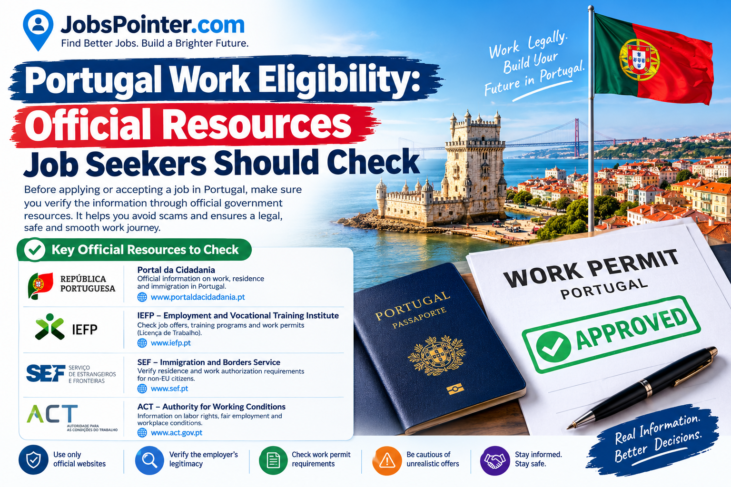
Portugal Work Eligibility: Official Resources Job Seekers Should Check
A Portuguese job offer is only the first step. Before you accept it, pay any recruitment charge or book a flight, you need to confirm your own Portugal work eligibility: whether your nationality and immigration status allow you to work, and which visa or residence authorisation applies. Rules differ between EU and non-EU citizens, between employees and self-employed people, and they have changed recently. Recruiters often simplify this, and some get it wrong. This guide shows which official websites to use, what each one can tell you, and what it cannot promise. Use it as a map to the authorities, not as a substitute for them. Where we could not confirm a detail, we say so.
Quick answer
| Your situation | Where to check first |
|---|---|
| Non-EU citizen with or without a job offer | gov.pt guide for migrants |
| Which work residence category fits | AIMA: Work |
| Visa application and documents | Portuguese visa portal and the consulate in your country |
| Finding jobs and public employment help | IEFP and EURES |
| Worker rights and contract rules | ACT: foreign worker page |
| The text of the law | Diario da Republica |
1. Who Is Eligible to Work in Portugal?
There is no single answer. Three questions matter: your nationality, your current basis of stay, and the kind of work (employee or independent).
Portuguese Citizens and Their Right to Work
Portuguese citizens do not need a visa or work authorisation to work in Portugal. They remain subject to normal employment law, such as contract, tax and social security rules.
EU/EEA and Swiss Citizens
Citizens of EU and EEA states, and Switzerland, are not subject to the same visa-and-residence-title requirements as nationals of other countries. The gov.pt migrant guide is written specifically for people from outside the European Economic Area, which reflects this difference. EU/EEA and Swiss citizens may still have registration formalities for longer stays, so check gov.pt for your exact nationality.
Non-EU Citizens and Work Authorisation
The official gov.pt guide says that if you come from outside the EEA and want to work in Portugal, you need a residence title that gives you access to employment. It adds that you can work as an employee or as an independent worker, for example as a freelancer or by starting your own business (gov.pt). The guide also says that students outside certain study levels cannot work in Portugal, so a study visa is not a general work permit.
Why Eligibility Depends on Immigration Status
Keep four things separate. They are often mixed up in recruiter messages.
| Concept | Meaning in plain English |
|---|---|
| Right to enter | Permission to arrive at the border, often through a visa |
| Right to reside | Permission to live in Portugal, for example a residence authorisation |
| Right to work | Permission to take employment or self-employment, which depends on your residence basis |
| Job offer | An employer’s proposal, which is not any of the three above |
A tourist or short-stay entry does not by itself authorise employment. The gov.pt guide’s statement that a residence title with access to employment is needed is the starting point.
2. Start With the Official Portugal Government Portal
How gov.pt Helps Foreign Jobseekers
The Migrants: living and working in Portugal section covers visas, work, healthcare, taxes and social security, and how foreigners obtain the tax number (NIF) and social security number (NISS). It focuses on public service procedures.
Question it answers: What type of title do I need, and what practical steps follow? What it does not do: assess your individual case or guarantee approval.
Find Relevant Work and Immigration Guidance
Open the work and business guide. Its sections cover looking for work, rights and duties, and starting a business. It also tells people with foreign qualifications to check whether their profession is regulated in Portugal.
Check the Latest Requirements Before Applying
Check the page date, then compare it with AIMA and the visa portal. Portuguese law was amended by Law 61/2025 and again by Law 62/2026 (see the box below), so a screenshot or a PDF from a recruiter may be out of date.
What changed recently (verified against the legal gazette where possible).
- Law 61/2025 amended the Foreigners Law (Law 23/2007) and entered into force on 23 October 2025, according to a legal summary of the published text (SFJ summary).
- Law 62/2026 was published on 10 September 2026 and took effect on 11 September 2026 (Diario da Republica; published text). Law-firm summaries report that it lets a worker change employer by notifying AIMA, without a new title, and sets a general 90-day decision period that may be extended by 30 days (TOF Advogados). Practical implementation details should be confirmed with AIMA.
3. Use AIMA to Understand Work-Related Residence Authorisation
What Is AIMA?
AIMA (Agencia para a Integracao, Migracoes e Asilo) is the Portuguese agency that handles migration and residence procedures. In simple terms, a visa lets you enter Portugal and apply for a residence authorisation, and AIMA is the body that deals with residence authorisations in Portugal (M|B Advogados explanation).
Find the Relevant Work Authorisation Category
The AIMA Work page lists separate categories. The page is mainly in Portuguese, with an English option on some pages, so use your browser’s translation tool.
| Category listed by AIMA | Who it concerns |
|---|---|
| Subordinate (employed) work, with residence visa, Art. 88(1) | People who obtain a residence visa for employment |
| Subordinate work, with visa exemption | Cases where the law allows exemption; do not assume you qualify |
| Independent professional activity, with or without visa | Self-employed people |
| Highly qualified activity, Art. 90 | Highly qualified work; EU Blue Card and Tech Visa regimes exist separately |
| Teaching and cultural activity | Specific professional categories |
| Remote work (digital nomad) | Work for employers outside Portugal |
| Intra-company transfer (ICT) | Employees transferred within a company |
| Job-seeking visa category | See Section 4: restricted since Law 61/2025 |
| Protocol for regulated labour migration | See Section 4 |
Question it answers: Which legal category and procedure applies to my type of work? What it does not do: decide your case before you apply.
Review Required Documents and Procedures
Each category page lists documents and how to apply (for example, the highly qualified page states the process and validity). Documents differ between categories, so never rely on a list written for another route. Many recruiters share a generic list; compare it with the page for your category.
4. Check Which Portugal Visa or Work Route Applies to You
Employment With a Portuguese Employer
The usual path for a non-EU employee is a residence visa for employment, followed by a residence authorisation at AIMA. The consular checklist for this visa asks for items such as the application form, passport, police clearance issued within the last 90 days, proof of means (which may come from an employment contract or a promise of one), and the contract or promise itself (VFS Global checklist). Checklists vary by consulate and date.
Temporary and Seasonal Employment
We could not confirm a specific seasonal-work route on the AIMA Work page. AIMA lists a Protocol of Cooperation for Regulated Labour Migration, but we could not verify its details. If a recruiter offers seasonal or short-term work, ask which legal category it falls under in writing, and confirm that with AIMA or your consulate.
Independent or Self-Employed Work
AIMA lists independent professional activity as its own category, and gov.pt says freelancers and business owners can work in Portugal with a suitable title. Self-employment requires a different set of proofs (such as service contracts or business plans) and a different application, so an employee checklist does not apply.
Job-Seeking Routes and Their Eligibility Conditions
Older articles describe a general job-seeking visa. According to a legal summary, Law 61/2025 replaced it with a visa for qualified job seeking, reserved for people with specialised technical skills and dependent on a ministerial regulation (M|B Advogados). A consular checklist refers to a Skilled Job Seeker Visa and notes it does not allow a family-member accompanying visa. We could not confirm which professions qualify or whether it is open for applications in your country, so check with the consulate before relying on it.
5. Check Visa Requirements Through Official Consular Resources
Identify the Correct Visa Category
The national visas section of the Portuguese visa portal is the official place for national (long-stay) visa legislation and requirements. Choose the category matching your purpose: employment, independent work, highly qualified work and so on.
Find the Competent Portuguese Consulate or Application Channel
Visa applications are usually lodged at a Portuguese embassy or consulate, or at a visa centre operated on its behalf, in your country of residence. We could not confirm which Portuguese post covers each of Nepal, India, Bangladesh and the Philippines, so find your country’s page on the official visa portal and the embassy website.
Review Documents, Fees and Procedures
Use the consulate’s own checklist, not a recruiter’s. Consular checklists warn that missing documents can lead to rejection, that the visa fee is not refunded if a visa is refused, and that false statements can lead to refusal. We do not quote fees here because they change; check the current figure on the official portal.
Understand Why a Job Offer Does Not Guarantee Visa Approval
The checklist itself states that submitting every requested document does not mean the visa will be granted automatically. A contract or promise of employment is evidence, not an approval. Law 61/2025 also introduced a ground for refusal for people who entered or stayed illegally in Portugal, according to the M|B Advogados summary.
6. Use IEFP and EURES for Employment Information
Search for Relevant Job Opportunities
EURES advises contacting the EURES services in your own country before travelling to Portugal to look for work (EURES Portugal page). If you are already in Portugal, you can register for IEFP’s job portal, iefponline, using a valid passport, a Portuguese social security number (NISS) and a Segurança Social Direta password.
Understand Public Employment Services
IEFP is Portugal’s public employment service for the mainland, with a network of local employment centres. EURES also lists temporary employment agencies authorised in Portugal on the IEFP temporary work agencies page, which is a useful check on any agency that contacts you.
Question they answer: Where can I find genuine vacancies and public job-search help? What they do not do: grant work authorisation. A vacancy on a job portal does not give you the right to work.
Match Vacancies With Your Skills and Experience
Compare the advertised duties and qualifications with your own, then check whether the role may need a regulated qualification (Section 7). Our Resume Builder can help you prepare a clear CV once you have a realistic shortlist.
7. Check Employment Contracts and Worker Rights
Review Employer and Job Details
The employer’s legal name, address, job title, workplace and start date should be written in your contract or promise of work. The consular checklists treat the contract or promise as a key document, so errors can affect your visa file.
Understand Salary, Hours, Holidays and Contract Terms
The Portuguese Authority for Working Conditions (ACT) states that a foreign worker authorised to work as an employee has the same rights and duties as a Portuguese worker (ACT foreign worker page). The same page offers a ‘Working in Portugal’ guide in several languages, including Nepali, Hindi and Bengali. We do not quote Portuguese minimum wage or leave figures because we did not verify current amounts for this article; check them on gov.pt or ACT.
Check Professional Qualification Recognition Requirements
If your profession is regulated in Portugal, you may need your qualifications recognised before you can practise. gov.pt tells migrants to check the list of regulated professions and refers readers to recognition information. The Directorate-General for Higher Education (DGES) publishes information on recognition of foreign academic qualifications. Recognition and a work visa are separate processes.
8. How to Verify Portugal Work Eligibility Step by Step
Confirm Nationality and Current Immigration Status
- Note your nationality and where you currently live, and any residence permit or visa you hold. If you hold none, you are likely applying from abroad.
Identify the Correct Work and Visa Category
- Decide whether the job is employment, self-employment, highly qualified work or something else, and match it to a category on AIMA’s Work page.
Compare Your Situation With Official Requirements
- Read the matching visa checklist on the visa portal and the consulate page for your country. Compare each requirement with your documents and your contract.
Confirm Documents With the Appropriate Authority
- If a recruiter’s statement differs from the official page, ask the consulate or AIMA in writing which is correct. For law questions, read or ask a qualified professional about the text in the Diario da Republica.
Keep Copies of Applications and Official Responses
- Keep copies of everything: application forms, receipts, emails, appointment confirmations, and any official decision. Store them yourself, not only with an agent.
9. Common Work Eligibility Mistakes to Avoid
Assuming Every Visa Allows Employment
Tourist, study and short-stay entries are not general work permissions. Confirm that the basis of stay you are applying for allows the type of work you plan to do.
Relying Only on Recruiter Advice
A recruiter may be wrong, outdated or paid per placement. Treat advice as a claim to check with an official page.
Using Outdated Immigration Information
Rules changed in October 2025 and September 2026. Check the date on every guide, including this one.
Confusing a Job Offer With Legal Work Authorisation
| Item | What it proves | What it does not prove |
|---|---|---|
| Job offer | An employer is interested | Your right to enter or work |
| Employment contract or promise | Terms of employment | Visa approval |
| Visa | Permission to enter and apply for residence | Residence authorisation by itself |
| Residence authorisation for work | Permission to live and work under its conditions | Permission to work outside its terms; check any employer change rules |
For more on recruiter fraud and verifying an agency, see our guide on how to check whether a job offer in Poland is genuine; the same checks (company registers, written terms, no advance payment) apply in Portugal.
10. Portugal Work Eligibility Checklist
Status and route
- I know my nationality and current basis of stay
- I identified the correct category on AIMA’s Work page
- I read the consulate checklist for that category
Documents
- My contract or promise of work shows employer, role, pay and start date
- My police certificate and other documents meet the checklist’s date and legalisation rules
- If my profession is regulated, I checked qualification recognition
Verification
- I checked the employer and any agency independently
- No one has guaranteed a visa
- I confirmed any disputed point with the consulate or AIMA in writing
Before paying or travelling
- I have not paid a fee I cannot explain
- I have copies of all applications and replies
- I have no travel booked that depends on an unconfirmed visa
Frequently Asked Questions
1. How can I check if I am eligible to work in Portugal?
Identify your nationality and status, then match your work type to a category on AIMA’s Work page and the visa portal checklist. Only the competent authority can confirm your individual case.
2. Which official website explains Portugal work visa requirements?
The Portuguese visa portal covers national visas, and your consulate’s checklist gives its documents. The gov.pt guide explains the overall process.
3. Can non-EU citizens work in Portugal?
Yes, with a residence title that gives access to employment, as an employee or as an independent worker, according to gov.pt. The route depends on the person and the job.
4. Does a job offer guarantee a Portugal work visa?
No. Consular checklists say that even a complete file does not mean automatic approval.
5. What is the role of AIMA in Portugal?
AIMA deals with migration, including residence authorisations after a visa is granted, and publishes the work-related categories on its website.
6. Where can I find official jobs in Portugal?
Use iefponline (with NISS access if you are in Portugal) and EURES. Verify any temporary agency on the IEFP list. A listing is not work authorisation.
7. Can I work in Portugal while visiting as a tourist?
Not on that basis. gov.pt states that non-EEA nationals need a residence title with access to employment. Ask the competent authority if you think an exception applies.
8. How can I check the latest Portugal immigration rules?
Check AIMA and the visa portal, then confirm the legal text in the Diario da Republica. Note the date of every page you rely on.
Conclusion
Checking Portugal work eligibility comes down to a few disciplined steps. Confirm your nationality and status, find the matching route on AIMA’s Work page, read the consulate’s checklist for your visa, and treat the job offer as evidence rather than approval. Use IEFP and EURES to find vacancies, and ACT to understand worker rights. Because Portuguese law changed in October 2025 and again in September 2026, rely on current official pages rather than recruiter messages or old blog posts. Keep your own copies of every document and decision. Where an answer is unclear, ask AIMA or your Portuguese consulate in writing before you pay, resign or travel.