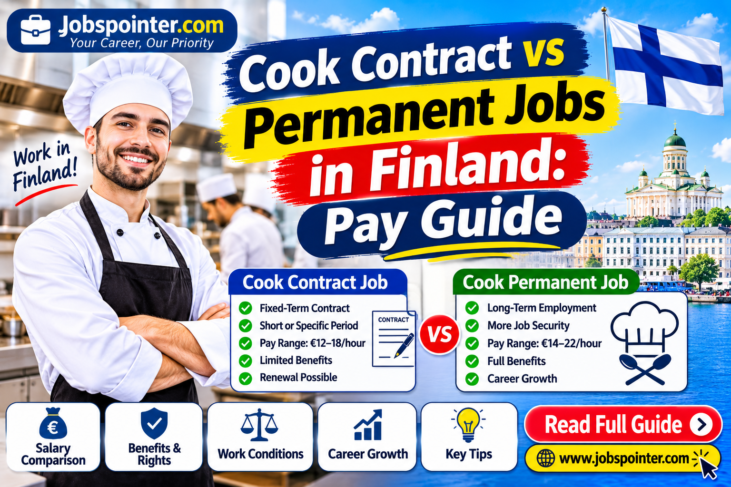
Cook Contract vs Permanent Roles in Finland: Which Pays Better?
In Finland, a contract job does not automatically pay more than a permanent one, and a permanent job does not automatically pay more than a contract. If the employer is covered by the hospitality collective agreement, both types of cook must be paid at least the same pay-scale rate for the same job. What changes your monthly income is the number of guaranteed hours, evening, night and Sunday supplements, overtime, and how holiday pay is handled.
This guide compares cook contract vs permanent roles in Finland using the current hotel, restaurant and leisure industry agreement. It covers fixed-term, agency and permanent work, shows the actual pay table for cooks, and ends with a checklist for your next offer.
Understanding cook employment contracts in Finland
Finnish law assumes an employment contract lasts until further notice unless there is a justified reason for a fixed term. The InfoFinland guide to employment contracts explains this and lists the details a written contract should contain. The three common arrangements for cooks are below.
| Type | Who is the employer | Typical situation | Main risk |
|---|---|---|---|
| Fixed-term (contract) | The restaurant, hotel or caterer | Seasonal work, a replacement, a project | The job ends on the agreed date |
| Permanent (indefinite) | The restaurant, hotel or caterer | Ongoing kitchen role | Shift patterns still include evenings and weekends |
| Agency (temporary) | The agency | Work in different client kitchens | Hours may vary between assignments |
Fixed-term or contract cook jobs
A fixed-term contract ends at the agreed end date without notice. Until recently the employer needed a justified reason, such as seasonal work or covering for someone. The TEK guide to fixed-term contracts explains those reasons.
New since 1 June 2026: employers may sign a fixed-term contract of up to 12 months without a justified reason, but only if:
- It is the first employment between you and the employer in the previous five years.
- If shorter than 12 months, it cannot be extended or renewed.
- Either side may end it by notice once employment has lasted six months.
- The employer tells you in writing, if you ask, whether you can continue (within one month of your request).
- The employer must first offer you a similar role if it hires for it soon after the contract ends.
If the contract has a justified reason, these extra conditions do not apply. Ask your employer which kind of fixed-term contract you are being offered.
Permanent or indefinite employment
A permanent contract continues until either side ends it under the rules. Under the hospitality agreement, a trial period can last up to six months for an indefinite contract. After that, an employer who ends the contract must give a reason that the Employment Contracts Act accepts, and must give notice: one month if you have worked 0 to 4 years, rising with service. If you resign, notice is 14 days if you have worked under 10 years.
Temporary agency cook jobs
In agency work, the agency is your employer and pays your wages, while the client kitchen directs your daily work, as Suomi.fi explains. For cooks, the same collective agreement applies as to the client’s own employees, if the client is covered. Ask the agency which agreement applies and how many hours it guarantees.
Cook salary in Finland: what can workers expect?
There is no single cook salary. Pay depends on the collective agreement pay group, years of similar experience, hours worked, supplements and the employer type.
The PAM and MaRa collective agreement for the hotel, restaurant and leisure industry sets minimum conditions for about 75,000 employees. It runs from 1 April 2025 to 31 March 2028, and PAM notes the third year can be terminated. Wages rise by 2.5% on 1 September 2025, 2.9% on 1 June 2026 and 2.4% on 1 July 2027, applying to both pay-scale wages and individually agreed wages.
Cook pay groups from 1 June 2026
These figures come from PAM’s key provisions booklet. Monthly gross pay is shown first, with the hourly rate in brackets. Experience in similar work counts.
| Pay group | Cook roles | 0–2 years | Over 2 years | Over 5 years | Over 10 years |
|---|---|---|---|---|---|
| 2 | Cook in a café, fast-food restaurant, or restaurant serving no alcohol or only drinks up to 5.5% | €1,942 (€12.21) | €1,989 (€12.51) | €2,062 (€12.97) | €2,160 (€13.58) |
| 3 | Staff restaurant cook (no strong alcohol), processed-food cook | €2,063 (€12.97) | €2,124 (€13.36) | €2,184 (€13.74) | €2,279 (€14.33) |
| 4 | Cook or cold-buffet cook in premises serving drinks above 5.5% | €2,179 (€13.70) | €2,239 (€14.08) | €2,307 (€14.51) | €2,392 (€15.04) |
A chef de cuisine is classed under the separate supervisors’ agreement, group 5, at €2,624 (€16.50) for 0–2 years and €2,855 (€17.96) over 10 years.
What this table shows. The same job title can fall into different groups depending on the establishment. A cook in a licensed restaurant can be in a higher group than a cook in a café. The agreement is the minimum, so an employer may pay more. A workgroup is also preparing a reform of the wage system, so the groups may change in future .
For first-time workers: the agreement describes a six-month training period when you start in the industry for the first time (two months if you already have the required training), with pay at 80% of the 0–2 year scale.
Market context. Pay in advertised cook jobs often sits near the agreement scale. A listing-based estimate from JobCrawls put the middle of advertised cook pay at roughly €2,270 per month in August 2026, with a quarter of listings near €1,920 and another quarter above €2,600. These are partly estimated figures, not official statistics ⚠.
Contract cook vs permanent cook: salary comparison
| Factor | Fixed-term / contract | Permanent | Agency |
|---|---|---|---|
| Basic pay | Same agreement scale for the same job | Same | Client’s agreement applies for most non-office work |
| Overtime | Same rules | Same rules | Same rules |
| Evening, night and Sunday supplements | Payable when they apply | Payable when they apply | Payable when they apply |
| Holiday | Accrues while employed; compensation paid if you do not meet accrual thresholds | Accrues over employment | Paid by the agency |
| Job security | Ends at the agreed date | Continues until lawfully ended | Depends on assignments and agency contract |
| Income predictability | Depends on contract length and agreed hours | Often steadier with regular hours | Can vary most |
The real difference is guaranteed hours, not hourly rate. A permanent cook with 160 guaranteed hours often takes home more across the year than a contract cook with 100, even at the same hourly pay.
What the hospitality agreement says about cook pay
Evening, night and Sunday supplements
- Evening (18.00 to 24.00): €1.40 per hour
- Night (24.00 to 06.00): €2.37 per hour
- Sundays and public holidays: supplements are doubled
These rates date from 1 September 2025 ⚠, so check the current table, since pay-scale wages rose again on 1 June 2026. Shift patterns therefore change monthly earnings noticeably.
Overtime, working hours and shifts
Regular working hours are 112.5 over three weeks. Overtime is work beyond 120 hours in three weeks, with these increases:
| Work | Extra pay |
|---|---|
| First 18 overtime hours (up to 138 hours per three weeks) | +50% |
| Overtime beyond 138 hours | +100% |
| Work on a Sunday, church holiday, Independence Day or May Day | +100% |
| Work on an extra day off or annual leave day | +50% |
These rules apply whether you are permanent or fixed-term, and the agreement’s adjustment systems change the details, so read the section on your system. Part-time cooks should have a guaranteed minimum number of hours over each three-week period. In fixed-term contracts shorter than a year, the agreed average minimum hours must be met during the contract, and the employer must pay compensation for missing hours unless the shortfall is your own absence.
Holiday pay, annual leave and other benefits
Annual leave and holiday compensation
- In the first holiday credit year you earn 2 weekdays of holiday for each full credit month, and 2.5 afterwards. A full month means at least 14 days or 35 hours worked. The credit year runs from 1 April to 31 March.
- If your hours do not reach those thresholds, you receive holiday compensation equal to holiday pay.
- At the end of employment you receive compensation for earned but untaken holiday.
- The holiday bonus is 50% of holiday pay, paid after the holiday.
- Under the annual leave system (“VV days”), you earn one extra leave day for every 200 hours worked after a two-month qualifying period, up to nine a year.
Sick leave
Paid sick leave grows with service under the agreement: 28 days after four months, 35 days after three years, 42 after five and 56 after ten. A shorter employment period means a shorter paid period, so this is one real difference for short fixed-term contracts.
Other benefits
The employer must provide meal breaks on days longer than six hours and work clothing required by law or the employer’s rules. Occupational healthcare, staff meals and training depend on the employer, so ask what is written into your contract. Pension and insurance contributions are paid by the employer, and for agency work the agency is responsible.
Job security: is permanent employment more reliable?
A permanent contract gives continuity, and ending it needs a legally accepted reason and notice. A fixed-term contract has a known end date. In hospitality, seasonal hiring is common, so a series of fixed-term jobs can be a legitimate path, but it carries gaps between jobs. A fixed-term job can also lead to a permanent one, and the 2026 rules oblige the employer to tell you in writing whether continuation is possible if you ask.
Advantages and disadvantages
| Contract cook | Permanent cook | |
|---|---|---|
| Advantages | Experience in different kitchens, seasonal work, flexibility, contacts | Continuity, steadier income, skills growth with one employer, career progression |
| Disadvantages | Uncertainty after the end date, gaps, less predictable income | Less flexibility to move, evening and weekend shifts still apply, no guarantee of a higher salary |
Which cook job pays better? Three hypothetical examples
These are illustrations only, not Finnish market averages. All three use the same assumptions: pay group 2, 0 to 2 years of experience, €12.21 per hour, €1,942 for a full month of about 159 hours, evening supplement €1.40 per hour, and Sunday work at +100% (an extra €12.21 per hour). Holiday compensation and other items are left out for simplicity.
| Item | A. Fixed-term seasonal cook | B. Permanent cook | C. Agency cook |
|---|---|---|---|
| Paid hours in the month | 159 | 165 (159 regular + 6 overtime) | 100 guaranteed |
| Base pay | €1,942.00 | €1,942.00 | €1,221.00 |
| Evening hours supplement | 60 h = €84.00 | 25 h = €35.00 | 30 h = €42.00 |
| Sunday work (extra +100%) | 16 h = €195.36 | 8 h = €97.68 | none |
| Overtime (+50% on 6 h) | none | €109.89 | none |
| Total gross for the month | €2,221.36 | €2,184.57 | €1,263.00 |
| Gross per paid hour | about €13.97 | about €13.24 | €12.63 |
What the examples show. The seasonal cook earns slightly more per hour because of heavy evening and Sunday work, but only while the contract lasts. The permanent cook earns a similar monthly total with more predictable hours. The agency cook earns the least in this month because only 100 hours are guaranteed. Compare total monthly gross and guaranteed hours, not the hourly rate in the advert.
What international applicants should check before accepting a cook job
Foreign workers in Finland generally have the same employment rights as Finnish workers. If you need a residence permit for an employed person, Migri requires gross pay of at least €1,600 per month in 2026, or the collective agreement minimum if higher. Zero-hours and on-demand contracts do not qualify for that permit. Pay group 2 at the entry level (€1,942) is above that floor, but check your own contract. Our guide to Portugal work eligibility shows how to check official sources for any country, and the Migri page on the employed-person permit covers Finland.
Checklist:
- Is the job fixed-term, indefinite or agency-based?
- What is the gross hourly or monthly salary?
- Which collective agreement applies, and which pay group?
- How many hours are guaranteed per three weeks?
- Are overtime and shift supplements explained in writing?
- How are annual leave and holiday pay handled?
- Who is the legal employer?
- Is there a written contract that matches the advert?
- Do you have the right to work in Finland?
- Is the employer genuine? See our guide to checking whether a job offer is genuine, which uses Poland as its example.
How to choose the right cook job in Finland
- Choose fixed-term if a defined period or seasonal work suits you.
- Consider permanent if continuity matters more.
- Treat agency work separately. Check the agency contract, the applicable agreement and guaranteed hours.
- Compare the whole package, not the advertised hourly rate. Our Germany salary guide explains the gross-versus-net trap.
- Get the written terms before you accept. The Job Market Finland guide to employment contracts is a good official starting point.
Frequently asked questions
1. Do contract cooks earn more than permanent cooks in Finland?
Not automatically. The same agreement scale applies to both. Total pay depends on hours, supplements and overtime.
2. What is the minimum salary for a cook in Finland?
Under the hospitality agreement from 1 June 2026, the lowest cook scale (group 2, 0 to 2 years) is €1,942 per month, or €12.21 per hour, if the agreement covers the employer. Check the current table.
3. Are fixed-term cooks entitled to paid holidays?
Yes. Holiday accrues while you work, and if you do not reach the accrual thresholds you receive holiday compensation instead.
4. Can a temporary cook receive overtime pay?
Yes. Overtime rules apply to fixed-term and permanent employees alike.
5. What is the difference between fixed-term and permanent contracts?
A fixed-term contract ends on an agreed date or when the agreed work ends. A permanent contract continues until lawfully ended.
6. Do agency cooks receive the same protections?
They have an employment relationship with the agency, and the client’s agreement generally applies for non-office work. Ask the agency which one applies.
7. Which collective agreement applies to cooks?
Often the PAM and MaRa hotel, restaurant and leisure agreement. Confirm with your employer.
8. Can a fixed-term cook become permanent?
Yes, and the employer must tell you in writing, if you ask, whether continuation is possible under the 2026 rules for contracts without a justified reason.
9. Do cooks receive extra pay for Sunday work?
Yes. Sunday work is paid at +100%, and evening and night supplements are doubled.
10. What should foreign cooks check before signing?
The agreement and pay group, guaranteed hours, who the legal employer is, written terms and your right to work.
Conclusion
The question of cook contract vs permanent roles in Finland does not have a single answer. The collective agreement sets a pay floor for both, so the better-paying job is the one with the higher pay group, more guaranteed hours, and supplements you will actually work. Compare the whole package, ask for the terms in writing, and use the official sources linked here. When you are ready, browse current openings on Jobspointer and prepare your CV with our resume builder. Jobspointer cannot guarantee a job, a visa or any pay level.